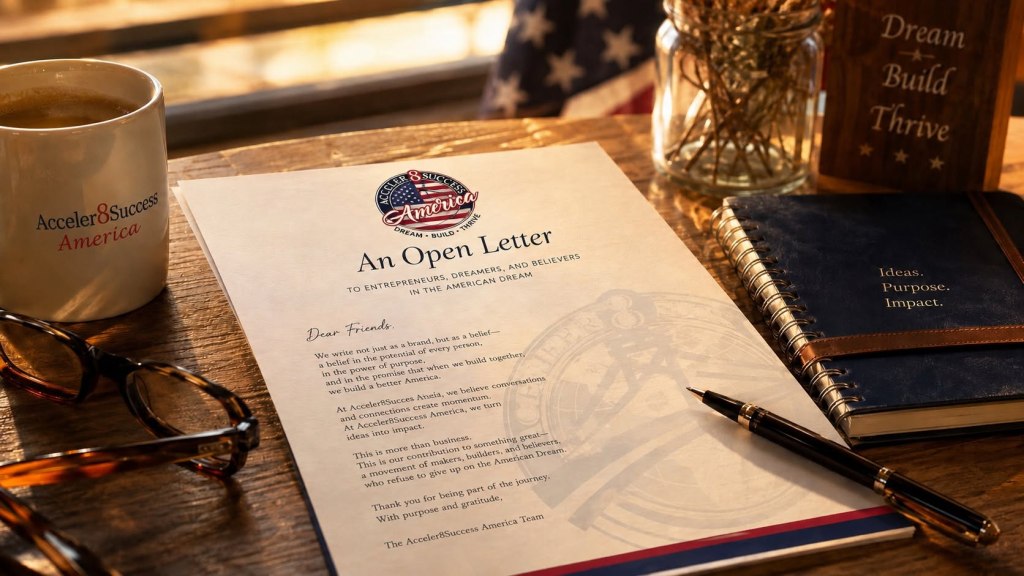
There are moments when an organization should clearly state what it believes.
Not because everyone must agree. Not because business should become political. And not because values should ever become a test of who belongs.
But because values matter.
They influence how an organization serves people, how it approaches opportunity, how it defines success, and ultimately the contribution it hopes to make.
At Acceler8Success America, our values are reflected in our name, our work, and our purpose.
We believe in entrepreneurship.
We believe in business ownership.
We believe in free enterprise and capitalism.
We believe in America and the American Dream.
We believe in responsibility, perseverance, optimism, service, and opportunity.
And yes, faith and the words “In God We Trust” have meaning to us.
These beliefs do not require everyone who works with us, learns from us, or becomes part of our entrepreneurial community to believe exactly as we do.
They explain something much more fundamental:
Why we do the work we do and what we want Acceler8Success America to represent.
A Time of Growth… and Reflection
Over the past several months, we have spent a great deal of time thinking about the future of Acceler8Success America.
That reflection has become particularly important as we have launched the Entrepreneurship Coaching & Advisory Suite by Acceler8Success America, creating new pathways for experienced professionals to guide aspiring entrepreneurs, early-stage business owners, and others pursuing business ownership.
And with the Acceler8Success America Entrepreneurship Coaching & Advisory Franchise Opportunity launching September 1st, this has become about much more than introducing another program, service, or business opportunity.
We are preparing other people to represent the brand.
To serve entrepreneurs under our name.
To share our methodologies, resources, experience, and philosophy.
To become trusted guides to individuals making some of the most consequential business and financial decisions of their lives.
That responsibility has caused us to ask deeper questions.
What exactly should Acceler8Success America stand for?
What do we want someone to experience when they encounter our brand?
What principles should guide our coaches, advisors, licensees, franchisees, leadership, and strategic partners?
What should remain true as the organization grows beyond the people who originally created it?
And perhaps most importantly:
What are we ultimately trying to deliver?
We have spent considerable time reflecting on those questions and solidifying the answers.
The result isn’t simply a collection of corporate values.
It is a clearer understanding of the organization we intend to build.
This Open Letter is part of that process.
We Believe in Entrepreneurship
Entrepreneurship is about far more than starting a business.
It represents independence, initiative, creativity, responsibility, perseverance, optimism, and the willingness to pursue possibility.
Every entrepreneurial journey begins with a belief that something can be created, improved, solved, or built.
Sometimes that vision becomes a company capable of changing an industry.
Sometimes it becomes a neighborhood restaurant, a franchise location, a family business, a professional practice, an online venture, or a small business serving its local community.
All matter.
The significance of entrepreneurship should never be measured solely by the size of the company eventually created.
For many people, business ownership represents something deeply personal: greater control over their future, financial independence, the opportunity to provide for their family, the ability to create generational wealth, the opportunity to contribute to a community, or simply the satisfaction of building something of their own.
We believe those aspirations are worth encouraging.
More importantly, we believe aspiring entrepreneurs deserve access to experienced people who will help them pursue those aspirations thoughtfully, responsibly, and with their eyes open to both the opportunities and the challenges ahead.
That belief is at the heart of our Entrepreneurship Coaching & Advisory platform.
We Believe in the American Dream
The American Dream is sometimes misunderstood as a promise of success.
It is not.
It is the opportunity to pursue success.
The opportunity to imagine something better.
To take a risk.
To build.
To succeed.
To fail.
To learn.
To rebuild.
And to try again.
For 250 years, America has been shaped by individuals willing to do exactly that.
Entrepreneurs, inventors, immigrants, small business owners, family businesses, farmers, tradespeople, restaurateurs, franchisees, founders, and countless others have transformed ideas into businesses and businesses into opportunity.
Their efforts created jobs.
Supported families.
Built communities.
Generated wealth.
Advanced innovation.
And helped create one of the most dynamic entrepreneurial cultures in the world.
That entrepreneurial spirit is part of the American story.
We believe it must also remain part of America’s future.
And as America celebrates 250 years, we have an opportunity to do more than commemorate what previous generations built.
We have an obligation to consider what our generation will build next.
We Believe in Free Enterprise and Capitalism
We believe in capitalism.
We believe in saying that plainly.
Free enterprise provides individuals with the opportunity to create, compete, invest, innovate, build wealth, own businesses, and determine their own economic path.
It gives someone with an idea the possibility of transforming that idea into something tangible.
It allows a small business to become a larger one.
An employee to become an employer.
A first-generation entrepreneur to begin building generational wealth.
An individual to take control of his or her economic future.
But we also believe capitalism works best when accompanied by responsibility.
Business cannot simply be about what an individual can accumulate.
Successful businesses create ripple effects.
They employ people.
They support families.
They purchase from suppliers.
They create opportunities for other businesses.
They develop leaders.
They strengthen communities.
They solve problems.
They create products and services people value.
And sometimes they create generational opportunity extending far beyond the individual who originally founded the company.
There is nothing wrong with creating wealth.
We believe wealth creation should be encouraged.
But we also believe the most meaningful entrepreneurial success creates opportunity beyond the entrepreneur.
Prosperity becomes even more powerful when it creates the opportunity for others to prosper as well.
We Believe Success Comes With Responsibility
Entrepreneurship celebrates independence, but independence does not eliminate responsibility.
Business owners accept responsibility when they decide to build something of their own.
Responsibility to customers.
Responsibility to employees.
Responsibility to partners.
Responsibility to investors and lenders.
Responsibility to vendors.
Responsibility to communities.
Responsibility for the decisions they make.
Entrepreneurship involves risk, and not every decision will be correct.
Businesses encounter setbacks.
Plans change.
Markets shift.
Opportunities disappear.
Mistakes happen.
The true measure of entrepreneurial leadership is not perfection.
It is how people respond when things do not go according to plan.
Learn.
Adapt.
Accept responsibility.
Make things right whenever possible.
And continue moving forward wiser than before.
These are not merely business principles.
They are character principles.
And they matter to the type of coaches and advisors we want representing Acceler8Success America.
We Believe Coaching and Advisory Must Mean More Than Giving Advice
The launch of our Entrepreneurship Coaching & Advisory Suite has also caused us to think deeply about what the words coach and advisor should mean.
We do not believe aspiring entrepreneurs simply need cheerleaders.
Entrepreneurs certainly need encouragement, but encouragement without perspective can become dangerous.
A trusted entrepreneurship coach or advisor must sometimes ask difficult questions.
Challenge assumptions.
Identify risks.
Encourage greater preparation.
Help someone recognize when an opportunity may not be right.
And sometimes say what a person needs to hear rather than merely what they want to hear.
At other times, that same advisor may be the person who says:
You can do this.
That combination matters.
Experience and encouragement.
Optimism and realism.
Opportunity and responsibility.
Strategy and accountability.
Listening and leadership.
We believe entrepreneurship coaching and advisory should help people make better decisions, not simply more decisions.
That is the standard we intend to build around.
We Believe Experience Should Be Shared
Those who have traveled the entrepreneurial road possess something extremely valuable:
Experience.
And experience includes much more than success.
It includes mistakes.
Missed opportunities.
Bad decisions.
Difficult lessons.
Unexpected setbacks.
Relationships that succeeded and others that did not.
Strategies that worked and assumptions that proved wrong.
Every generation of entrepreneurs should not have to learn every lesson from the beginning.
Those who have gone before have an opportunity… and we believe a responsibility to reach back and help those who are beginning their journey.
That does not mean telling aspiring entrepreneurs that business ownership will be easy.
Quite the opposite.
Responsible entrepreneurial guidance requires honesty.
Entrepreneurship can be extraordinarily rewarding.
It can also be difficult, uncertain, expensive, frustrating, and humbling.
Experience can be an extraordinary teacher.
Sometimes the tuition is very expensive.
If sharing that experience helps another entrepreneur make a better decision, recognize a warning sign, avoid an unnecessary mistake, or discover a better path forward, then the lesson acquires even greater value.
That philosophy is fundamental to Acceler8Success America.
It is also fundamental to the Entrepreneurship Coaching & Advisory Suite we are now building and expanding.
We Believe Optimism Matters
Every entrepreneur possesses some degree of optimism.
They have to.
Starting or acquiring a business requires believing something can exist tomorrow that does not exist today.
Optimism creates momentum.
It helps people see possibility when circumstances are uncertain.
It encourages entrepreneurs to search for another solution, another opportunity, another approach, and another way forward.
But optimism must be accompanied by discipline, judgment, accountability, preparation, and reality.
Optimism should never become an excuse for ignoring problems.
It should become the motivation for solving them.
We believe entrepreneurs need both:
The optimism to believe something is possible and the discipline to do the work required to make it possible.
Our responsibility as coaches and advisors is not to diminish someone’s dream.
It is to help give that dream a stronger foundation.
We Believe Faith Has a Place
Faith is part of the values upon which Acceler8Success America has been built.
For us, faith represents gratitude, purpose, humility, service, and recognition that success is about something greater than any individual business transaction or financial accomplishment.
The words “In God We Trust” have meaning to us.
We do not believe those words require an apology or qualification simply because they are expressed within a business environment.
At the same time, America is a nation of many faiths, cultures, traditions, backgrounds, and experiences.
We respect that.
Our belief in God is not a requirement imposed upon anyone else.
People do not need to share a particular religion—or any religion—to participate in the entrepreneurial community we are building.
Our table is open to people who believe opportunity matters, responsibility matters, character matters, and helping others succeed matters.
Faith should strengthen our commitment to service.
It should never narrow the circle of those we are willing to serve.
We Believe the American Dream Belongs to Everyone Willing to Pursue It
One of America’s greatest strengths has always been its ability to attract and inspire people who believe tomorrow can be better than today.
Some were born here.
Others arrived here.
Some come from generations of entrepreneurs.
Others will become the first business owner in their family.
Some begin with capital, education, connections, and experience.
Others begin with little more than an idea, determination, and the willingness to work.
Their starting points may be dramatically different.
Their opportunity to dream should not be.
The American Dream is strengthened when more people have access to knowledge, resources, mentorship, capital, business ownership, and opportunity.
That is why entrepreneurial education matters.
That is why coaching matters.
That is why advisory matters.
That is why mentorship matters.
That is why access matters.
And that is why experienced business leaders reaching back to help aspiring entrepreneurs matters.
Opportunity grows when it is shared.
We Believe Entrepreneurship Can Be a Profession of Service
As we prepare to franchise Acceler8Success America, this belief has become particularly important.
We are creating an opportunity for experienced professionals to build businesses of their own by helping other people pursue businesses of theirs.
Think about that for a moment.
The entrepreneur becomes the guide to another entrepreneur.
Experience becomes intellectual capital.
Perspective becomes a resource.
Lessons become tools.
Relationships become bridges.
And helping others succeed becomes both a purpose and a profession.
That is what we believe the Entrepreneurship Coaching & Advisory business can become.
Not merely consulting.
Not simply coaching.
Not another business opportunity centered primarily on selling something.
But a platform through which experienced professionals can help aspiring and early-stage entrepreneurs evaluate opportunities, make better decisions, build stronger businesses, overcome obstacles, access resources, and accelerate their own entrepreneurial journey.
That is a responsibility we take seriously.
And as the franchise opportunity launches September 1st, these values will become increasingly important.
Because ultimately, we are not simply expanding a brand.
We are expanding the number of people representing what that brand stands for.
America’s Next 250 Years
As America celebrates 250 years, there is much to honor about the entrepreneurial spirit that helped build this nation.
But perhaps the more important question is:
What will we build next?
Somewhere today, someone is sitting at a kitchen table thinking about starting a business.
Someone is considering buying a franchise.
Someone is planning to acquire an existing company.
Someone is building a side business after finishing a full day’s work.
Someone is preparing to leave corporate America.
Someone who recently arrived in this country is imagining building something here.
Someone is recovering from a business failure and wondering whether to try again.
Someone has an idea but does not yet know where to begin.
And somewhere, a future entrepreneur is looking at a problem and thinking:
There has to be a better way.
Those individuals will help write America’s next chapter.
They will build companies we cannot yet name.
Create jobs that do not yet exist.
Develop technologies we cannot yet imagine.
Open restaurants, franchises, stores, professional practices, service businesses, and family companies across communities throughout America.
Some will build organizations employing thousands.
Others will proudly operate businesses employing five.
Both matter.
Because entrepreneurship is not defined solely by scale.
It is defined by the willingness to create.
And many of those entrepreneurs will need someone to turn to along the way.
Someone experienced.
Someone willing to listen.
Someone willing to ask difficult questions.
Someone willing to challenge them.
Someone willing to encourage them.
Someone willing to share experience without pretending to have all the answers.
Someone willing to help them move forward.
We intend for Acceler8Success America to help develop more of those people.
What We Believe
At Acceler8Success America, we believe the American Dream remains alive.
We believe entrepreneurship is one of its greatest expressions.
We believe business ownership can change lives.
We believe in free enterprise and capitalism.
We believe wealth creation is something to encourage, particularly when prosperity creates opportunity for others.
We believe success comes with responsibility.
We believe character matters.
We believe mistakes should become lessons.
We believe optimism must be accompanied by accountability.
We believe experience should be shared.
We believe entrepreneurship coaching and advisory should help people make better decisions.
We believe those who have traveled the entrepreneurial road should help those beginning their journey.
We believe faith, gratitude, humility, and service have a place in business.
We believe people of different backgrounds, cultures, experiences, and beliefs can sit at the same entrepreneurial table.
We believe entrepreneurship can become a profession of service for those willing to turn their experience into guidance for others.
And we believe America’s entrepreneurial future can be even greater than its entrepreneurial past.
The next great businesses have not all been created.
The next generation of entrepreneurs has not yet fully emerged.
And the next generation of coaches, advisors, mentors, and entrepreneurial leaders who will help guide them is only beginning to take shape.
As we launch the Entrepreneurship Coaching & Advisory Suite by Acceler8Success America and prepare for the September 1st launch of our franchise opportunity, we know more clearly than ever what we want this brand to deliver.
Knowledge.
Perspective.
Opportunity.
Guidance.
Accountability.
Encouragement.
Community.
And a genuine commitment to helping people move forward.
America’s next 250 years are waiting to be built.
The American Dream is not merely something to remember.
It is something to pursue.
Something to build.
Something to protect.
Something to expand for others.
And something each generation has a responsibility to pass forward.
That is what we believe.
That is what Acceler8Success America is being built to represent.
And as we enter this next chapter of our own growth, we are committed to ensuring those beliefs remain at the center of everything we do.
The American Dream. Built. Scaled. Accelerated.
— Acceler8Success America







You must be logged in to post a comment.