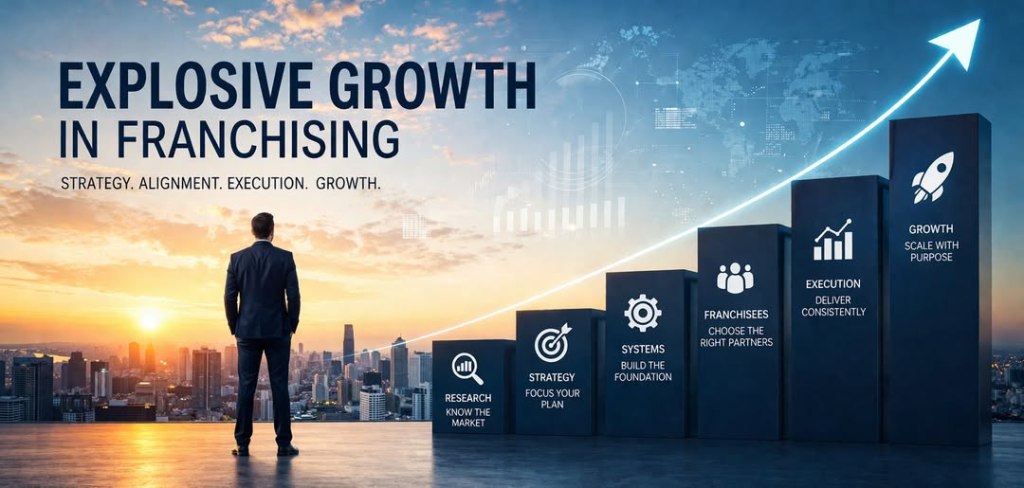
Explosive growth in franchising has always carried a certain mystique. It suggests momentum, demand, brand heat, and the kind of scalability that defines category leaders. But in today’s business climate where labor challenges persist, capital is more selective, and consumers are both value-driven and experience-focused—the question isn’t just whether explosive growth is possible. It’s whether it can be achieved responsibly, sustainably, and with intention.
The short answer is yes, a franchise brand can still achieve explosive growth. But not in the way many once imagined. The era of growth for growth’s sake is over. What replaces it is a more disciplined, structured, and deliberate approach… one that requires brands to earn their expansion rather than chase it.
The first reality is that explosive growth today must be built on strong unit economics. Without this, nothing else matters. A brand can generate interest, sign franchisees, and even open locations quickly, but if those units are not profitable, or at least predictably trending toward profitability, the system will fracture. Franchisees will struggle, validation will weaken, and growth will stall as quickly as it began. Today’s sophisticated franchise candidates are asking deeper questions. They want transparency. They want data. They want to understand not just the opportunity, but the risk. Brands that cannot confidently present this foundation will not sustain momentum.
That evolution in the franchise candidate is not new. It is something I first recognized back in 2008, when I stated that candidates were becoming more knowledgeable, more sophisticated, and more technologically advanced than ever before. At the time, that realization was eye-opening. It marked a shift in how brands needed to present themselves, how they needed to communicate, and how they needed to support their systems. Fast forward 18 years, and that shift has accelerated beyond what most could have imagined… assuming it is even fully recognized. Today’s candidates are not just informed; they are highly analytical. They research deeply, compare aggressively, and leverage technology in ways that fundamentally change the dynamic between franchisor and franchisee. Brands are no longer simply offering an opportunity; they are being evaluated with a level of scrutiny that demands precision, transparency, and credibility at every level.
Closely tied to this is operational infrastructure. Growth is not just about selling franchises; it is about supporting them. The brands that scale effectively are those that have invested early in systems, training, supply chain alignment, and field support. Without this, rapid expansion becomes a liability. Locations open, but consistency erodes. Customer experience varies. Brand integrity weakens. In today’s environment, where online reviews and social media amplify every misstep, inconsistency can do more damage than slow growth ever could.
Another critical factor is clarity of positioning. The market is crowded. Consumers have more choices than ever, and franchise candidates are evaluating multiple opportunities at once. A brand that hopes to grow quickly must stand for something distinct and relevant. It cannot be a slightly better version of something that already exists. It must be clearly understood, easily communicated, and consistently delivered. Whether that differentiation comes from product, experience, operational model, or target market, it must be undeniable.
Equally important is the quality of the franchisee. Explosive growth fueled by the wrong partners is one of the fastest ways to undermine a brand. The pressure to expand can lead to compromises in franchisee selection, but those decisions rarely age well. Strong brands are disciplined in awarding franchises. They look for alignment, capability, and commitment—not just capital. They understand that every franchisee is a steward of the brand, and that long-term growth depends on the collective strength of the system.
All that said, it raises a question that is becoming more relevant with each passing year: is there even a place in franchising today for the single-unit franchisee?
The answer is yes, but the role is evolving. The single-unit franchisee is no longer the default growth engine for most emerging or scaling brands. Instead, many franchisors are prioritizing multi-unit operators and area developers who bring capital, infrastructure, and experience. This shift is driven by efficiency, speed to market, and the ability to scale with fewer, more sophisticated partners.
However, to dismiss the single-unit franchisee would be a mistake. In many ways, they remain the backbone of franchising, particularly at the community level. Single-unit operators often bring a level of passion, local engagement, and hands-on ownership that is difficult to replicate at scale. They are deeply invested in their business, their team, and their customer base. They can be exceptional brand ambassadors.
Where the shift has occurred is in expectations. Today’s single-unit franchisee must operate with the mindset of a multi-unit operator, even if they only own one location. They must be disciplined, data-driven, and operationally sound. They must embrace technology, understand their numbers, and execute consistently. In other words, the bar has been raised.
For franchisors, the challenge is alignment. Not every concept is suited for single-unit ownership, and not every candidate is suited for multi-unit development. The most effective brands are those that clearly define their ideal franchisee profile and build their growth strategy accordingly. Some will lean heavily into multi-unit development to accelerate expansion. Others will intentionally cultivate strong single-unit operators in targeted markets to build density and brand integrity.
Capital strategy also plays a more nuanced role today. Access to funding still exists, but it is more scrutinized. Lenders and investors are looking closely at performance, leadership, and scalability. Brands seeking rapid expansion must be prepared to demonstrate not only their current success, but their ability to replicate it across markets. This often means having a thoughtful development strategy, targeting specific regions, building density, and avoiding overextension. The concept of “saturate, then scale” has never been more relevant.
Technology has also become a force multiplier. From POS systems and data analytics to digital marketing and customer engagement platforms, the right technology stack can accelerate growth by improving efficiency, enhancing the customer experience, and providing actionable insights. However, technology alone is not the answer. It must be integrated into the broader operational strategy and supported by proper training and execution at the unit level.
Brand storytelling and marketing cannot be overlooked. Explosive growth requires demand, not just from consumers, but from prospective franchisees. The brands that capture attention today are those that communicate a compelling narrative. They connect emotionally while delivering rational value. They show not only what they are, but why they matter. This is where public relations, content strategy, and social proof play a critical role in building credibility and momentum.
Perhaps the most overlooked element of explosive growth is leadership discipline. Growth introduces complexity. It tests systems, people, and decision-making. Leaders must be prepared to make difficult choices, to say no when necessary, and to protect the long-term integrity of the brand over short-term gains. This requires a mindset shift from chasing opportunity to curating it.
There is also an important distinction to be made between fast growth and explosive growth. Fast growth can be linear. Explosive growth suggests acceleration, often driven by a combination of strong fundamentals, market timing, and strategic execution. It is not accidental. It is engineered. And more often than not, it follows a period of deliberate preparation that may not appear “explosive” at all from the outside.
In today’s environment, the brands that will achieve this level of growth are those that embrace a paradox. They move quickly, but think long-term. They pursue scale, but prioritize stability. They generate excitement, but remain grounded in fundamentals. They are aggressive in vision, but disciplined in execution.
So yes, explosive growth is still possible in franchising. But it looks different. It is less about speed alone and more about alignment… alignment between economics, operations, brand, leadership, and franchisees. When those elements come together, growth can accelerate in a way that is not only impressive, but enduring.
And within that framework, both multi-unit developers and single-unit franchisees still have a role to play, provided they evolve with the expectations of the modern franchising landscape.
The brands that understand this will not just grow. They will define what growth looks like in the next era of franchising.
The question is, where does your brand stand today, and more importantly, where is it truly prepared to go?
If you’re evaluating growth, recalibrating your strategy, or questioning whether your brand is positioned for disciplined, scalable expansion, now is the time to take a step forward with clarity and intention. Let’s start the conversation. Connect directly with me to explore how your brand can build, scale, and accelerate the right way. My email is paul@acceler8success.com.
Discover more from Acceler8Success Cafe
Subscribe to get the latest posts sent to your email.

You must be logged in to post a comment.