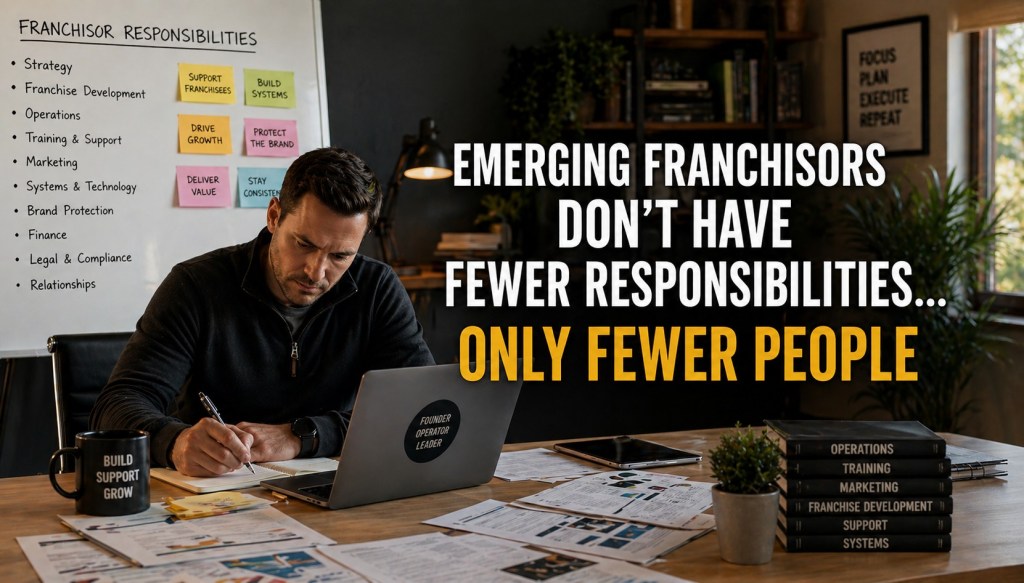
When people think about a large franchise organization, they picture a sophisticated corporate structure with layers of leadership, departments, specialists, systems, and support personnel spread across every discipline imaginable.
There’s a CEO, COO, CFO, legal counsel, franchise development department, operations team, field support managers, marketing department, training directors, HR personnel, technology support, supply chain management, real estate professionals, construction coordinators, and more. The organization chart can look overwhelming from the outside looking in.
And rightfully so.
Large franchise organizations are complex businesses with significant responsibilities tied to franchise development, operations, compliance, brand protection, and long-term scalability.
Now let’s compare that same structure to an emerging franchise brand.
An emerging franchisor may have a founder acting as CEO, head of operations, franchise salesperson, trainer, marketer, recruiter, and sometimes even technology support… all in the same day. The leadership team may consist of only a handful of people. In some cases, fewer than ten individuals are responsible for supporting an entire franchise system.
So the obvious question becomes:
Are the responsibilities of the franchisor actually different?
The answer is no.
The responsibilities are exactly the same.
The only real difference is scale, specialization, and volume.
A franchisee who invests in an emerging franchise brand is still entitled to proper onboarding, training, operational guidance, leadership, communication, systems, accountability, support, and brand stewardship. The obligation does not become smaller simply because the franchisor is smaller.
That reality is one of the most misunderstood aspects of franchising today.
Large organizations divide responsibilities among departments and specialists. Emerging brands consolidate those same responsibilities into fewer hands. That is where the challenge and the danger often begins.
In a mature franchise organization, individuals typically operate within clearly defined roles. One person focuses on field operations. Another handles franchise recruitment. Another oversees training. Another manages digital marketing. Another handles supply chain relationships.
At the emerging brand level, one individual may be responsible for all of it simultaneously.
And that creates enormous pressure on leadership.
The founder of an emerging franchise brand is not simply building locations. They are building infrastructure while simultaneously trying to grow revenue, support franchisees, protect the brand, recruit talent, establish systems, and preserve culture.
That balancing act is extraordinarily difficult.
Unfortunately, many emerging brands underestimate what franchising actually requires operationally.
They often view franchising primarily as expansion.
But franchising is not simply expansion.
Franchising is support.
Franchising is systems.
Franchising is consistency.
Franchising is accountability.
Franchising is leadership.
Franchising is infrastructure.
And perhaps most importantly, franchising is responsibility.
The franchisee does not invest in potential alone. They invest in the expectation that the franchisor is capable of helping them operate successfully within a structured system.
That expectation does not diminish because the franchisor is “still growing.”
In fact, one could argue that emerging brands must often work harder than large brands because they lack the margin for error that mature systems possess.
Large brands may have the advantage of established recognition, operational depth, vendor relationships, technology infrastructure, training departments, and extensive support teams.
Emerging brands compete differently.
They compete through accessibility.
They compete through founder involvement.
They compete through passion.
They compete through adaptability.
They compete through innovation.
They compete through speed of decision-making.
They compete through culture.
And when done correctly, they compete through relationships.
One of the greatest advantages an emerging franchisor can offer is direct access to leadership. Franchisees in emerging systems often work closely with founders and senior leadership in ways that would never occur within massive franchise organizations.
That can create a uniquely collaborative environment.
However, passion and accessibility alone are not enough.
An emerging franchisor must still operate with discipline.
Systems must still be documented.
Training must still be structured.
Operational standards must still be enforced.
Communication must still be consistent.
Support must still be reliable.
And perhaps most critically, growth must remain deliberate.
One of the biggest mistakes emerging franchisors make is pursuing unit growth faster than their infrastructure can support. The excitement of selling franchises can quickly outpace operational readiness.
That creates strain internally.
It creates inconsistency externally.
And eventually, it creates frustration among franchisees.
Emerging franchisors must understand something very important:
Every franchise sold increases responsibility exponentially.
Each additional franchisee requires onboarding, operational support, coaching, communication, problem solving, technology assistance, marketing guidance, and relationship management.
Growth without support infrastructure becomes dangerous very quickly.
This is why disciplined franchising matters.
Not every brand should franchise immediately.
Not every successful independent business is automatically franchise-ready.
And not every founder is naturally prepared to become a franchisor.
Operating one successful business and leading a franchise organization are two entirely different responsibilities.
The transition requires a shift in mindset from operator to organizational leader.
That shift often determines whether an emerging brand becomes sustainable or unstable.
So how does an emerging franchisor successfully lead and manage the brand?
By recognizing early that franchising is not merely about selling opportunities.
It is about building systems capable of supporting other people’s investments, livelihoods, and futures.
It requires humility to recognize operational gaps.
It requires discipline to grow deliberately.
It requires leadership to build culture.
It requires structure to maintain consistency.
And it requires a commitment to franchisees that cannot fluctuate based on company size.
Because at the end of the day, the franchisee’s investment is very real.
Their risk is very real.
Their expectations are very real.
And their need for leadership, training, support, and accountability is no less important simply because the franchisor is still emerging.
The strongest emerging franchise brands understand this early.
That understanding often becomes the foundation for sustainable growth, stronger franchise relationships, healthier unit economics, and ultimately, long-term brand value.
The reality is this…
Emerging franchise brands do not compete by pretending to be large organizations.
They compete by becoming disciplined organizations early.
The brands that ultimately separate themselves are not always the ones growing the fastest. More often, they are the brands building the strongest operational foundation, protecting franchisee relationships, developing infrastructure deliberately, and understanding that franchising is a long-term leadership responsibility… not simply a growth strategy.
That requires difficult conversations.
It requires honest evaluation.
It requires strategic planning.
And in many cases, it requires guidance from individuals who understand both the entrepreneurial side of building a business and the structural realities of franchising.
Whether you are an emerging franchisor evaluating your next stage of growth, a founder considering franchising for the first time, or a franchisee evaluating an emerging opportunity, the questions surrounding infrastructure, support, scalability, leadership, and operational readiness matter more than ever.
At Acceler8Success America and especially through through this platform, Acceler8Success Cafe, and across social media, those are exactly the conversations being had every day with founders, operators, franchisors, and entrepreneurs navigating growth and expansion.
If you would like to discuss your franchise brand, growth strategy, operational readiness, franchise infrastructure, or the realities of scaling an emerging system, connect directly with me by email at Paul@Acceler8Success.com.
Discover more from Acceler8Success Cafe
Subscribe to get the latest posts sent to your email.

You must be logged in to post a comment.