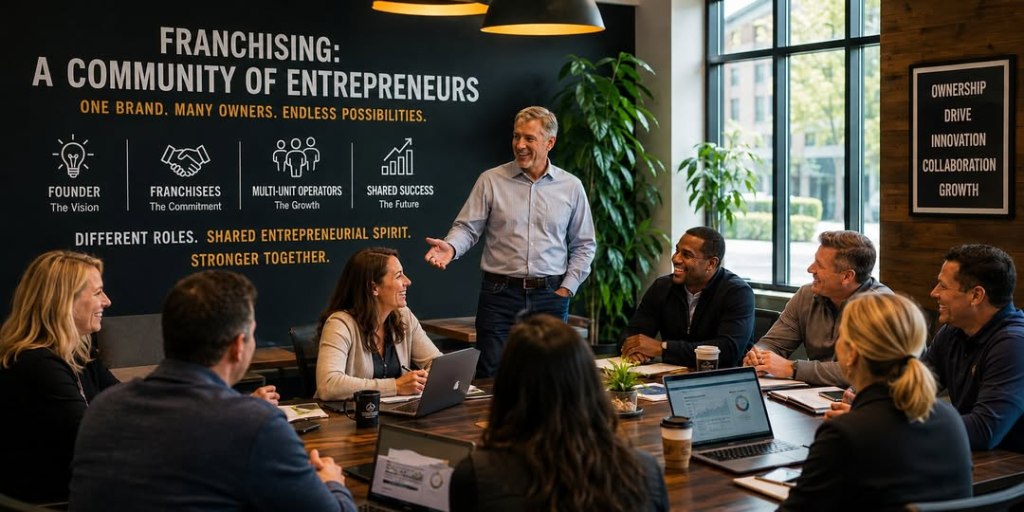
Over the past 40 years, I’ve had the privilege of working alongside franchise founders, franchisees, multi-unit operators, emerging brands, legacy brands, and just about every type of entrepreneur imaginable within franchising. And after decades of observing the relationships, the successes, the failures, the conflicts, and the extraordinary growth stories, I’ve come to one very firm conclusion:
Franchising is, at its core, an entrepreneurial ecosystem.
Yet for some reason, the industry still occasionally struggles with the idea that franchisees are entrepreneurs.
Personally, I’ve never fully subscribed to that debate. Yes, over the years I’ve questioned it, analyzed it, and listened carefully to the arguments from both sides. But ultimately, I’ve always come back to the same conclusion.
There is absolutely no doubt that franchise founders are entrepreneurs. In fact, many are among the most driven entrepreneurs I’ve ever encountered. They often begin with little more than a vision, relentless belief, and a willingness to risk nearly everything in pursuit of building something meaningful. They create systems from scratch. They make mistakes. They adapt. They pivot. They survive uncertainty. They spend years, and often decades refining operations, shaping culture, strengthening the brand, and building something scalable that others can eventually become part of.
That is entrepreneurship in every sense of the word.
But franchisees? In my opinion, they are entrepreneurs too. Absolutely.
No, they may not have created the original concept. They may not have started from a blank sheet of paper. But let’s stop pretending that investing substantial capital, signing long-term leases, hiring employees, managing operations, taking on debt, risking family savings, and putting your reputation on the line somehow isn’t entrepreneurship.
That’s real risk.
That’s real pressure.
That’s real ownership.
And anyone who has ever sat across from franchisees during difficult times — recessions, inflationary periods, labor shortages, economic downturns, operational crises, family sacrifices, sleepless nights — understands very quickly that these are entrepreneurs fighting every day to build successful businesses.
Then we move into the world of multi-unit operators and especially multi-unit, multi-brand operators.
Without question, many of these individuals and groups are highly sophisticated entrepreneurs. In some cases, they’ve evolved into organizations with infrastructure, leadership teams, financial sophistication, operational expertise, development strategies, and growth visions that rival large independent companies. Some have mastered scaling businesses across multiple concepts, territories, and industries while balancing people, culture, profitability, operations, and long-term growth simultaneously.
Again, entrepreneurship at the highest levels.
So now let’s step back and look at what franchising really is.
You have founders who are entrepreneurs.
You have franchisees who are entrepreneurs.
You have multi-unit operators who are entrepreneurs.
You have multi-brand operators who are entrepreneurs.
Essentially, you have an entire organization filled with entrepreneurial blood flowing throughout every layer of the system.
And that’s where things become both incredibly powerful and, at times, incredibly challenging.
Because entrepreneurs don’t think like employees.
Entrepreneurs are independent by nature.
They’re opinionated.
They move fast.
They challenge ideas.
They look for opportunities.
They push boundaries.
They want input.
They want ownership.
They want to innovate.
They want to improve things.
And yes, sometimes they want to do things their own way.
Over the years, I’ve seen franchise systems thrive when they understand this dynamic properly. I’ve also seen systems create unnecessary friction because they attempt to suppress entrepreneurial behavior rather than channel it productively.
That’s a major mistake.
One of the biggest misconceptions in franchising is the belief that operational consistency and entrepreneurial thinking cannot coexist. In reality, the strongest franchise systems I’ve ever encountered are the ones that found a healthy balance between both.
Franchisees should never feel like employees, nor should they be treated as such because they are not employees of the franchisor. They are independent business owners who have invested their own capital, assumed substantial risk, and committed themselves to building successful businesses. At the same time, a franchise system cannot operate as a free-for-all where every operator simply does things their own way. The strength of franchising lies in finding the proper balance between entrepreneurial independence and system-wide consistency.
The best franchise cultures create alignment without destroying individuality.
That requires leadership.
Real leadership.
Not leadership through fear.
Not leadership through control.
Not leadership through constant enforcement.
Leadership through trust, communication, collaboration, and mutual respect.
Over the years, I’ve watched many franchise founders struggle during the transition from entrepreneur to franchisor. Building a successful unit and leading a network of entrepreneurs are two entirely different skill sets. Founders often begin with passion, instinct, and vision. But once franchisees enter the system, leadership becomes less about control and more about influence.
That shift is critical.
Franchisees want to feel heard.
They want transparency.
They want honesty.
They want to understand why decisions are made.
They want opportunities to contribute.
They want partnership.
And frankly, they should.
The healthiest franchise organizations create environments where entrepreneurial input is welcomed while still protecting the integrity of the brand. Advisory councils, collaborative planning, open communication, franchisee involvement, peer leadership groups, operational collaboration, and mutual accountability all become essential pieces of long-term cultural health.
When franchisees feel emotionally invested in the brand beyond their four walls, the entire system becomes stronger.
Unfortunately, I’ve also seen the opposite.
I’ve seen organizations where distrust develops between franchisor and franchisee.
I’ve seen founders become disconnected from operators.
I’ve seen franchisees become cynical.
I’ve seen corporate leadership teams unintentionally create “us versus them” environments.
I’ve seen entrepreneurial energy turn into frustration instead of innovation.
And once that happens, growth becomes much harder.
Culture always wins in the long run.
Always.
You can have great branding, sophisticated technology, beautiful locations, impressive development numbers, and strong marketing. But if the entrepreneurial spirit within the organization becomes fractured, eventually the cracks begin to show.
The franchise organizations that endure are the ones that create cultures where entrepreneurs can thrive together.
Not identically.
Not perfectly.
But collectively.
That takes maturity from everyone involved.
Founders must evolve into leaders capable of empowering other entrepreneurs.
Franchisees must recognize the value of systems and alignment.
Multi-unit operators must use their experience to strengthen organizations rather than divide them.
Corporate leadership must become facilitators of growth, not simply enforcers of rules.
Most importantly, everyone must remember they entered the same sandbox for a reason:
To build something bigger than themselves.
In my opinion, encouraging entrepreneurship within a franchise organization should never be viewed as dangerous. It should be viewed as one of the organization’s greatest assets… if properly aligned and nurtured.
After 40 years of working throughout franchising, I can say with confidence that the strongest systems are rarely built solely through operational control. They’re built through entrepreneurial alignment, trust, collaboration, shared vision, and culture.
That’s where real long-term growth happens.
If you’d like to have a discussion about how to encourage and strengthen the entrepreneurial mindset within your franchise organization while still protecting operational consistency and brand integrity, I’d welcome the opportunity to connect.
Discover more from Acceler8Success Cafe
Subscribe to get the latest posts sent to your email.

You must be logged in to post a comment.