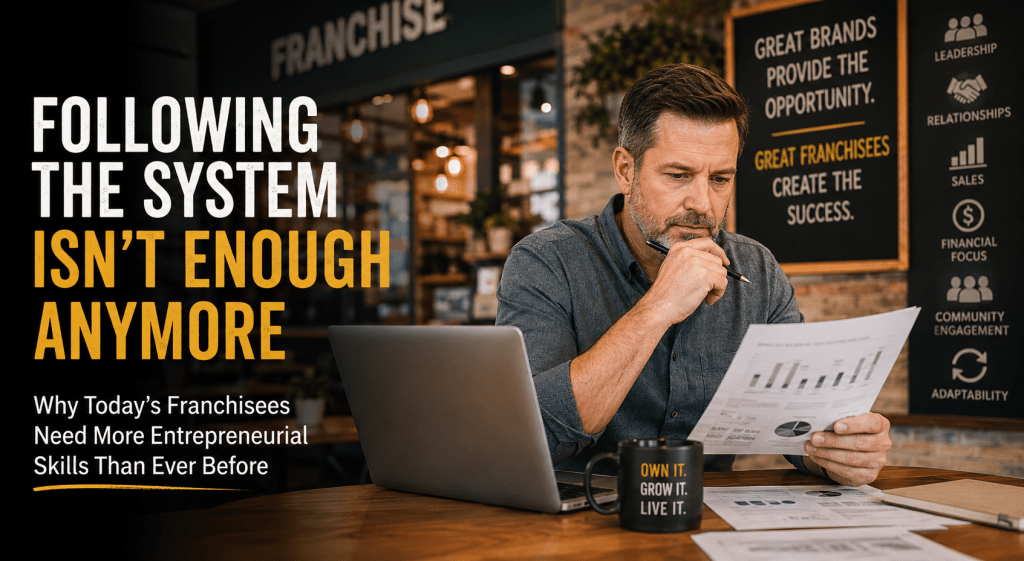
For decades, one of the most compelling promises of franchising has been the system. Buy into a proven concept. Follow the model. Execute established standards. Leverage the brand. Success should follow.
To be clear, I still believe in the value of the franchise system. Brand standards matter. Operational consistency matters. Training matters. Marketing support matters. The experience and guidance of a franchisor matter. These are among the reasons franchising has helped thousands of individuals realize their entrepreneurial dreams while reducing many of the risks associated with starting a business entirely from scratch.
Yet after more than forty years of working alongside franchisors, franchisees, restaurant operators, and entrepreneurs, I find myself increasingly asking a question that perhaps isn’t discussed often enough.
Has the role of the franchisee fundamentally changed?
I believe it has.
In fact, I would argue that today’s franchisees need more entrepreneurial skills than at any point in modern franchising history.
That statement may seem contradictory. After all, many individuals choose franchising precisely because they are seeking a proven path rather than creating something entirely on their own. But somewhere along the way, I believe many operators have confused following a system with relying upon a system. There is a significant difference between the two.
The system provides a foundation. It does not guarantee success. The franchisor provides tools. It does not build every customer relationship. The brand creates awareness. It does not generate every sale. The operations manual provides guidance. It does not make decisions. Ultimately, the responsibility for success still rests squarely on the shoulders of the franchisee.
What I continue to observe across franchise systems of all sizes is that many operators remain focused almost exclusively on what happens inside the four walls of their business. They focus on staffing, scheduling, inventory, customer service, compliance, and operational execution. All of those things remain critically important. However, in today’s marketplace, they are no longer enough.
Consumers have more choices than ever before. Competition is no longer limited to the business across the street. Today’s competitors include virtual brands, delivery platforms, independent operators, digital-first concepts, and emerging businesses that can seemingly appear overnight. At the same time, labor challenges continue, operating costs remain elevated, and consumer expectations continue to evolve.
Against this backdrop, I often wonder whether some franchisees are expecting the system to do more than it was ever designed to do.
Are they expecting the brand to create every opportunity?
Are they expecting national marketing to generate all local demand?
Are they expecting customers to simply appear because a sign is hanging above the front door?
Perhaps the more important question is whether those expectations are realistic in today’s environment.
From what I am seeing, the franchisees who are thriving tend to view their role very differently. They understand that operational excellence is only part of the equation. They recognize that growth increasingly depends upon activities that extend well beyond the four walls of the business.
They understand that visibility matters.
Relationships matter.
Community involvement matters.
Networking matters.
Local partnerships matter.
They become active participants in their markets rather than passive observers of them.
These operators are attending community events, participating in local organizations, building relationships with schools, churches, youth groups, chambers of commerce, civic organizations, and fellow business owners. They are looking for opportunities to create awareness, develop trust, and position their businesses as part of the fabric of the community.
In many respects, they are doing what entrepreneurs have always done.
They are creating opportunities rather than waiting for them.
This naturally leads to another observation that may make some franchisees uncomfortable.
Every franchisee is in sales.
Yes, sales.
For some reason, the word often carries a negative connotation. Many franchisees see themselves as operators, managers, or business owners, but not salespeople. Yet the reality is that sales is far more than asking someone to buy something.
Sales is communicating value.
Sales is building trust.
Sales is creating awareness.
Sales is developing relationships.
Sales is helping others understand why they should choose your business over countless alternatives.
When a franchisee is recruiting employees, they are selling. When they are pursuing catering accounts, they are selling. When they are introducing themselves to local organizations, they are selling. When they are building partnerships with neighboring businesses, they are selling. When they are representing their brand within the community, they are selling.
The most successful franchisees I encounter embrace this reality. They understand that business development is not someone else’s responsibility. It is part of their responsibility as business owners.
I also believe today’s franchisees must possess stronger financial skills than ever before. There was a time when growing sales could often compensate for operational inefficiencies. Today’s environment is far less forgiving. Rising costs and shrinking margins leave little room for error.
Understanding financial statements, labor percentages, food costs, occupancy expenses, customer acquisition costs, cash flow, and profitability drivers is no longer an advantage. It is a necessity.
The strongest operators don’t simply review reports. They study them. They ask questions. They identify trends. They seek opportunities for improvement. They understand that financial statements often reveal opportunities and challenges long before they become obvious in daily operations.
The same can be said for negotiation. Whether dealing with landlords, vendors, service providers, employees, local marketing opportunities, or strategic partnerships, negotiation has become an increasingly important leadership skill. Yet many franchisees have never received meaningful training in this area. Those who develop these skills often create significant competitive advantages over time.
Perhaps what I find most interesting is that franchising and entrepreneurship are becoming increasingly interconnected rather than increasingly separate.
For years, franchising was often positioned as an alternative to entrepreneurship. Today, I believe the most successful franchisees are among the most entrepreneurial business owners in any industry. Not because they ignore the system. Quite the opposite. They respect it. They leverage it. They maximize it.
But they also understand that the system is a starting point, not a finish line.
They ask questions. They challenge assumptions. They identify opportunities. They solve problems. They develop relationships. They understand their numbers. They engage their communities. They continuously learn and adapt.
In other words, they think like entrepreneurs.
Whether operating a single location or multiple units, whether part of a legacy brand or an emerging concept, I believe the underlying premise remains the same. The franchisees who will thrive in the years ahead will not simply be the best operators. They will be the best leaders. They will be the best communicators. They will be the most engaged within their communities. They will be financially astute. They will understand the importance of business development. And they will never lose the entrepreneurial mindset that drives growth and opportunity.
After more than four decades in franchising, I have become increasingly convinced that one of the greatest competitive advantages a franchisee can possess is the ability to operate within a proven system while simultaneously thinking like an entrepreneur.
The system remains important.
But from where I sit, following the system alone simply isn’t enough anymore.
I’d love to hear your thoughts. Has the role of the franchisee changed? Are today’s operators being asked to do more than previous generations of franchisees? What entrepreneurial skills do you believe are most critical for success in today’s franchise environment?
Please continue the discussion in the comments below, send me a direct message, or reach out to me directly at paul@acceler8success.com. I look forward to hearing your perspective.
Discover more from Acceler8Success Cafe
Subscribe to get the latest posts sent to your email.

You must be logged in to post a comment.