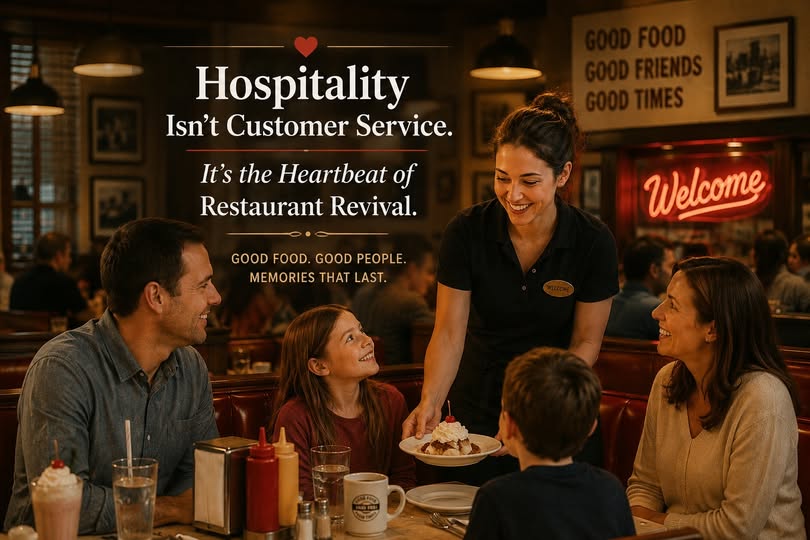
For the past several days, I’ve written about something that has clearly resonated with thousands of restaurant professionals, franchise leaders, operators, and consumers alike: the revival of beloved restaurant brands and the nostalgia they continue to inspire.
In case you missed them, here are the previous articles in this unofficial Restaurant Revival series:
Restaurant Revival: Looking Back to Move Forward
The Nostalgia Economy: Restaurant Revival Isn’t About Building Chains… It’s About Reviving Legends
The response has been overwhelming, especially on LinkedIn.
People didn’t simply talk about restaurants they missed. They shared memories. They remembered birthday celebrations, first dates, Sunday dinners after church, family traditions, neighborhood gathering places, and the people who made those moments special.
What struck me most wasn’t the discussion about menus or recipes.
It was the repeated mention of one word.
Hospitality.
That raises an important question.
Has the restaurant industry slowly lost sight of what hospitality actually means?
Today, we hear endless conversations about customer service. We measure speed of service, order accuracy, mobile ordering, loyalty apps, technology, labor efficiency, and operational excellence. All of these matter.
But customer service and hospitality are not the same thing.
Customer service is transactional.
Hospitality is emotional.
Customer service is delivering what the customer ordered.
Hospitality is making someone feel welcomed, appreciated, comfortable, and genuinely happy they chose to spend their time with you.
The distinction matters more today than perhaps ever before.
Somewhere along the way, customer experience also seems to have faded from many conversations. It has increasingly been replaced by discussions centered on service metrics and operational efficiency.
Those things certainly improve operations.
But they don’t necessarily create memories.
For years, I’ve encouraged restaurant operators and franchise organizations to focus on delivering positively memorable experiences.
Not simply satisfactory experiences.
Not acceptable experiences.
Not “good enough.”
Experiences people remember.
Experiences they talk about.
Experiences they want to repeat.
Experiences they share with family and friends.
That is where loyalty is truly born.
The restaurant industry was never built solely on food.
It was built on gathering.
On celebration.
On community.
On relationships.
On belonging.
In many ways, restaurants have always served as America’s dining room.
The most beloved brands of yesterday understood this instinctively.
Think about the neighborhood coffee shop where the server knew your name before you sat down.
The family restaurant where birthdays were celebrated with genuine enthusiasm.
The ice cream parlor where children stared through the glass display case trying to decide between twenty flavors while parents smiled patiently.
The local diner where regulars didn’t even need to order because everyone already knew what they wanted.
Counter-service restaurants where conversations happened naturally between customers, employees, and neighbors.
None of those experiences happened because of sophisticated technology.
They happened because people genuinely cared about people.
That’s hospitality.
Interestingly, many of the comments on my recent articles mentioned something else that deserves attention.
Traditional values.
Not political values.
Human values.
Courtesy.
Respect.
Kindness.
Warm welcomes.
Eye contact.
Conversation.
Knowing a customer’s name.
Thanking someone sincerely.
Treating every guest as though their visit truly mattered.
Those values haven’t become outdated.
If anything, they’ve become increasingly rare.
Which makes them even more valuable.
Ironically, while our industry has invested heavily in technology to improve convenience, we’ve often unintentionally reduced the very human interactions that once differentiated great restaurants from average ones.
Convenience is appreciated.
Connection is remembered.
The future of restaurant revival won’t be determined simply by bringing back old logos, vintage signs, nostalgic menus, or classic recipes.
Those elements may get customers through the door.
Hospitality is what brings them back.
A revived brand should never become a museum dedicated to the past.
Instead, it should recapture the spirit that made people fall in love with it in the first place while thoughtfully modernizing for today’s consumer.
That’s a very different objective.
The opportunity before today’s restaurant leaders is extraordinary.
Consumers have already told us what they’re looking for.
They want authenticity.
They want familiarity.
They want comfort.
They want community.
They want places that make them feel welcome again.
In other words, they want hospitality.
Perhaps restaurant revival isn’t really about bringing back yesterday.
Perhaps it’s about restoring what we’ve unintentionally left behind.
Not because it’s nostalgic.
But because it’s timeless.
The restaurants that thrive over the next decade may not be those with the most advanced technology, the fastest kitchens, or the largest marketing budgets.
They may simply be the ones that remember something the industry once knew instinctively:
People may come for the food.
But they return because of how you made them feel.
And that’s the kind of positively memorable experience no technology will ever replace.
My Final Thoughts
Over the past few days, something interesting happened.
What began as a conversation about reviving iconic restaurant brands evolved into a much broader discussion about nostalgia, hospitality, customer experience, and even the traditional values that once defined so many of our favorite neighborhood restaurants. Judging by the thoughtful comments and stories so many of you shared, it became clear this wasn’t simply a discussion about restaurants. It was about people, relationships, and the memories that great hospitality creates.
After more than 40 years in the restaurant and franchise industries, I’ve never been more convinced that our greatest competitive advantage isn’t technology, operational efficiency, or even the food itself. Those things certainly matter, but they’re not what people remember years later.
People remember how we made them feel.
For years, I’ve encouraged restaurant operators and business leaders to focus on creating positively memorable experiences. This series has only strengthened my belief that this philosophy is more relevant today than ever before. Hospitality isn’t an old-fashioned concept. It’s a timeless one. In an increasingly digital and transactional world, genuine hospitality has become one of the few things that cannot be automated, replicated, or replaced.
My hope is that this unofficial Restaurant Revival series doesn’t end the conversation—it begins a larger one. One where restaurant leaders, franchise organizations, independent operators, and entrepreneurs challenge themselves not simply to revive brands, but to revive the culture of hospitality that once made those brands unforgettable.
Because I don’t believe consumers are simply longing for the past.
I believe they’re searching for places that make them feel welcome, valued, connected, and remembered.
And if we can give them that, I truly believe the next generation of America’s great restaurant stories is still waiting to be written.
Discover more from Acceler8Success Cafe
Subscribe to get the latest posts sent to your email.

You must be logged in to post a comment.