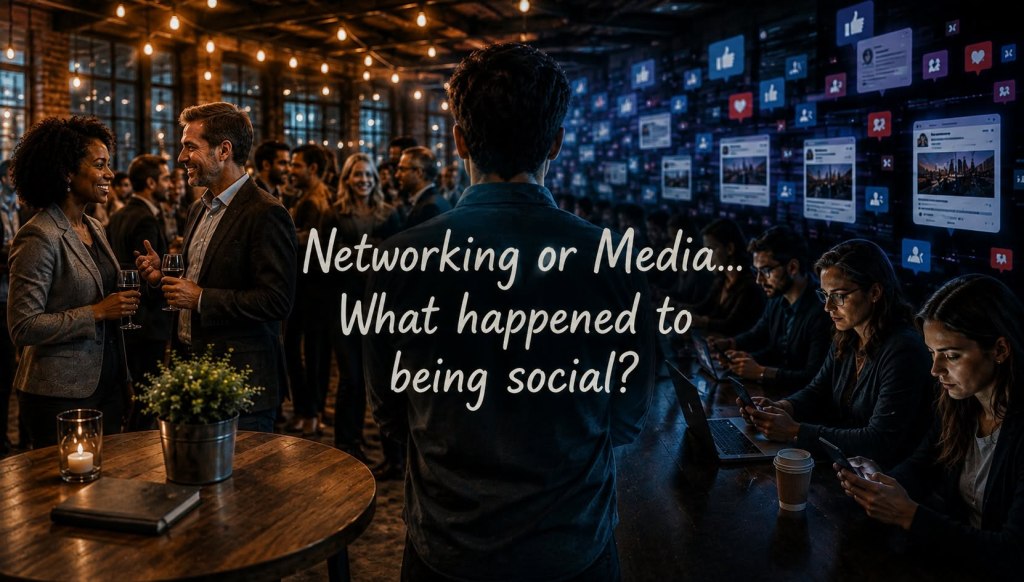
Social platforms connected billions of people, yet brands increasingly use them to broadcast. The resurgence of community may finally change that.
There was a time when we didn’t talk nearly as much about social media. We talked about social networking. The distinction may sound insignificant today, perhaps even like a matter of terminology, but I believe it represents one of the most consequential changes in how businesses, brands and individuals have come to use the internet. Social networking was originally about connecting people. We joined networks, participated in groups, introduced ourselves, commented on discussions, exchanged ideas and found people with common interests. Quite often, those online connections eventually moved into telephone conversations, meetings, business relationships and even friendships. The technology was certainly important, but the technology wasn’t the point. The people were.
Somewhere along the way, networking became media, and media changed the objective. Instead of asking who we might meet, we began asking how many people we could reach. Conversations became impressions. Relationships became followers. Participation became engagement rates. Communities became audiences. Listening increasingly gave way to posting. We became fascinated with views, likes, shares, followers, algorithms and eventually virality. Businesses that had initially entered social networks to connect with people gradually learned to behave more like publishing companies, and individuals increasingly began thinking of themselves as personal brands with audiences to cultivate. It was an extraordinary transformation, and in many respects an enormously beneficial one. But after nearly two decades, it may be worth asking whether something valuable was lost along the way.
I remember the excitement surrounding social networking in 2009 and 2010, when I was spending considerable time writing, speaking and working with franchise organizations about what was then still a relatively new business phenomenon. What fascinated me wasn’t simply the ability to distribute information inexpensively or reach prospective customers and franchise candidates. It was the possibility of connecting people who otherwise might never meet. I thought of the emerging online world much like an enormous virtual cocktail party. You could walk into a room filled with people from different cities, industries and backgrounds and begin conversations that geography, time and circumstance previously might have prevented.
Think about how we traditionally behave at a cocktail party, networking event or business reception. Most of us wouldn’t walk through the door, climb onto a chair and immediately begin shouting about our company, our services, our accomplishments and whatever we’re selling. We would look around the room. We might recognize someone and say hello. We would introduce ourselves to someone new. We’d listen to conversations before joining them. We’d ask questions. Someone might introduce us to another person because we shared an interest or could possibly help one another. We might exchange business cards and agree to continue the conversation later. Some conversations would lead nowhere. Others could unexpectedly lead to customers, partnerships, friendships, investments or opportunities that neither person anticipated when walking into the room. That was networking, and social networking promised to replicate much of that human behavior on an unprecedented scale.
That thinking was reflected in work I was doing at the time. A 2010 presentation for Virtual Franchise Events described online environments that included lounges, conference halls, roundtables and opportunities for one-on-one interaction and “interactive social gatherings.” The idea wasn’t simply to reproduce a trade show on a computer screen. The larger promise was that technology could create places where people gathered, interacted and developed relationships even when they couldn’t occupy the same physical room. Around the same period, in writing about social media and franchise development, I emphasized the need to move beyond simply distributing information and toward personal interaction. The interaction, I argued, should be subtle and guiding rather than an aggressive sales effort. The objective wasn’t merely to capture someone’s attention. It was to begin developing a relationship.
Looking back from 2026, the contrast is striking. We have built social platforms infinitely more powerful than anything we imagined then. Smartphones have placed sophisticated publishing studios in virtually everyone’s pocket. Video can reach millions of people within hours. Entrepreneurs can build recognizable personal brands without traditional media. Restaurants can show thousands of customers tonight’s special before dinner. Franchise brands can communicate across entire systems almost instantaneously. Small businesses can reach customers around the world. Executives can speak directly to employees, customers and investors without waiting for a newspaper, television station or trade publication to give them access. The democratization of media has been extraordinary, and there is no reasonable argument for turning back the clock on those capabilities.
But there is a reasonable argument for asking what we have done with them.
Open almost any social platform today and everyone seems to be talking. Companies are publishing. Entrepreneurs are publishing. Influencers are publishing. Consultants are publishing. Politicians are publishing. Employees are publishing. Customers are publishing. Artificial intelligence is now helping all of us publish even more. Content calendars are filled weeks in advance. Videos are optimized for attention. Headlines are designed for clicks. Posts are evaluated by impressions, engagement and reach. Algorithms are studied, praised when they favor us and blamed when they don’t. Businesses invest enormous amounts of time determining what they should post next.
Perhaps the more revealing question is how much actual networking is taking place.
How many businesses intentionally introduce people within their networks to one another? How many brands participate meaningfully in conversations that aren’t taking place beneath their own posts? How many executives spend time listening to customers rather than studying reports about customers? How often does a thoughtful comment receive a thoughtful response rather than a quick “Thanks for sharing”? How many organizations know how many genuine business relationships were created through their social presence last year? How many even attempt to measure such a thing?
We may have created the largest cocktail party in human history and somehow ended up with everyone standing on chairs shouting announcements at one another.
That’s the irony of where social networking has taken us. We have never been more connected technologically, yet much of what takes place on social platforms increasingly resembles broadcasting rather than networking. The platforms are called social, but the behavior frequently looks remarkably similar to traditional media, except now everyone owns a microphone. Brands build audiences. Individuals build followings. Companies distribute messages. The tools changed dramatically, but in many cases we recreated the one-to-many communication model that social networking originally appeared capable of disrupting.
This doesn’t mean social media has failed. Far from it. Social media has become one of the most powerful communication, marketing and information systems ever created. For brands in particular, the benefits have been enormous. Businesses can tell their stories directly, respond to crises quickly, demonstrate expertise, humanize leadership, showcase customers and employees, recruit talent, generate leads and reach audiences that would have required enormous advertising budgets a generation ago. An entrepreneur operating from a home office can command an audience that once required ownership of a television station or newspaper. That is remarkable progress.
The question is whether reach and relationship must be mutually exclusive. I don’t believe they are. In fact, I believe brands that recognize the difference may be approaching one of the most significant opportunities of the next several years.
We’re already seeing renewed interest in community. Businesses are developing private groups, membership communities, customer networks, founder communities, professional groups and niche environments organized around shared interests. Entrepreneurs are discovering that several hundred highly engaged people can sometimes be more valuable than tens of thousands of passive followers. Brands are increasingly recognizing that customers don’t merely want to consume messages; many want to participate, contribute, share experiences and interact with people who have something in common with them. In some respects, what is being promoted today as the future of community-led business looks remarkably similar to what social networking was supposed to accomplish in the first place.
The danger, of course, is that marketing has a habit of turning every human behavior into a tactic. If “community” simply becomes the next marketing buzzword, we will repeat the same cycle. Companies will establish community strategies, community KPIs and community funnels. Managers will be instructed to increase community engagement by a certain percentage each quarter. People will be pushed through communities toward transactions, and before long “community” will become little more than another word for audience. That would miss the point entirely.
A genuine community isn’t simply a group of people listening to the organization that assembled them. People within a community communicate with one another. They exchange ideas, help each other, challenge each other, recommend resources, make introductions and develop relationships independent of the brand at the center. The organization may provide the room, but it doesn’t need to dominate every conversation taking place inside it. In fact, one of the clearest signs that a community has become valuable may be when meaningful conversations continue even when the organization isn’t participating.
This presents an interesting strategic question for brands. What would happen if companies began thinking about social networking again rather than simply social media? Instead of beginning every morning by asking what they should post, what if they asked who they should talk with? Instead of concentrating primarily on increasing followers, what if they focused on creating relationships? Instead of evaluating success almost exclusively through views and impressions, what if they considered how many meaningful conversations were started? Instead of always trying to move people into a funnel, what if they concentrated on becoming valuable enough that people voluntarily remained connected?
The opportunity becomes even greater when a brand stops thinking only about its relationship with individual customers and begins thinking about relationships among the people surrounding the brand. A restaurant doesn’t have to limit its social presence to photographs of food, promotions and announcements. It can help create conversations within the neighborhoods it serves. A franchise organization doesn’t have to use social platforms solely to promote its franchise opportunity. It can create environments where franchisees, prospective entrepreneurs, suppliers, employees and business owners exchange knowledge and experiences. A professional services firm doesn’t need to demonstrate expertise through an endless stream of thought leadership while everyone else politely watches. It can become a catalyst for introducing people who should know one another.
There is a profound difference between building an audience around your brand and building a network around a shared interest. The first makes the company the center of attention. The second makes the company valuable because it helps create connections. One asks people to watch. The other gives people reasons to participate.
There is also a practical business argument for reconsidering this distinction. Brands that build their entire social strategy around reach increasingly depend upon platforms they don’t control. An algorithm changes and organic reach disappears. Advertising costs increase. A platform falls out of favor. A new one emerges. Suddenly, a company can discover that years spent accumulating followers didn’t necessarily translate into years spent building relationships. The audience belonged, at least in part, to the platform all along.
Relationships behave differently. When someone knows you, trusts you, subscribes to your communications, participates in your community, attends your events, introduces others to you and engages with people within your network, that relationship can transcend any particular social platform. Facebook may facilitate the introduction. LinkedIn may start the conversation. Instagram may create awareness. An email newsletter, virtual event, private group or face-to-face meeting may deepen the relationship. The technology changes, but the human connection survives. Perhaps that was one of the most important principles embedded in the original idea of social networking: the platform was never supposed to become the relationship. It was supposed to facilitate one.
That idea may become even more important as artificial intelligence accelerates content creation. We are rapidly entering a world in which almost every organization can produce competent articles, social posts, images, videos, presentations and marketing messages at extraordinary speed and relatively little cost. The amount of content competing for attention will continue increasing. If everyone can produce more media, media itself becomes less scarce. When something becomes less scarce, its ability to differentiate tends to decline.
Human connection, however, may move in the opposite direction.
Trust is difficult to automate. Genuine conversation is difficult to scale. Relationships take time. Community requires participation. Introductions require judgment. Listening requires patience. Helping someone without immediately calculating the return isn’t easily captured on a marketing dashboard. In a world overflowing with automatically generated content, those distinctly human behaviors may become more valuable rather than less.
Perhaps that is why the renewed interest in community deserves more attention than simply treating it as another marketing trend. Maybe we’re witnessing the beginning of a correction. After years of building enormous audiences and sophisticated publishing machines, perhaps businesses and individuals are beginning to recognize that reach without relationship has limitations. Having 100,000 followers isn’t necessarily the same as knowing 100,000 people. Being seen by millions isn’t the same as being trusted by hundreds. Engagement isn’t necessarily connection, and attention isn’t automatically community.
I don’t believe the answer is abandoning social media. That would ignore everything valuable it has created. Instead, perhaps the opportunity is to reclaim the social part of social media. Use media to initiate conversations rather than treating the publication itself as the objective. Allow conversations to develop into relationships. Allow relationships to create communities. And allow those communities to produce opportunities that advertising, algorithms and content calendars cannot manufacture on their own.
Nearly seventeen years after those early conversations about social networking, I find it fascinating that we’re again talking so much about community, belonging, authenticity, conversation and human connection. Maybe we’ve come full circle. Maybe people are growing tired of being audiences, followers, prospects, targets and data points. Maybe they want to participate again. Maybe they want to be part of something instead of simply being marketed to by something.
If social networking originally resembled a virtual cocktail party, perhaps somewhere along the way we became so focused on building bigger stages, brighter lights and louder microphones that we forgot about the people standing in the room. We became extraordinarily good at attracting attention while gradually becoming less intentional about what happened after we received it.
Perhaps it’s time for brands to step down from the stage and walk back into the room. Introduce people. Listen to conversations. Ask questions. Participate in discussions that aren’t about themselves. Help people connect with one another. Create reasons for people to return even when nothing is being sold. Use technology for what once made social networking seem so revolutionary: bringing people together who otherwise might never have met.
So maybe the question isn’t whether social media has been good or bad for brands. Clearly, it has created extraordinary opportunities. The more interesting question is whether we’ve taken one of the greatest networking technologies ever created and gradually turned it into another broadcasting system.
And if we have, perhaps the next great innovation in social media won’t be technological at all.
Maybe it will simply be remembering how to network again.
What do you think? Have we gained more than we’ve lost in the evolution from social networking to social media? Is today’s movement toward community simply the next marketing strategy, or is it evidence that people and brands are searching for something we left behind? And perhaps most importantly, when you log onto a social platform today, are you there to network… or are you there to broadcast?
Maybe the answer to that question says more about the future of social media than any algorithm ever could.
Discover more from Acceler8Success Cafe
Subscribe to get the latest posts sent to your email.

You must be logged in to post a comment.