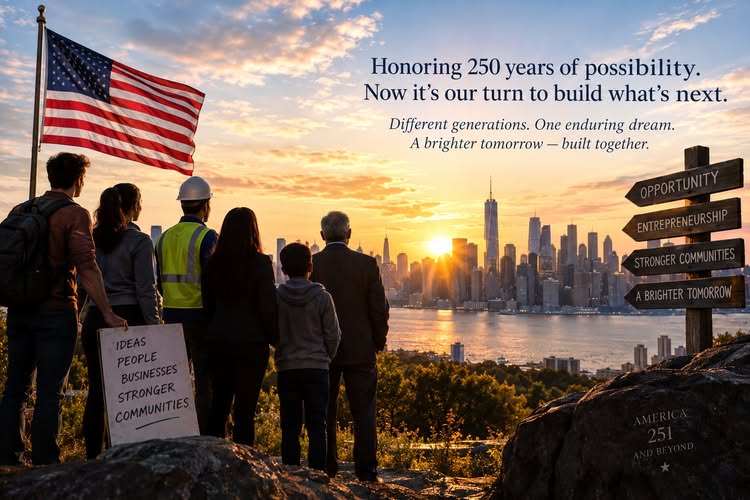
America spent months preparing to commemorate 250 years. The fireworks came. The speeches were delivered. The flags waved. Then July 4 passed, and much of the conversation seemed to pass with it. But perhaps we have been looking at the milestone backward. America at 250 should never have been merely a celebration of where we have been. It should have been the starting point for a serious national conversation about where we are going… and whether entrepreneurship will remain one of the great engines that gets us there.
America turned 250 years old on July 4, 2026.
Think about that for a moment.
Two hundred and fifty years.
Generations of people building, working, struggling, immigrating, inventing, risking, failing, rebuilding, succeeding, raising families, creating businesses, serving communities, and pursuing their own interpretations of what eventually became known simply as the American Dream.
For months leading up to July 4, we heard about America 250.
There were celebrations and commemorations. Flags appeared everywhere. Organizations incorporated the milestone into their messaging. Communities planned events. Businesses joined the celebration. Politicians delivered speeches. Historians reflected upon America’s past.
Then came the fireworks.
And then came July 5.
And something strange happened.
The conversation seemed to stop.
Where did America 250 go?
Where did all that energy go?
Where did the discussion about America’s next chapter go?
Most importantly, why would we spend so much time preparing to commemorate 250 years without spending at least as much time asking what we intend to do with the years that come next?
Maybe July 4 should not have been the finish line.
Maybe it should have been the starting line.
Because while anniversaries give us an opportunity to look backward, milestones should also force us to look forward.
And when we look forward, one question deserves considerably more attention:
What does the American Dream mean today and what role will entrepreneurship play in keeping it alive?
That is not a nostalgic question.
It is an economic question.
A cultural question.
A generational question.
And increasingly, I believe, it is a question about whether people still believe they have meaningful control over their own futures.
The American Dream Has Never Stood Still
Ask ten people to define the American Dream and you may receive ten different answers.
For previous generations, the image was often fairly straightforward.
A stable job.
A house.
A family.
A car in the driveway.
Some savings.
A retirement account.
Perhaps the proverbial white picket fence.
Work hard, keep your head down, play by the rules, save what you can, and leave your children a little better off than you were.
There was something reassuring about that version of the Dream.
But does it accurately describe what millions of Americans want today?
Or even what millions believe is realistically attainable?
Maybe today’s American Dream is less about owning certain things and more about possessing something increasingly precious:
control.
Control over one’s time.
Control over one’s income.
Control over where one works.
Control over what one builds.
Control over the decisions that determine one’s future.
The ability to say, This is mine. I built this. I am responsible for where it goes next.
Perhaps today’s Dream is freedom combined with security.
Perhaps it is the ability to care for one’s family without constantly worrying about the next unexpected expense.
Perhaps it is the ability to build something meaningful instead of spending decades performing work that feels disconnected from any larger purpose.
Perhaps it is simply waking up and knowing that your future is not entirely dependent upon a corporate restructuring, an algorithm, an economic downturn, a merger, a new technology, or somebody else’s decision made hundreds of miles away.
That raises an uncomfortable question:
If people increasingly feel they have less control over their economic lives, can the American Dream remain believable?
And another:
If the Dream no longer feels attainable through traditional paths, where will people turn?
For many, the answer may increasingly be entrepreneurship.
Entrepreneurship Is Not What Social Media Has Made It Out to Be
We should be careful here.
Entrepreneurship has been romanticized almost beyond recognition.
Spend enough time online and you might believe entrepreneurship consists primarily of laptops on beaches, motivational quotes, exotic cars, passive income, four-hour workweeks, viral businesses, and people announcing that they have “escaped the 9-to-5.”
Anyone who has actually built a business knows better.
Entrepreneurship can be exhilarating.
It can also be exhausting.
It can provide freedom while simultaneously demanding more of you than any employer ever did.
It can create wealth.
It can consume wealth.
It can produce extraordinary confidence one morning and profound doubt that same night.
There are days when everything appears possible.
And there are nights when an entrepreneur lies awake wondering how payroll will be met Friday morning.
That is entrepreneurship.
It is not an escape from responsibility.
It is the acceptance of more responsibility.
So why do people continue choosing it?
Why does someone risk savings accumulated over twenty years to buy a business?
Why does a restaurant manager decide to open a restaurant knowing how difficult the restaurant business can be?
Why does someone purchase a franchise?
Why does a consultant leave a comfortable corporate position?
Why does an immigrant arrive in a new country and begin building a business almost immediately?
Why does a parent work a full day, put the children to bed, and then spend another three hours building something at the kitchen table?
Why?
Because somewhere inside entrepreneurship lives something deeply human:
the desire to create one’s own possibility.
But Dreams Still Have to Compete With Reality
There is another truth we cannot ignore.
Dreams do not pay the mortgage.
Purpose does not automatically pay for groceries.
Passion does not cover health insurance.
Possibility does not make the car payment.
Millions of Americans are balancing very real financial pressures.
Housing consumes a substantial portion of household income for many families. Healthcare can be financially daunting. Education debt follows people well into adulthood. Childcare, insurance, transportation, utilities, food, and countless everyday expenses compete for every available dollar.
For someone living paycheck to paycheck, telling them to simply “follow their passion” is not inspirational.
It can be insulting.
That is why the conversation about entrepreneurship must mature.
Entrepreneurship does not always begin with someone resigning from a job and announcing a startup.
Sometimes entrepreneurship begins because somebody needs another $300 this month.
Or $500.
Or $1,000.
Maybe they start detailing cars on weekends.
Maybe they cater food from their kitchen.
Maybe they consult after work.
Maybe they sell something online.
Maybe they repair equipment.
Maybe they teach.
Maybe they design websites.
Maybe they clean offices.
Maybe they begin providing a service to one customer.
Then another.
And another.
A side hustle created out of necessity can become supplemental income.
Supplemental income can become meaningful income.
Meaningful income can become a business.
A business can become an employer.
An employer can become part of the economic foundation of a community.
And sometimes something that began because a family needed an extra $500 becomes the business that changes that family’s trajectory for generations.
We should stop treating those stories as small.
They are entrepreneurship at its most fundamental level.
Someone sees a need.
Someone possesses a skill.
Someone takes initiative.
Someone accepts responsibility.
Someone creates value.
Someone gets paid.
And possibility begins.
Entrepreneurship Is About More Than Money
Yet survival cannot be the final objective.
People need something beyond financial security.
They need meaning.
They need purpose.
They need to believe their work matters.
They need to feel that they are creating, contributing, solving, helping, building, or moving toward something worthwhile.
That need may become increasingly important as artificial intelligence, automation, globalization, and technological disruption transform the nature of work.
Consider the questions millions of people may increasingly find themselves asking:
What happens if technology changes my profession?
What happens if my company restructures?
What happens if my industry changes faster than I can adapt?
What skills do I actually own?
What relationships have I built?
What knowledge could I turn into value?
What could I create if I had to create something for myself?
Those are entrepreneurial questions.
And perhaps that is where we need to expand our definition of entrepreneurship.
Entrepreneurship is certainly business ownership.
But entrepreneurial thinking is bigger than business ownership.
It is the willingness to see possibilities where others see obstacles.
To identify problems and imagine solutions.
To take initiative without waiting for permission.
To understand that failure is information rather than identity.
To adapt.
To improvise.
To build.
To persist.
To take ownership.
An employee can think entrepreneurially.
A teacher can think entrepreneurially.
A physician can.
A restaurant manager can.
A tradesperson can.
A corporate executive can.
A student can.
A retiree can.
Maybe one of the most important things America could do entering its next 250 years is stop treating entrepreneurship merely as a career category and begin teaching it as a way of thinking.
The Entrepreneurial Mindset May Be More Important Than the Entrepreneurial Business
What if we taught children to recognize opportunity instead of simply preparing them to seek employment?
What if students learned how businesses actually make money?
What if they understood profit and loss?
Cash flow?
Debt?
Investment?
Risk?
Sales?
Negotiation?
Customer service?
Problem-solving?
What if failure were discussed not simply as something to avoid but as something from which people can learn?
What if a seventeen-year-old graduated from high school understanding the difference between revenue and profit?
What if every young adult understood how to turn a skill into income?
What if we taught young people that creating a job can be as worthy an ambition as obtaining one?
Imagine the difference.
Not because every young person should become an entrepreneur.
They should not.
But every young person should understand that entrepreneurship is an option.
They should understand what it requires.
They should understand the risks.
And they should understand the possibilities.
Because the workforce they are entering will almost certainly look very different from the one their parents entered.
The ability to think entrepreneurially may become one of the most important forms of economic resilience a person can possess.
America Has Always Been a Nation of Underdogs
Some of America’s most compelling entrepreneurial stories do not begin with ideal circumstances.
They begin with obstacles.
The immigrant arriving with little money but enormous determination.
The employee laid off after twenty-five years who suddenly must reinvent a career.
The single parent building a small business after the children fall asleep.
The restaurant worker saving money for years to eventually open a place of their own.
The tradesperson who realizes the skill they have spent twenty years developing might support a company.
The veteran translating discipline and leadership into business ownership.
The franchisee risking accumulated savings on a first location.
The entrepreneur whose first business failed but who eventually finds the courage to try again.
The older executive wondering whether decades of experience could become something entirely new.
The young entrepreneur nobody takes seriously—until customers do.
These stories matter because they remind us of something fundamental.
The American Dream has never been a guarantee of success.
It has been the possibility of trying.
That distinction matters enormously.
We cannot guarantee entrepreneurial success.
Nor should we pretend we can.
Businesses fail.
People make bad decisions.
Markets shift.
Competitors emerge.
Capital disappears.
Partnerships break apart.
Economic conditions change.
Sometimes entrepreneurs do almost everything right and still lose.
But a society committed to entrepreneurship can do something else:
It can make the opportunity to try more accessible.
Which raises perhaps one of the most important questions coming out of America 250:
How do we expand the opportunity to try?
Opportunity Cannot Merely Be a Slogan
If entrepreneurship is truly part of the American Dream, then access to entrepreneurial opportunity deserves serious attention.
Not guaranteed outcomes.
Opportunity.
How do we provide better entrepreneurial education before someone risks their savings?
How do we help aspiring entrepreneurs understand whether entrepreneurship is actually right for them?
How do we help people evaluate opportunities objectively instead of emotionally?
How do we connect entrepreneurs with experienced mentors?
How do we provide access to credible advisors?
How do we help someone understand financing before signing loan documents?
How do we help entrepreneurs understand franchising before purchasing a franchise?
How do we help restaurant operators understand food costs, labor costs, occupancy costs, and cash flow before those numbers become fatal?
How do we help a successful small-business owner determine whether expansion is prudent?
How do we help struggling early-stage entrepreneurs before they reach the point where recovery becomes nearly impossible?
How do we connect entrepreneurs with resources without forcing them to navigate a confusing maze of disconnected organizations, service providers, consultants, programs, and information?
And perhaps most importantly:
Who is responsible for helping them?
Government?
Educational institutions?
Banks?
Franchise organizations?
Chambers of commerce?
Economic development groups?
Private enterprise?
Experienced entrepreneurs?
Professional advisors?
The answer may be all of them.
But if responsibility belongs to everyone, there is always a danger that it effectively belongs to no one.
That needs to change.
Where Did America 250 Go?
Which brings me back to the question that prompted this reflection.
Where did America 250 go?
We spent months building toward July 4.
Then the day arrived.
America celebrated.
The fireworks exploded.
The speeches ended.
The crowds went home.
And somehow, much of the momentum seemed to disappear with the smoke.
Why?
Why would we treat a 250-year milestone as the conclusion of something rather than the beginning?
Why would the conversation become quieter precisely when it should become louder?
Where is the discussion about America 251?
America 260?
America 300?
What kind of economy are we building?
What kind of entrepreneurial environment are we creating?
What opportunities will exist for someone starting with very little?
Will entrepreneurship become increasingly accessible—or increasingly reserved for people who already possess capital, connections, education, and resources?
Will small businesses remain central to local communities?
Will independent restaurants survive?
Will franchising continue to provide pathways into business ownership?
Will experienced entrepreneurs mentor the next generation?
Will today’s business leaders share what they know—or take decades of accumulated knowledge into retirement with them?
Will artificial intelligence create more entrepreneurs or eliminate opportunities for them?
Will technology democratize entrepreneurship or concentrate economic power?
Will young people see business ownership as achievable?
Will immigrants continue seeing America as a place where something can be built from almost nothing?
Will someone sitting at a kitchen table tonight with an idea believe there is a realistic path forward?
Those are America 250 questions.
And we should still be asking them.
Franchising Should Be Part of This Conversation
The franchise community has a particular responsibility here.
Franchising has long represented one pathway into entrepreneurship by allowing individuals to operate businesses using established brands, systems, training, processes, and support structures.
But franchising should not simply spend the next decade asking:
How do we sell more franchises?
It should also ask:
How do we create better-prepared franchisees?
How do we improve education before investment?
How do we make expectations clearer?
How do we strengthen unit-level economics?
How do we help franchisees become better business operators?
How do we encourage responsible expansion?
How do we preserve entrepreneurship within increasingly sophisticated franchise systems?
How do we make sure that people understand that buying a franchise does not eliminate entrepreneurial responsibility?
A franchise agreement may provide a system.
It does not provide determination.
It does not provide leadership.
It does not guarantee customers.
And it certainly does not guarantee success.
The best future for franchising will not be built merely by selling opportunities.
It will be built by helping entrepreneurs become capable owners and operators.
The Restaurant Industry Should Lead, Too
Few industries embody entrepreneurship as visibly as restaurants.
Walk down almost any Main Street in America and entrepreneurship is staring back at you through restaurant windows.
Someone took a risk.
Someone signed a lease.
Someone bought equipment.
Someone created a menu.
Someone hired employees.
Someone worried about food costs.
Someone unlocked the door early in the morning.
Someone stayed late at night.
Someone hoped enough customers would walk through the door.
Restaurants are businesses.
But they are also gathering places.
First jobs.
Training grounds.
Immigrant success stories.
Family legacies.
Community anchors.
And sometimes second chances.
The restaurant industry should be among the loudest voices advocating for entrepreneurship.
Not because everyone should open a restaurant.
Far from it.
But because restaurants reveal entrepreneurship in its rawest form.
Customer.
Product.
People.
Cost.
Service.
Risk.
Margin.
Reputation.
Community.
Survival.
There may be no better classroom for understanding what business ownership actually demands.
What About the Entrepreneur Who Is Already Struggling?
We spend considerable energy encouraging people to start businesses.
Perhaps we should spend considerably more energy helping them survive.
The early-stage entrepreneur is frequently celebrated at launch.
Congratulations.
Ribbon cutting.
Social post.
Grand opening.
Then everyone goes home.
Six months later, that entrepreneur may be alone trying to understand why revenue is increasing but cash is disappearing.
Why employees keep leaving.
Why marketing isn’t producing results.
Why customers are not returning.
Why margins are shrinking.
Why the loan payment suddenly feels enormous.
Why the business they dreamed about has become the source of tremendous stress.
Where does that entrepreneur go?
Who becomes their sounding board?
Who asks the difficult questions?
Who identifies the warning signs?
Who tells them what they need to hear instead of what they want to hear?
Who helps them distinguish a temporary problem from a fundamental flaw?
We cannot claim to champion entrepreneurship only at the beginning.
Entrepreneurship requires an ecosystem that remains present after the ribbon is cut.
Experience Must Become a Renewable Resource
There is another enormous entrepreneurial resource hiding in plain sight.
Experience.
America has millions of professionals, executives, operators, entrepreneurs, franchise professionals, restaurateurs, tradespeople, sales leaders, financial professionals, and business owners carrying decades of accumulated knowledge.
What happens to that knowledge?
Too often, it simply disappears.
Someone retires.
Someone sells a company.
Someone leaves an industry.
Someone decides they have had enough.
And forty years of experience walks out the door.
What if we looked at experienced professionals differently?
What if we viewed their knowledge as entrepreneurial infrastructure?
Mentors.
Advisors.
Coaches.
Investors.
Board members.
Teachers.
Connectors.
Sounding boards.
Entrepreneurship does not have to be a young person’s game.
Nor should experience be treated as something with an expiration date.
A 25-year-old entrepreneur may possess technological fluency and extraordinary energy.
A 65-year-old entrepreneur may possess pattern recognition built through decades of successes, mistakes, negotiations, recessions, recoveries, failures, relationships, and reinventions.
Imagine what happens when those generations actually work together.
That is an entrepreneurial ecosystem.
The Next Generation Is Watching Us
Perhaps the most consequential audience in this conversation has not started a business yet.
They are sitting in classrooms.
Playing sports.
Working first jobs.
Watching their parents.
Watching entrepreneurs online.
Watching artificial intelligence transform the world around them.
They are trying to understand what adulthood will look like.
What are we teaching them?
Are we teaching them to wait for opportunity?
Or recognize it?
Are we teaching them only how to apply for jobs?
Or also how jobs are created?
Are we teaching them to fear failure?
Or understand it?
Are we teaching them that success is instant?
Or showing them that meaningful achievement usually requires patience, resilience, discipline, persistence, sacrifice, and time?
Most importantly:
Do they believe they can build something?
Because before entrepreneurship becomes a business plan, it begins as belief.
Someone has to believe:
Maybe I can.
Maybe I can solve this problem.
Maybe I can serve this customer.
Maybe I can build this company.
Maybe I can change the direction of my family.
Maybe I can create jobs.
Maybe I can make something better.
Maybe I can recover from failure.
Maybe I can start again.
America cannot afford to lose that “maybe.”
America 251 Starts Now
Perhaps that should be the legacy of America 250.
Not nostalgia.
Not fireworks.
Not commemorative logos.
Not another historical milestone placed on a shelf.
A renewed commitment to possibility.
America 251 should become the first year of the next chapter.
A chapter in which entrepreneurial education becomes more accessible.
A chapter in which aspiring entrepreneurs can find credible information before making life-changing investments.
A chapter in which early-stage entrepreneurs have somewhere to turn before small problems become business-ending problems.
A chapter in which successful entrepreneurs give something back by sharing their experience.
A chapter in which franchising takes seriously its responsibility to develop business owners, not merely sell franchises.
A chapter in which the restaurant industry celebrates and develops the entrepreneurs behind the storefronts.
A chapter in which corporations encourage entrepreneurial thinking instead of suppressing it.
A chapter in which communities intentionally connect entrepreneurs with resources.
A chapter in which young people understand entrepreneurship as a realistic option.
A chapter in which older professionals understand that their entrepreneurial contributions may be far from finished.
A chapter in which immigrants, veterans, women, minorities, tradespeople, corporate executives, restaurant workers, franchisees, professionals, and people starting over all see pathways toward ownership.
And perhaps a chapter in which we stop asking only:
“How do we create more businesses?”
And begin asking:
“How do we create stronger entrepreneurs?”
Because strong entrepreneurs build stronger businesses.
Stronger businesses create jobs.
They support families.
They purchase from suppliers.
They occupy storefronts.
They pay taxes.
They mentor employees.
They strengthen communities.
And sometimes they inspire someone watching from across the street to think:
Maybe I could do that too.
That is how entrepreneurial cultures perpetuate themselves.
One person sees possibility because someone else demonstrated that possibility exists.
This Is Where Acceler8Success America Must Stand
For Acceler8Success America, we know this cannot simply be an opinion.
It represents our commitment.
Our role is not to romanticize entrepreneurship.
Our role is to strengthen the entrepreneur.
Before launch.
During launch.
After launch.
During growth.
During struggle.
During reinvention.
And sometimes during the difficult decision of whether to continue, change direction, sell, or start again.
Entrepreneurship needs more than inspiration.
It needs education.
Resources.
Connections.
Experience.
Community.
Accountability.
Mentorship.
Advisory.
Opportunity.
And sometimes it simply needs a trusted person willing to sit across the table and ask:
Have you really thought this through?
Or:
What are you missing?
Or:
What happens if you’re wrong?
Or:
What happens if you’re right?
Or perhaps the most important question of all:
What are you going to do next?
That is the future I believe Acceler8Success America will help build.
Not as an organization standing on the sidelines talking about entrepreneurship.
Instead, an organization working within the entrepreneurial ecosystem—connecting experience with ambition, resources with needs, opportunity with preparation, and today’s entrepreneurs with tomorrow’s.
Because entrepreneurship does not need more spectators.
It needs participants.
It needs advocates.
It needs mentors.
It needs experienced voices willing to tell the truth.
And it needs people willing to help others move from thinking to doing, and from merely doing to building something sustainable.
Don’t Let the Fireworks Be the Finale
America turned 250 on July 4, 2026.
We celebrated.
We should have.
Two hundred and fifty years is worthy of celebration.
But perhaps somewhere amid the fireworks, flags, speeches, and nostalgia, we missed the larger opportunity.
July 4 was never supposed to be the finale.
It should have been the starting gun.
The question now is not what America accomplished during its first 250 years.
History will continue debating that.
The question for those of us alive today is much more immediate:
What will we contribute to the years ahead?
What will we build?
Who will we help?
Who will we teach?
Who will we mentor?
What problems will we solve?
What opportunities will we create?
What knowledge will we pass along?
What risks are we willing to take?
What mistakes are we willing to learn from?
What struggling entrepreneur will we help before they give up?
What young person will we encourage before they decide their idea is impossible?
What experienced professional will discover that retirement from one career can become the beginning of another contribution?
What entrepreneur will look back twenty years from now and remember that someone believed in them before anyone else did?
And what will we tell the generation celebrating America’s 300th birthday about what we did after America turned 250?
Will we tell them we watched the fireworks?
Or will we tell them we went back to work?
That may ultimately be the question.
Because the American Dream has never been something one generation could simply preserve in a museum and hand intact to the next.
Every generation must build its own version.
Every generation must redefine opportunity according to the realities of its time.
Every generation must decide whether possibility will remain accessible to those willing to pursue it.
And every generation must decide whether entrepreneurship remains something we merely admire—or something we actively cultivate.
America’s first 250 years were built by people willing to imagine things that did not yet exist.
Businesses.
Industries.
Restaurants.
Franchise systems.
Technologies.
Products.
Services.
Communities.
Careers.
Second chances.
Family legacies.
Entirely new lives.
The next 250 years will require the same spirit.
Maybe more of it.
So let the fireworks fade.
Let the banners come down.
Let the commemorative merchandise disappear.
But do not let the entrepreneurial momentum disappear with them.
America 250 is over.
America 251 has already begun.
And the question facing all of us who believe in entrepreneurship is remarkably simple:
What are we going to build now?
Paul Segreto is Founder & CEO of Acceler8Success America and has spent more than four decades working across entrepreneurship, franchising, restaurants, small business, business development, and advisory. Acceler8Success America is committed to strengthening entrepreneurs through education, resources, connections, advisory, and opportunities across the entrepreneurial journey.
Acceler8Success America
The American Dream Accelerated.
Discover more from Acceler8Success Cafe
Subscribe to get the latest posts sent to your email.

You must be logged in to post a comment.