Your franchise sales and development company is generating leads. Your opportunity appears on franchise portals. Someone is running digital campaigns, distributing information to brokers, and following up with inquiries.
But what is actually being developed?
A growing contact list? A collection of interested prospects scattered across the country? Or a deliberate path toward a stronger franchise system?
For an emerging franchise brand, these questions deserve serious attention. The earliest franchise awards help establish the operating culture, support demands, market presence, and relationships upon which future growth will depend.
Yet too often, the conversation centers on how many franchises can be sold before anyone has sufficiently addressed where those franchises should be developed, who should operate them, or how the franchisor will support them.
If your development partner cannot explain why a particular candidate, market, and development structure fit your brand, you should be asking what you are paying for.
A National Ambition Needs a Practical Starting Point
There is nothing wrong with wanting to build a national franchise brand. The concern is whether national expansion has become the immediate sales strategy simply because the opportunity can be advertised nationwide.
For many emerging brands, local and regional development should receive the first and strongest emphasis.
Consider the difference between several franchise locations concentrated in a manageable region and the same number spread across distant states. The franchise award count might look identical. The demands on training, field support, travel, supplier coordination, and local marketing can look very different.
Concentrated development can give leadership more opportunities to stay close to franchisees, recognize problems early, build market familiarity, and refine the systems needed for expansion.
Scattered development can stretch an emerging organization before those systems are ready.
Neither geography nor proximity guarantees success. But support capacity should help determine the growth strategy. A territory should not become a priority merely because someone there is willing to sign an agreement.
The question is straightforward: Where can this brand responsibly build its next stage of growth?
Local Focus Does Not Require Local-Only Recruitment
A focused development strategy can still attract candidates from a broad geographic area.
An experienced operator in another state may be well positioned to expand into your priority market. An established franchise group may already have the leadership, capital, and real estate relationships needed to develop there. An entrepreneur considering relocation may bring relevant experience and a credible operating plan.
The distinction is between where you recruit candidates and where you intend to develop the brand.
Those decisions serve different purposes.
A development company should be able to reach beyond your immediate region while keeping franchise awards aligned with your approved market priorities. It should also maintain a separate pipeline for candidates interested in future markets, with clear expectations about availability and timing.
Broad recruitment can support concentrated growth. It does not have to dictate scattered expansion.
Your Brand Deserves More Than a Standard Sales Package
Emerging brands differ in meaningful ways.
A restaurant concept requires a different candidate conversation than a home services business. A brand pursuing multi-unit operators needs a different outreach strategy than one built around active owner-operators. A concept entering a new region faces different challenges than one expanding around an established customer base.
Your sales and development effort should reflect those differences.
Who is the intended franchisee? What experience matters? What operating responsibilities will ownership require? Which markets fit the concept? What resources must a candidate have beyond the initial investment? What can the franchisor’s team realistically support?
These questions should shape the campaign before advertising begins.
At Acceler8Success America, our approach is to connect franchise sales with the practical work of development. A recent restaurant franchise proposal illustrates what that can include, without identifying the brand or suggesting that proposed activities are completed results.
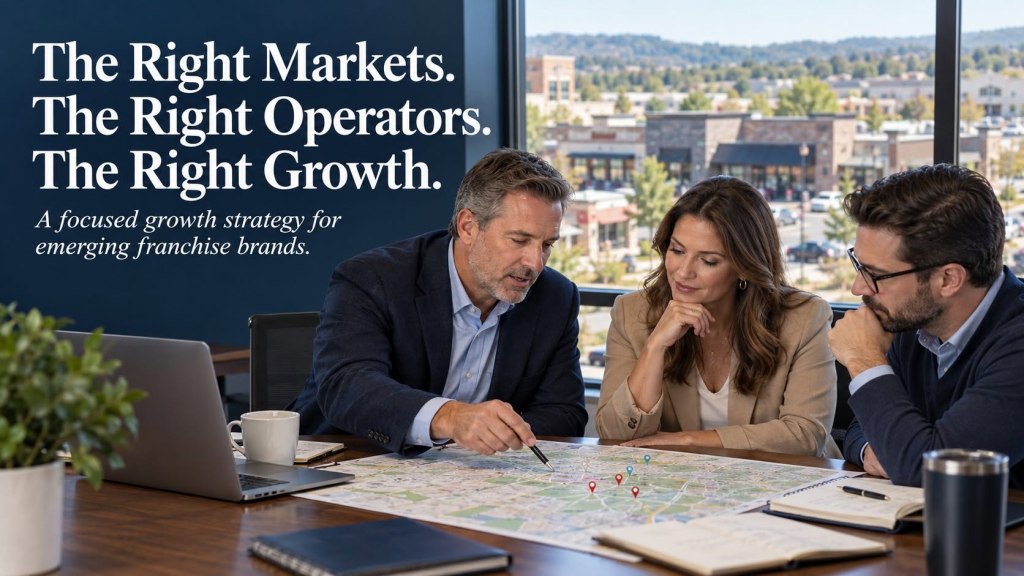
Start by Mapping the Market
In that proposal, we recommended concentrating initial development in one priority metropolitan market while preparing a broader regional candidate pipeline.
The proposed work begins with a preliminary development map and rollout recommendation.
That means evaluating population and household growth, employment centers, residential development, traffic patterns, competitive supply, and relevant customer demand. It also means considering access, visibility, parking, labor availability, occupancy costs, and development timelines against the brand’s requirements.
Just as important, the planning considers how potential locations could form manageable clusters and how openings might be sequenced to support supervision, training, and local awareness.
This work does not replace the franchisor’s real estate team or final site approval. It gives recruitment a purpose.
Instead of asking, “Who wants a franchise somewhere in this state?” the effort can ask, “Who has the capability to execute this approved development plan?”
Match the Development Commitment to the Operator
The same proposal outlines a sequence of development priorities: evaluate a qualified area developer for the approved market, pursue manageable commitments of three to five restaurants, and consider selective single-unit awards that complement the overall plan.
That sequence is specific to the proposed assignment. It should not be copied automatically into every emerging brand’s strategy.
Its broader lesson is that development structure should be intentional.
An area development commitment requires more than enthusiasm and available capital. It requires a leadership bench, phased funding, regional operating capability, and a credible opening schedule.
A multi-unit commitment requires enough management depth to supervise existing operations while developing additional locations.
A single-unit award deserves equal discipline in assessing ownership responsibilities, operating readiness, and market fit.
A larger commitment is only valuable when the candidate can reasonably carry it out.
Pursue Candidates Who Can Operate the Business
Financial qualification is essential. It is also incomplete.
For a restaurant franchise, our proposed screening emphasizes operating experience, management resources, staffing plans, site development capability, capital allocation, and accountability.
Targeted outreach may include experienced restaurant operators, multi-unit and multi-brand franchisees, development groups, and investors with an acceptable operating structure.
A transitioning executive may be a viable candidate, but corporate experience alone does not establish restaurant operating readiness. An investor may have substantial resources, but someone still needs to lead the business.
Your development partner should investigate the people and resources behind the application.
The ability to buy a franchise and the ability to develop and operate one are different qualifications. Both matter.
Build Relationships Around the Market
Digital campaigns can support recruitment, but they should be part of a coordinated effort.
Our proposed scope combines direct database outreach with select business and franchise broker relationships, commercial real estate introductions, developer relationships, webinars, content, and local meetings.
Each channel has a purpose.
Business brokers may know established owners considering another operating business. Franchise brokers may have relationships with experienced franchisees. Commercial real estate professionals may know operators seeking expansion opportunities. Developers and municipal economic development contacts may provide useful local intelligence.
Those relationships require active management: approved opportunity briefings, clear candidate criteria, documented introductions, consistent follow-up, and reviews of referral quality.
For an emerging brand, a smaller group of informed, productive referral partners may provide more value than broad distribution to people who barely understand the concept.
Put People in the Market
There is practical value in meeting candidates, touring markets, and speaking with the people involved in local development.
Our Texas presence supports proposed in-person candidate meetings, market tours, and coordination with real estate and development contacts.
A conversation in the market can reveal questions that an online inquiry form never will. Who will oversee operations? How well does the candidate understand the area? What competing commitments exist? What local resources can the ownership group actually access?
Local presence creates opportunities to test assumptions and strengthen relationships.
Emerging brands need that depth of engagement as they establish their first development clusters.
Make Marketing Accountable to Candidate Quality
Content, social media, paid campaigns, and webinars should communicate a consistent, approved explanation of the brand and ownership opportunity.
Our proposed approach includes coordinated messaging, audience selection, landing pages, tracking, and follow-up. Paid campaigns begin with controlled tests, with expansion based on the quality and progression of candidates generated.
That is a different conversation from celebrating impressions and inquiry volume alone.
A webinar for experienced operators should address different questions than an introductory session for prospective first-time owners. Outreach to development groups should reflect their interest in market capacity, management requirements, and opening schedules.
Brand-specific marketing should help appropriate candidates recognize the opportunity—and help others understand when it does not fit their objectives.
Demand Visibility Into the Work
Franchise development should not disappear into a monthly report that says, “We are continuing to follow up.”
Our proposed reporting includes weekly pipeline updates and monthly strategy reviews, with visibility into candidate sources, qualifications, development interests, stages, next actions, stalled opportunities, and decisions requiring leadership attention.
It also separates different measures of progress.
An inquiry is not a qualified candidate. A qualified candidate is not an approved franchisee. A signed development commitment is not an opened business.
Each matters, but they should be reported distinctly.
The proposed initial 90-day plan also identifies reviewable work: candidate criteria, preliminary market planning, outreach lists, campaign preparation, documented qualification activity, pipeline assessments, and next-quarter priorities.
These are planning milestones, not promises of awards or openings. They allow leadership to evaluate whether the development effort is being executed thoughtfully and consistently.
Sometimes the Sales System Needs Work First
More advertising will not necessarily resolve an unclear franchise offering, weak sales materials, inconsistent follow-up, or an incomplete candidate journey.
A responsible development partner should be willing to identify those gaps.
At Acceler8Success America, when substantial sales-system repair or repositioning is needed, our approach is to define that work separately, with agreed deliverables and timing.
Founders deserve to understand what needs attention before committing additional resources to attracting candidates.
They also deserve a partner who respects brand approval authority, documents candidate interactions, coordinates with franchise counsel, and makes a thorough handoff to development and operations after an award.
The relationship does not become less important when the agreement is signed. That is when the operating commitment begins.
Final Thoughts
Emerging franchisors should expect their sales and development partner to understand the business behind the franchise opportunity.
That understanding should be visible in the markets prioritized, the candidates pursued, the relationships activated, the questions asked, and the work reported.
National growth may remain the destination. For many emerging brands, a focused local and regional strategy offers a more practical foundation for getting there.
Before your next development meeting, ask:
“Show me how your work is helping us build the right franchise system, in the right markets, with the right people.”
You should receive a specific answer supported by a specific scope of work.
If you cannot, it may be time to reassess your approach.
Let’s put your franchise development strategy under the same scrutiny you would apply to any other major business investment.
Acceler8Success America offers a complimentary consultation for emerging franchise brands to discuss market priorities, candidate targeting, development readiness, and the work needed to support your next stage of growth.
As part of that consultation, you can receive an actual proposed scope of work, redacted to protect the brand’s identity and confidential information, so you can see the level of planning, execution, and accountability for yourself.
Email paul@acceler8success.com with the subject line “Emerging Franchise Brand Consultation” or call or text (832) 797-9851.
Bring your growth goals, your current development challenges, and your questions. Let’s examine what a focused franchise sales and development effort should look like for your brand.
Discover more from Acceler8Success Cafe
Subscribe to get the latest posts sent to your email.

6 thoughts on “What Is Your Franchise Sales & Development Company Really Doing for Your Emerging Franchise Brand?”
Comments are closed.