The FTC’s action involving Premier Martial Arts and Franchise FastLane—and the IFA’s response—should prompt a deeper examination of how franchise opportunities are sold.
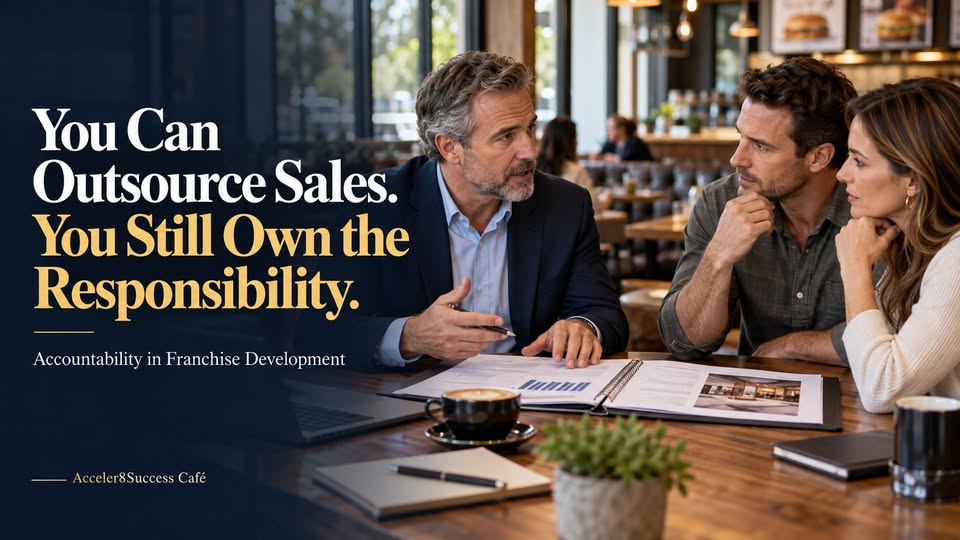
Special op-ed supplement to the four-part Acceler8Success Café series examining market strategy, franchisee readiness, recruitment practices, and development accountability, inspired by “What Is Your Franchise Sales & Development Company Really Doing for Your Emerging Franchise Brand?”
Before a franchise agreement is signed, a prospective owner has usually begun building an imagined future around it. A departing executive pictures a career with greater control. A couple considers a business their family might build together. An investor envisions several locations supported by capable managers. The opportunity becomes more than a business proposition. It becomes a possible answer to questions about security, independence, purpose, and the years ahead.
That is why the words used to sell a franchise matter so much. They help shape decisions that may involve savings, debt, career changes, and commitments extending well beyond the initial investment. Franchising offers a meaningful path to entrepreneurship, but the confidence required to pursue it should rest on an honest understanding of the business, including the work ownership demands.
The Federal Trade Commission’s action involving Premier Franchising Group, the franchisor of Premier Martial Arts, and its former franchise sales organization, Franchise FastLane, brings that responsibility into sharper focus. The FTC announced proposed settlements requiring combined payments of $1.85 million over allegations of misleading representations and Franchise Rule violations. The proposed relief also includes an option for certain franchisees to cancel agreements without penalty. The agency’s announcement notes that stipulated orders acquire legal force when approved and signed by the court.
The complaint alleges that the opportunity was promoted as one in which people without martial arts experience could profitably operate one or multiple studios while working fewer than 15 hours a week. It also challenges earnings representations involving existing studios that allegedly differed materially from those new franchisees were expected to operate. These remain allegations presented in an enforcement proceeding and proposed settlements, rather than findings following a contested trial. An industry discussion should respect that distinction while taking the underlying questions seriously. search.ftc.gov
The International Franchise Association’s response deserves attention. In its statement, the IFA welcomed the enforcement action and described it as the FTC’s first against a third-party franchise sales organization for an alleged Franchise Rule violation. IFA President and CEO Matt Haller emphasized that prospective franchisees deserve an accurate understanding of the investment, risks, and participants, and that brands and their sales representatives share responsibility for establishing transparent relationships. International Franchise Association
I agree with that principle. Its value will depend on how thoroughly it enters the daily work of franchise development. A statement of support can establish direction. Founders, sales organizations, brokers, and advisers must then examine what their own conversations, incentives, and approval processes are producing.
Over the past four articles at Acceler8Success Café, I have explored where emerging brands should grow, who is prepared to operate them, how appropriate candidates should be recruited, and what development accountability should reveal. This case gives those discussions added urgency. All four depend on the same foundation: the opportunity presented to a prospective franchisee must remain connected to the business that person will actually be expected to own.
That connection can weaken when a compelling ownership narrative advances faster than the operating evidence supporting it. A candidate hears that a manager will handle daily execution and begins imagining limited personal involvement. A founder points to a successful location and assumes its results establish what a new operator can accomplish. A development team sees enthusiasm and available capital and interprets both as evidence of readiness. Each step can appear reasonable in isolation while leaving important assumptions unexamined.
Consider the difference between hiring a manager and having a business capable of functioning reliably under that manager’s leadership. The latter requires recruiting, training, oversight, accountability, and continuity when circumstances change. Someone must make decisions when staffing breaks down, service deteriorates, or the manager leaves. A prospective owner needs to understand who that someone will be. Describing ownership involvement is consequential because candidates use that information to decide whether the opportunity fits their lives.
The same scrutiny belongs in discussions of business performance. A mature operation led by an experienced owner may benefit from relationships, judgment, routines, and a customer base developed over years. A newly recruited franchisee may be entering a different market, using a different format, and learning the business while building a team. Leadership should understand those differences before treating existing performance as evidence for a materially different ownership arrangement.
For restaurant founders, this should feel familiar. The original location may depend on the founder’s ability to spot a problem before it appears in a report, recruit through established relationships, or make dozens of small decisions almost instinctively. Replication requires discovering those dependencies and determining how they will be transferred. Documentation and training help, but so does an honest assessment of what the next operator must bring. Feasibility deserves a central place in that work because declaring a business ready for expansion does not establish that its essential capabilities can travel with it.
Hiring a franchise sales organization can strengthen an emerging brand. Experienced professionals may contribute relationships, qualification discipline, coordinated outreach, and resources a founder could not efficiently build alone. Their involvement should make leadership better informed about its opportunity and candidates. The founder still needs to understand how the business is explained in introductory calls, presentations, webinars, and follow-up conversations.
The FTC complaint describes Franchise FastLane’s participation in introductory, financial, validation, and discovery activities, while alleging that the franchisor retained candidate-approval authority and reviewed promotional materials. My broader leadership conclusion is that outside participation should prompt deliberate oversight of the candidate’s experience. Founders should know what questions are being asked, what answers are being given, and what expectations are taking shape before an application reaches final approval.
An approved presentation cannot capture every impression formed during recruitment. Candidates interpret tone, examples, assurances, and the apparent confidence of the people guiding them. Leadership should therefore ask what candidates believe about involvement, earnings, staffing, and support. When those beliefs exceed what the model can substantiate or deliver, the discrepancy needs attention before the relationship advances.
That may mean losing an award. I believe a sound development process must be willing to reach that outcome. A candidate’s money cannot fill every gap in their operating plan, and enthusiasm cannot make an unsuitable arrangement viable. Some gaps can be addressed through preparation or an experienced operating partner. Others may require a smaller commitment or a different opportunity. Qualification deserves enough independence to make those distinctions without being pressured to explain concerns away.
This also requires a candid discussion of compensation. Performance-based arrangements can reward substantial recruitment work and create access to expertise. They can also produce tension when the payment event occurs at signing while the consequences of a poor match emerge later. Raising that concern does not establish that commissions caused the conduct alleged here. It asks whether our structures give sufficient weight to the quality of the relationship being created.
Who can pause a candidate’s progression? Can operations challenge readiness without being treated as an impediment to growth? Does leadership value a well-supported recommendation to decline an applicant? These questions deserve answers under any fee structure. Changing compensation without changing oversight may leave the same weaknesses intact. A stronger approach connects incentives with clear approval authority, documented qualification, and a culture that recognizes sound judgment even when it reduces the immediate award count.
The IFA statement acknowledges the useful role of sales organizations and brokers while warning that too many connections are poor fits. It also calls for updated disclosure practices, stronger enforcement resources, and improved state registration processes. International Franchise Association Those policy discussions matter. At the brand level, fit still has to be established through careful work involving the candidate’s capabilities, objectives, market, and proposed operating structure.
Candidates should understand the commercial relationships behind that work. They should know whether the person guiding them works for the franchisor, an outside sales organization, or a referral business. They should understand the role each participant performs and who can answer questions about operating requirements and support. In my view, those explanations belong in ordinary language, accompanied by appropriate review of disclosure obligations with counsel. Clarity helps people evaluate the information they receive.
The IFA also points to voluntary education efforts, including a developing curriculum for third-party franchise sellers modeled on its Certified Franchise Executive program and Fran-Guard compliance training. International Franchise Association Education can improve competence and establish expectations. Its practical test comes when a representative encounters an unsupported claim, an unsuitable candidate, or pressure to move an opportunity forward. Training should equip people to recognize those situations and respond appropriately.
Formal licensing of franchise sales professionals is also a legitimate subject for discussion. I would welcome a serious examination of qualifications, oversight, enforcement, and whether such a system would improve protection. That is my proposal for debate, not an existing requirement established by this case or an endorsement attributed to the IFA. Whatever direction that discussion takes, brands can already set stronger expectations for the people representing them.
Due diligence must also have room to reach an uncomfortable conclusion. Candidates should seek independent advice, speak with operating franchisees, and examine whether the opportunity fits their circumstances. The people presenting the opportunity should support that inquiry. If existing owners describe responsibilities that differ from the recruitment message, the difference deserves examination. If candidates repeatedly misunderstand the ownership role, leadership should reconsider how it is being communicated.
For founders, meaningful accountability reaches beyond a pipeline stage or an award total. It includes what candidates understand, what remains unresolved, and how operations will receive the relationship after signing. A development report should help leadership see whether the proposed operator is identified, management assumptions are credible, and expectations have been examined. That information allows the organization to act while there is still time to improve preparation or reconsider the decision.
Franchising has helped many people build businesses, careers, and family legacies. Protecting that opportunity requires a willingness to examine our own practices. I believe the industry strengthens its credibility when it welcomes responsible scrutiny and turns it into better execution. The IFA’s statement provides a useful starting point. The work now belongs in individual brands’ development meetings, candidate conversations, and approval decisions.
Final Thoughts
The lasting significance of this case should be measured partly by the questions it causes franchisors to ask themselves. Do we understand the ownership story being presented? Have we established the basis for the expectations it creates? Are we selecting candidates who can fulfill the operating commitment? Are we prepared to support the relationship after the sales process ends?
Those questions connect this special addition to the four-part series that preceded it. Market discipline, candidate readiness, coordinated recruitment, and transparent reporting are practical expressions of responsible growth. Each helps leadership determine whether the next award advances a supportable franchise system.
The people considering that award may be placing years of work and substantial personal resources behind their decision. They deserve a process that helps them understand the opportunity clearly enough to choose it—or decline it—with confidence grounded in reality.
You can outsource franchise sales. You can engage experienced professionals whose contribution makes your organization stronger. You must still take responsibility for the story told in your name and the system expected to deliver on it.
Let’s examine what your franchise development effort is building.
Acceler8Success America offers a complimentary consultation for emerging franchise brands to discuss market priorities, candidate targeting, development readiness, and the work needed to support their next stage of growth.
As part of that consultation, you can receive an actual proposed scope of work, redacted to protect the brand’s identity and confidential information, so you can review the level of planning, execution, and accountability a focused franchise sales and development engagement can include.
Email paul@acceler8success.com with the subject line “Emerging Franchise Brand Consultation,” or call or text (832) 797-9851.
Bring your growth goals, current development challenges, and questions. Let’s discuss a practical path forward for your brand.
This special op-ed supplements the four-part Acceler8Success Café series expanding on “What Is Your Franchise Sales & Development Company Really Doing for Your Emerging Franchise Brand?.”
Discover more from Acceler8Success Cafe
Subscribe to get the latest posts sent to your email.

You must be logged in to post a comment.