Tag: franchise growth

The Ability to Buy a Franchise Is Only the Beginning

Financial qualification opens the conversation. Operating readiness should help determine whether it moves forward.
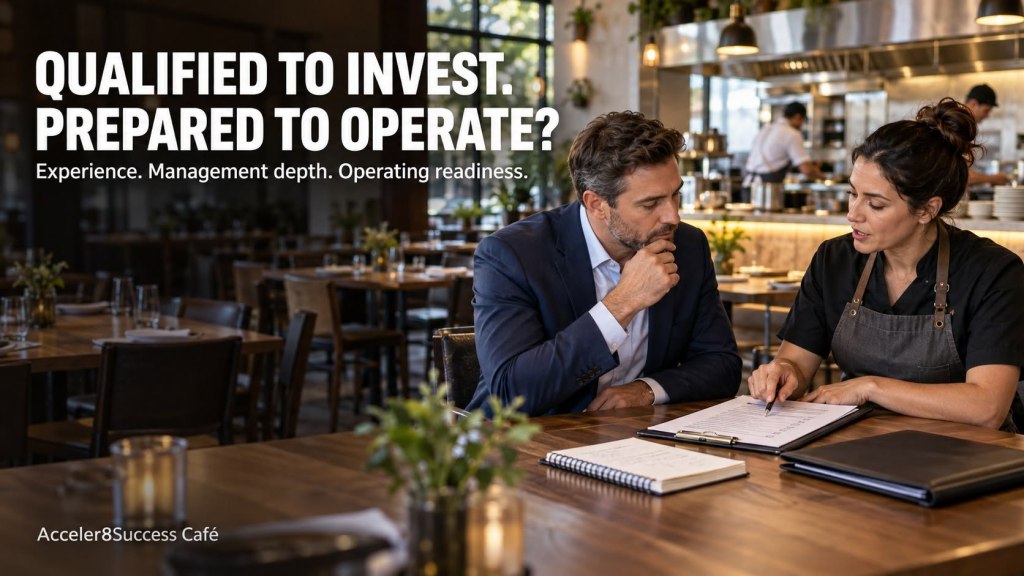
The candidate has the money.

For an emerging franchise brand eager to gain traction, that statement can change the tone of a development meeting. Conversations become more animated. A territory receives closer attention. The possibility of an award begins to feel real.

The candidate may also be enthusiastic, professionally accomplished, and personally impressive. They understand the presentation, ask thoughtful questions, and speak confidently about growth.

But who will operate the business?

That question deserves an answer with the same level of scrutiny given to the candidate’s financial qualifications.

In my recent op-ed, “What Is Your Franchise Sales & Development Company Really Doing for Your Emerging Franchise Brand?,” I challenged emerging franchisors to examine the practical development work behind their recruitment efforts. The first article in this series explored where a brand should grow. This second article considers the people expected to carry that growth forward.

A candidate’s ability to fund the investment is essential. It does not, by itself, establish the ability to build a team, open a location, manage operations, or fulfill a development commitment.

Those capabilities deserve attention before the agreement is signed, when there is still time to clarify expectations, address gaps, and determine whether the relationship should proceed.

Financial Qualification Should Start a Deeper Conversation

Financial screening helps establish whether a candidate has resources appropriate to the opportunity. It is a necessary part of evaluating a prospective franchisee.

However, founders should be careful about how much confidence they attach to the result.

A balance sheet does not tell you whether someone can recruit a capable general manager. Available liquidity does not establish whether an ownership group has agreed on decision-making authority. A willingness to invest does not explain how the candidate will respond when staffing problems, operating demands, and unexpected expenses arrive together.

The development conversation should connect financial capacity with the actual work required. What responsibilities will ownership carry? What experience prepares the candidate for those responsibilities? What resources will be available locally? What must be put in place before opening?

An effective process gives leadership a clearer understanding of the person or group behind the application. It also gives the candidate a more realistic understanding of what they are considering.

Define the Ownership Role Before Evaluating the Owner

An emerging brand should be able to explain what participation in its system will require.

Will the franchisee operate the business personally? Will a designated operating partner lead it? Can an investor ownership structure work within the model? What experience is required of the person responsible for daily performance?

Those expectations should be clear before recruitment campaigns begin.

Otherwise, the sales conversation can create room for assumptions. The franchisor expects active involvement. The candidate expects to hire a manager and review results. Both believe they have discussed ownership, but they are imagining different arrangements.

That misunderstanding may remain hidden until training begins or an opening approaches.

For a restaurant franchise, daily leadership can include staffing, scheduling, food quality, service execution, inventory discipline, and attention to guest concerns. A candidate needs to understand how those responsibilities will be fulfilled, even when someone else will perform much of the work.

If the model allows management-led operations, the evaluation should address the proposed manager, the owner’s oversight, and the process for resolving performance problems. If the model requires an active owner-operator, that expectation should be communicated consistently and reflected in the qualification decision.

Experience Matters When It Connects to the Assignment

Professional achievement can provide valuable skills. A transitioning executive may understand budgets, organizational structure, accountability, and team development. An experienced entrepreneur may bring resilience, commercial judgment, and familiarity with business ownership.

The question is how those capabilities apply to this business.

Someone who has led a large corporate division may be accustomed to established departments and experienced staff. A new franchise operation may require that same person to make decisions with a small team, limited administrative support, and immediate customer demands.

An experienced restaurant manager may understand daily execution but need development in cash management, ownership responsibilities, or opening a new location.

A multi-unit franchisee may have strong operating infrastructure while facing constraints in management availability or competing development obligations.

Qualification should explore the relevance and limits of the candidate’s experience.

Ask about situations they have actually managed. How have they addressed employee turnover? What happened when a manager underperformed? How have they maintained standards across shifts or locations? What responsibilities have they personally carried?

Specific examples can reveal judgment and capability that a résumé alone cannot.

A Management Plan Needs People Behind It

“We’ll hire a good manager” can sound reasonable during an early conversation.

It becomes less reassuring when the candidate cannot explain the role, compensation, recruitment process, training requirements, or timing.

A management plan should become progressively more concrete as the candidate advances. Who is expected to lead the business? Is that person already identified? What qualifications will be required? Who will evaluate them? How will ownership supervise their performance?

The answers do not all need to be finalized during the first call. By the time leadership is considering an award, however, unresolved management assumptions should be visible and addressed.

Consider an investor who plans to own a restaurant while maintaining a demanding career elsewhere. That arrangement may be workable for a brand that permits it, provided the operating structure is credible.

But the development team needs to understand who will make daily decisions, how the owner will stay informed, and who will step in if the manager leaves.

A single capable manager can be an important resource. A business also needs a plan for continuity when that person is unavailable.

Capital Must Be Allocated Across the Work Ahead

Having enough money to enter the opportunity and allocating it appropriately are connected but distinct issues.

The candidate needs to understand the demands of development, opening preparation, staffing, training, and ongoing operations. They also need to consider their personal financial responsibilities and the timing of other commitments.

A discussion centered only on the franchise fee and initial investment can leave important questions unanswered.

How much of the available capital is already committed elsewhere? What assumptions support the opening schedule? How will the ownership group respond if development takes longer than anticipated? What resources are available to support operations while the business establishes itself?

These discussions should be grounded in the brand’s disclosed information and the candidate’s circumstances. The development team should avoid suggesting a universal financial cushion or promising how quickly the business will support its owner.

The objective is to understand whether the candidate has a thoughtful funding plan and recognizes the demands that plan must accommodate.

For multi-unit development, the analysis should also address how later locations will be funded. An attractive first-unit funding plan does not automatically establish the ability to carry out a larger commitment.

Local Capability Deserves Its Own Evaluation

A candidate may understand the business model while having limited familiarity with the market where they intend to operate.

That does not necessarily disqualify them. It does create questions worth exploring.

Who will establish local real estate relationships? How will the business recruit employees? What knowledge does the ownership group have of the customer base? Who will coordinate development activity and remain accessible during opening preparation?

An operator expanding from another region may bring capable people and established processes. A relocating entrepreneur may be prepared to build local relationships personally. Either approach should be supported by a credible plan.

The first article in this series emphasized that broad recruitment can serve focused geographic development. That strategy depends on evaluating the candidate’s ability to execute in the approved market.

An address on an application tells you where someone lives. It does not tell you how they will lead the business where it opens.

Match the Development Commitment to Demonstrated Capacity

Larger commitments can be appealing to emerging franchisors.

One qualified group willing to develop several locations may appear to offer a more efficient path to growth. It may also create expectations that exceed the group’s available resources.

A commitment should reflect operating capacity, management depth, funding, and a realistic development schedule.

An owner who can operate one restaurant effectively may not yet have the people needed to oversee three. An established group may have substantial infrastructure, but much of it may already be committed to other brands or openings.

Leadership should ask what will be available for this assignment.

Who will supervise the first location while the second is being developed? Who will recruit and train additional managers? What competing obligations could affect the schedule? How will ownership evaluate readiness for each subsequent opening?

A capable candidate may be better served by a manageable commitment that allows the organization to demonstrate performance and build depth.

The number written into an agreement should have a reason behind it.

Coachability and Accountability Affect the Relationship

Operating readiness also involves how a candidate responds to expectations, feedback, and the responsibilities of participating in a system.

Franchisees are independent business owners. They bring experience, judgment, and entrepreneurial ambition. A strong relationship gives those qualities room to contribute while maintaining the standards necessary to protect the brand.

The recruitment process offers opportunities to observe that balance.

Does the candidate engage seriously with operating requirements? Do they ask for clarification when something is unfamiliar? Can they discuss a past mistake and what changed afterward? Do they complete agreed next steps or explain promptly when circumstances prevent them?

An informed candidate should ask difficult questions. Thoughtful scrutiny of the opportunity is healthy. The concern is when someone dismisses important requirements without examining why they exist, or repeatedly makes commitments they do not fulfill.

The franchisor must demonstrate accountability as well. Candidates should receive clear information, consistent communication, and an honest explanation of the support available.

Qualification is more useful when both parties can assess the relationship realistically.

The Founder’s Instinct Should Be Supported by a Process

Founders often develop a strong instinct for people. Years of hiring, negotiating, serving customers, and building a business can sharpen that judgment.

Still, enthusiasm about a candidate can influence how unanswered questions are interpreted.

A polished presentation may make an incomplete operating plan seem more developed than it is. Shared interests may create confidence before important responsibilities have been clarified. Pressure to achieve the first awards may make leadership reluctant to slow the conversation.

A structured process helps bring those questions into view.

Candidate criteria should reflect the brand’s operating model. Conversations should document relevant experience, ownership responsibilities, management plans, financial assumptions, and development interests. Where appropriate, references and additional discussions can help assess claims about operating capability.

The process should also identify gaps openly. Some may be addressed through training, a qualified operating partner, or a revised commitment. Others may indicate that the candidate is poorly suited to the opportunity.

Consistency in evaluation protects the quality of the decision while giving the founder’s judgment a stronger foundation.

The Qualification Work Should Inform the Operational Handoff

Important information can be lost when the development team treats an award as the end of its involvement.

Training and operations should understand the ownership structure, the intended operator, the candidate’s relevant experience, and the gaps identified during qualification. They should know what expectations have been established and which preparations still require attention.

That information helps the support team plan its work.

A first-time restaurant owner may need different emphasis during preparation than an experienced operator adapting to a new concept. An ownership group entering a new market may need particular attention to local coordination. A candidate relying on a designated manager may need support focused on the relationship between ownership and daily leadership.

A thorough handoff gives operations a clearer starting point.

It also helps prevent the franchisee from discovering that the people responsible for supporting them have a different understanding of the arrangement than the people who recruited them.

Your Development Partner Should Know Who Will Operate the Business

A franchise sales and development partner should be able to explain more than a candidate’s investment capacity and preferred territory.

Who will lead operations? What experience supports that role? What management resources are available? How will the business be funded through its development stages? Why does the proposed commitment fit this candidate?

If those answers remain vague, the qualification work needs further attention.

At Acceler8Success America, we believe candidate targeting and evaluation should connect directly to the operating responsibilities of the brand and its approved development strategy.

That requires conversations with substance, documentation that helps leadership make decisions, and a willingness to identify limitations even when a candidate has the money and wants to proceed.

An emerging brand’s early franchisees help shape its operating culture, support demands, and future credibility. Their selection deserves deliberate attention.

Final Thoughts

The ability to buy a franchise creates an opportunity to explore ownership. What follows requires an honest examination of the work ahead.

Someone will need to lead the team, maintain standards, manage resources, make difficult decisions, and remain accountable when the business becomes demanding.

Before your next award, understand who that person will be and how the ownership structure will support them.

Evaluate the experience behind the enthusiasm. Examine the management plan behind the investment. Connect the development commitment to the people, funding, and local capabilities available to carry it out.

There may be a strong candidate ready to proceed. There may be a promising candidate who needs additional preparation or a different commitment. There may be someone whose goals and capabilities fit another opportunity more appropriately.

A disciplined process should make those distinctions clearer.

Your next franchisee is making a consequential decision. So are you.

Both deserve a conversation that reaches well beyond whether the check can clear.


Let’s examine what your franchise development effort is building.

Acceler8Success America offers a complimentary consultation for emerging franchise brands to discuss market priorities, candidate targeting, development readiness, and the work needed to support their next stage of growth.

As part of that consultation, you can receive an actual proposed scope of work, redacted to protect the brand’s identity and confidential information, so you can review the level of planning, execution, and accountability a focused franchise sales and development engagement can include.

Email paul@acceler8success.com with the subject line “Emerging Franchise Brand Consultation,” or call or text (832) 797-9851.

Bring your growth goals, current development challenges, and questions. Let’s discuss a practical path forward for your brand.

This is the second article in a four-part Acceler8Success Café series expanding on “What Is Your Franchise Sales & Development Company Really Doing for Your Emerging Franchise Brand?.”
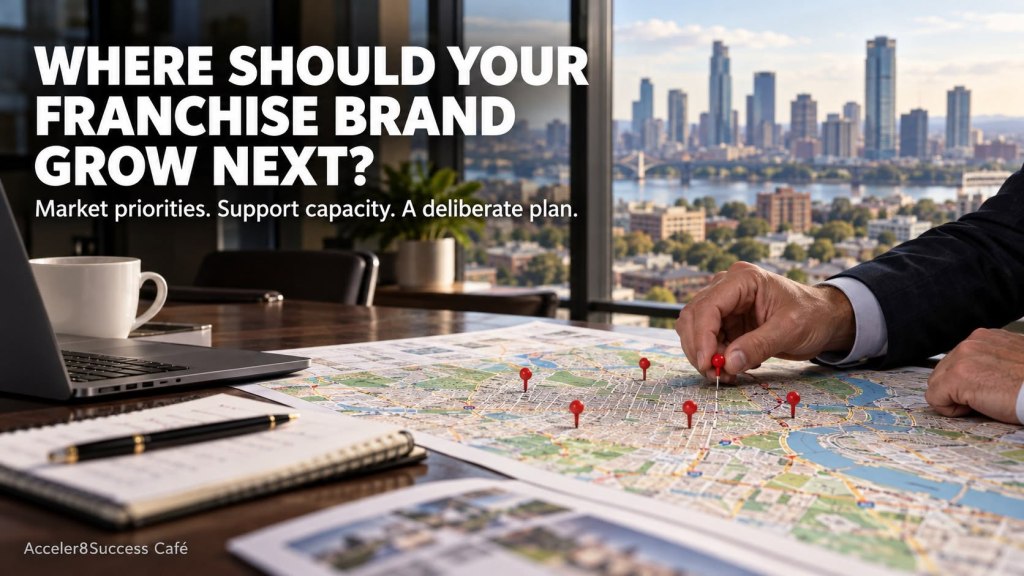
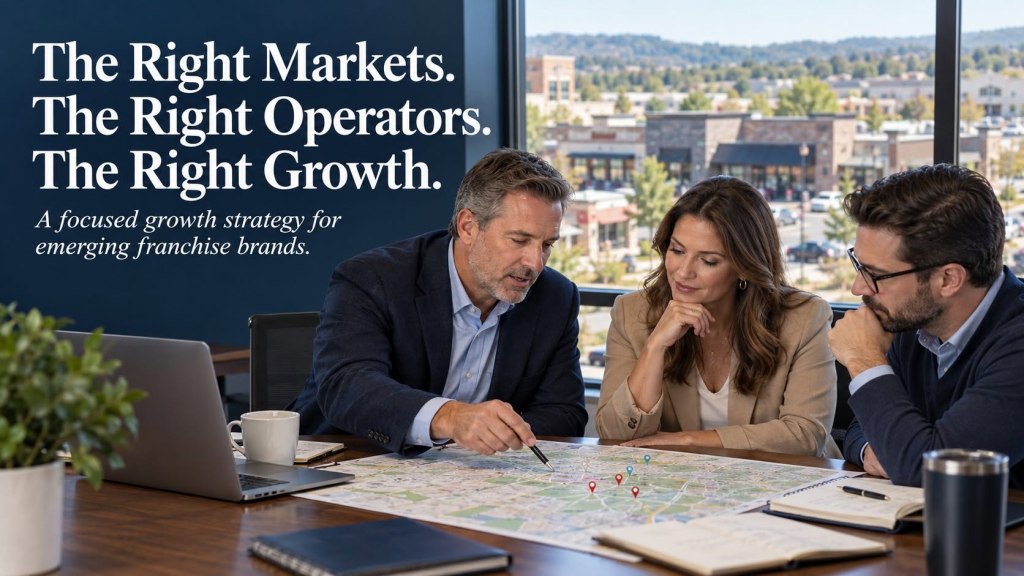
Before You Sell the Next Franchise, Decide Where Your Brand Should Grow

An emerging franchise brand’s expansion strategy should begin with the markets it can develop and support responsibly.

There is a moment in the life of an emerging franchise brand when interest from a prospective franchisee can feel like confirmation that everything is finally coming together. The business has been prepared for franchising. The investment has been made. The opportunity has been introduced to the marketplace. Someone sees the potential and wants to become part of the vision.

Then comes the question: Where would you like to open?

For too many emerging brands, that question arrives before leadership has sufficiently answered a more consequential one: Where should we be growing?

In my recent op-ed, “What Is Your Franchise Sales & Development Company Really Doing for Your Emerging Franchise Brand?,” I challenged founders to examine how their development efforts connect franchise recruitment with building a stronger system. Market selection deserves particular attention because every award creates obligations that extend well beyond the sales process.

The location of your next franchise will influence how you train, support, supervise, supply, and communicate with its owner. It will affect the demands on your leadership team and the resources available for the franchisees who follow.

Before celebrating the next award, you should understand what its geography will require of your organization.

National Ambition Requires a Practical Starting Point

Most founders do not enter franchising with a modest vision. They see opportunities in other cities, other states, and eventually across the country. That ambition can provide the energy needed to move through the difficult work of building a franchise organization.

But ambition needs a sequence.

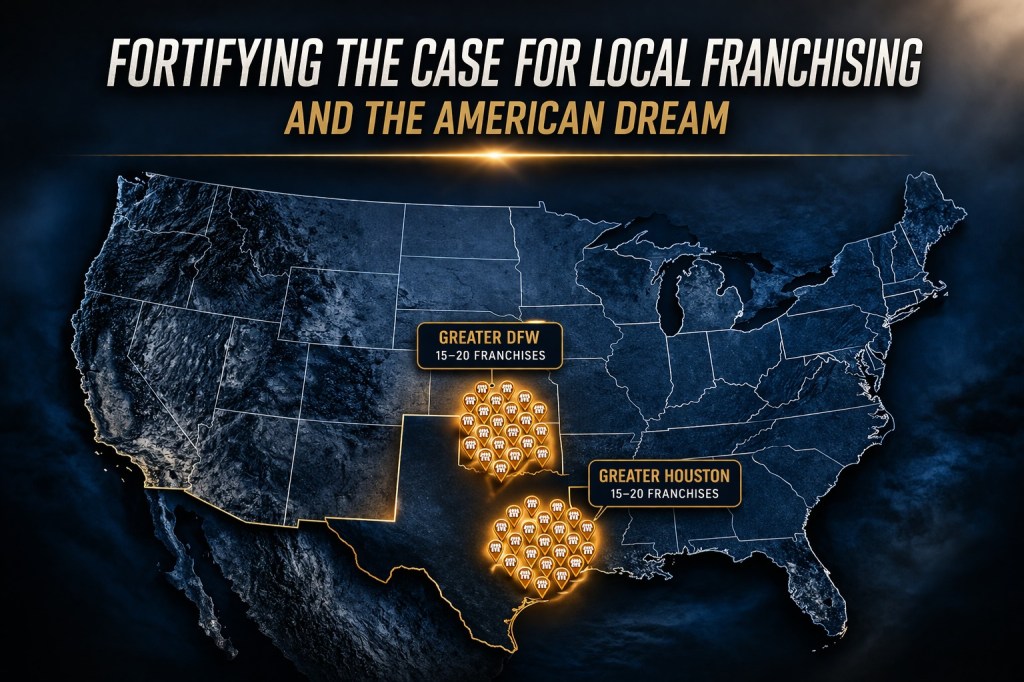
A brand can aspire to national recognition while concentrating its next stage of development in one metropolitan area or a manageable region. That focus gives leadership an opportunity to learn how the concept performs under different owners, strengthen training, refine support, and establish the relationships needed for continued expansion.

Think about a founder who has operated two successful restaurants in one market. Those restaurants may benefit from the founder’s personal relationships, daily involvement, reputation, and ability to solve problems quickly. Moving into franchising changes the operating arrangement. Moving into a distant market adds another layer of complexity.

The founder’s familiarity with the original business does not automatically establish the organization’s ability to support a franchisee several states away.

The practical question is what the brand must demonstrate, build, and resource before taking that step.

A Map of Signed Agreements Can Conceal a Support Problem

Imagine two emerging franchise brands, each with six newly awarded locations.

One has concentrated those awards within a region its leadership team can visit regularly. The other has awarded locations across six distant markets. Viewed through a sales report, the brands may appear to have made similar progress.

Viewed through the work ahead, they face different demands.

The dispersed brand may need to coordinate separate real estate relationships, supplier arrangements, training trips, local marketing efforts, and opening schedules. A problem in one market can compete for attention with an opening in another. Leadership may spend substantial time traveling while the home-office team tries to keep development moving.

The concentrated brand still faces significant challenges. Proximity does not fix inadequate training, weak unit economics, or poor franchisee selection. However, it may make hands-on support more practical and allow the organization to develop deeper familiarity with the markets it serves.

Geographic concentration also has limits. Too many locations in a poorly understood trade area can create competition within the system. Concentration must be supported by demand analysis, appropriate spacing, and thoughtful opening schedules.

A development map should show more than where agreements have been signed. It should help leadership understand whether the resulting businesses can form a viable, supportable system.

Support Capacity Belongs in the Market-Selection Discussion

Founders often evaluate new markets by looking at population, household income, competition, and the apparent appeal of the concept. Those considerations matter. So does the organization’s ability to deliver what franchisees will need.

Who will conduct initial training? Who will assist with opening preparation? Who will visit when an operator struggles? Who will help adapt approved marketing to local conditions? What happens when two franchisees need intensive assistance at the same time?

These questions should influence market priorities before candidates receive enthusiastic assurances about territory availability.

An organization with a small leadership team and limited field support may need a different geographic approach than one with experienced regional personnel. A restaurant concept with complex opening requirements may need a different rollout sequence than a business with a simpler launch process.

Support capacity can grow. It should grow deliberately, with responsibilities, staffing, and funding connected to the development plan.

If the strategy assumes that resources will somehow become available after agreements are signed, leadership should examine that assumption carefully. Franchisees will be preparing to invest, hire, and open on their own timelines. They need an organization prepared to meet its commitments.

Market Planning Should Begin Before Lead Generation

When franchise recruitment begins without defined market priorities, candidate interest can gradually become the expansion strategy.

An inquiry arrives from one state. Another prospect asks about a distant metropolitan area. A broker introduces someone interested in a territory leadership has never seriously evaluated. Each conversation seems worth pursuing, especially when the brand needs its first awards.

Over time, the organization may find itself considering a collection of opportunities with little connection to one another.

Preliminary market planning gives those conversations a clearer purpose.

For a restaurant brand, that work may include examining residential growth, employment centers, customer demand, traffic patterns, competitive concepts, labor availability, and occupancy costs. It should consider the brand’s format, customer profile, investment requirements, and operating needs.

A market with substantial population growth may still present challenges if suitable sites are scarce, rents undermine the model, or the labor requirements are difficult to meet. A smaller market may merit attention if the customer fit and operating conditions are stronger.

Preliminary planning cannot establish the suitability of every site or guarantee performance. It provides a reasoned basis for determining where to focus further work.

With that foundation, recruitment can pursue candidates capable of executing a defined plan in approved markets.

A Territory Is a Commitment to an Operating Environment

A territory discussion often centers on boundaries, availability, and how much room exists for future units. Those issues matter, but the underlying operating environment deserves equal attention.

Two territories of similar size may offer very different opportunities. One may contain growing residential communities, accessible retail space, and customer patterns suited to the concept. Another may have fragmented demand, difficult access, or development costs that challenge the economics.

Leadership should understand the assumptions behind the territory’s appeal.

For multi-unit development, the analysis becomes more demanding. A candidate’s willingness to commit to several locations does not establish that appropriate sites can be secured or that openings can be completed on the proposed schedule.

Real estate availability, construction timelines, management recruitment, and phased capital needs should inform the commitment.

The market plan, the candidate’s capabilities, and the development schedule must be considered together. Each affects the feasibility of the others.

Recruit Broadly While Developing Deliberately

A focused geographic strategy does not require a narrowly geographic recruitment strategy.

The right candidate for a priority market may live elsewhere. An experienced franchise operator may already have businesses and management resources in that region. A development group may be seeking a complementary concept. An entrepreneur may be planning a relocation and have a credible path to local operating involvement.

Where a candidate lives and where the brand should develop are separate questions.

A development partner should be able to explain the market priorities clearly while reaching candidates whose experience and resources fit the assignment. That requires understanding who will operate the business, how the ownership group will establish a local presence, and what responsibilities must be fulfilled before opening.

Candidates interested in future markets can remain part of a longer-term pipeline. However, expectations should be clear. Interest should not be allowed to create the impression that a territory is approved or that expansion timing has been established.

Broad recruitment is useful when it helps the brand execute its strategy.

Sequence Openings Around What the System Can Absorb

Even within an approved market, the pace of development matters.

Several signed agreements may create an encouraging pipeline. Several simultaneous openings may overwhelm the same organization.

Training teams have limits. Opening support has limits. Leadership attention has limits. New franchisees may need assistance at precisely the moment another location requires an intensive launch effort.

A practical rollout plan considers these competing demands.

For example, an early opening may provide lessons that improve training or launch preparation for subsequent locations. Leadership may discover that a supplier arrangement needs refinement or that a marketing approach requires adjustment. A thoughtful sequence creates room to incorporate those lessons.

That does not mean every brand should adopt the same opening schedule. It means the schedule should reflect the work required, the people available, and the readiness of each operator.

An award creates a development obligation. An opening puts the operating model to the test. The strategy needs to account for both.

Establish Conditions for the Next Stage of Expansion

Geographic focus becomes more useful when leadership also defines what would justify expanding beyond it.

Those conditions might include evidence that franchisees can operate effectively using the established systems, that support responsibilities are being fulfilled consistently, and that the organization has the personnel and resources needed for additional markets.

Leadership should also consider what it has learned from the first development cluster. Were site assumptions sound? Did openings follow realistic timelines? What assistance did franchisees need beyond what had been anticipated? Which parts of the model depended too heavily on the founder?

The answers can guide the next stage.

Performance in one region does not guarantee performance in another. It can, however, provide a more informed basis for deciding what needs to be evaluated or adapted before expansion proceeds.

The decision to enter a new market should follow a readiness discussion, supported by operating experience and a clear plan for additional obligations.

Your Development Partner Should Be Able to Explain the Geography

If your franchise sales and development company recommends a market, ask for the reasoning.

Why does this market fit the concept? How does it connect with existing operations? What work has been completed to understand demand and development conditions? What would the award require from your team? How does the candidate’s operating plan fit those requirements?

The answers should be specific enough to support a decision.

At Acceler8Success America, we believe market priorities, candidate targeting, development structure, and support readiness should be considered together. The recruitment effort should reflect the business the franchisor is building and the responsibilities that growth will create.

Founders should expect their development partner to help make those connections visible.

Leadership retains responsibility for approving the strategy and making award decisions. A capable partner provides the analysis, coordination, and candid discussion that help leadership exercise that responsibility thoughtfully.

Final Thoughts

The next franchise award can feel like a milestone because it is one. Someone has chosen to invest in your brand and participate in its future.

That decision deserves a development strategy worthy of the commitment.

Before you sell the next franchise, decide where your brand should grow. Understand why that market fits, what the operator will need, how the opening will be supported, and how the location contributes to the system you intend to build.

You may discover that the strongest next move is closer to home than expected. You may identify a compelling opportunity farther away. Either conclusion should emerge from a deliberate evaluation of the market, the candidate, and your organization’s readiness.

National growth can remain the vision. Every next step should have a practical reason behind it.

When a prospective franchisee asks whether a territory is available, your answer should reflect more than an open space on a map. It should reflect a plan.


Let’s examine what your franchise development effort is building.

Acceler8Success America offers a complimentary consultation for emerging franchise brands to discuss market priorities, candidate targeting, development readiness, and the work needed to support their next stage of growth.

As part of that consultation, you can receive an actual proposed scope of work, redacted to protect the brand’s identity and confidential information, so you can review the level of planning, execution, and accountability a focused franchise sales and development engagement can include.

Email paul@acceler8success.com with the subject line “Emerging Franchise Brand Consultation,” or call or text (832) 797-9851.

Bring your growth goals, current development challenges, and questions. Let’s discuss a practical path forward for your brand.

This is the first article in a four-part Acceler8Success Café series expanding on “What Is Your Franchise Sales & Development Company Really Doing for Your Emerging Franchise Brand?.”

What Is Your Franchise Sales & Development Company Really Doing for Your Emerging Franchise Brand?

Your franchise sales and development company is generating leads. Your opportunity appears on franchise portals. Someone is running digital campaigns, distributing information to brokers, and following up with inquiries.

But what is actually being developed?

A growing contact list? A collection of interested prospects scattered across the country? Or a deliberate path toward a stronger franchise system?

For an emerging franchise brand, these questions deserve serious attention. The earliest franchise awards help establish the operating culture, support demands, market presence, and relationships upon which future growth will depend.

Yet too often, the conversation centers on how many franchises can be sold before anyone has sufficiently addressed where those franchises should be developed, who should operate them, or how the franchisor will support them.

If your development partner cannot explain why a particular candidate, market, and development structure fit your brand, you should be asking what you are paying for.

A National Ambition Needs a Practical Starting Point

There is nothing wrong with wanting to build a national franchise brand. The concern is whether national expansion has become the immediate sales strategy simply because the opportunity can be advertised nationwide.

For many emerging brands, local and regional development should receive the first and strongest emphasis.

Consider the difference between several franchise locations concentrated in a manageable region and the same number spread across distant states. The franchise award count might look identical. The demands on training, field support, travel, supplier coordination, and local marketing can look very different.

Concentrated development can give leadership more opportunities to stay close to franchisees, recognize problems early, build market familiarity, and refine the systems needed for expansion.

Scattered development can stretch an emerging organization before those systems are ready.

Neither geography nor proximity guarantees success. But support capacity should help determine the growth strategy. A territory should not become a priority merely because someone there is willing to sign an agreement.

The question is straightforward: Where can this brand responsibly build its next stage of growth?

Local Focus Does Not Require Local-Only Recruitment

A focused development strategy can still attract candidates from a broad geographic area.

An experienced operator in another state may be well positioned to expand into your priority market. An established franchise group may already have the leadership, capital, and real estate relationships needed to develop there. An entrepreneur considering relocation may bring relevant experience and a credible operating plan.

The distinction is between where you recruit candidates and where you intend to develop the brand.

Those decisions serve different purposes.

A development company should be able to reach beyond your immediate region while keeping franchise awards aligned with your approved market priorities. It should also maintain a separate pipeline for candidates interested in future markets, with clear expectations about availability and timing.

Broad recruitment can support concentrated growth. It does not have to dictate scattered expansion.

Your Brand Deserves More Than a Standard Sales Package

Emerging brands differ in meaningful ways.

A restaurant concept requires a different candidate conversation than a home services business. A brand pursuing multi-unit operators needs a different outreach strategy than one built around active owner-operators. A concept entering a new region faces different challenges than one expanding around an established customer base.

Your sales and development effort should reflect those differences.

Who is the intended franchisee? What experience matters? What operating responsibilities will ownership require? Which markets fit the concept? What resources must a candidate have beyond the initial investment? What can the franchisor’s team realistically support?

These questions should shape the campaign before advertising begins.

At Acceler8Success America, our approach is to connect franchise sales with the practical work of development. A recent restaurant franchise proposal illustrates what that can include, without identifying the brand or suggesting that proposed activities are completed results.

Start by Mapping the Market

In that proposal, we recommended concentrating initial development in one priority metropolitan market while preparing a broader regional candidate pipeline.

The proposed work begins with a preliminary development map and rollout recommendation.

That means evaluating population and household growth, employment centers, residential development, traffic patterns, competitive supply, and relevant customer demand. It also means considering access, visibility, parking, labor availability, occupancy costs, and development timelines against the brand’s requirements.

Just as important, the planning considers how potential locations could form manageable clusters and how openings might be sequenced to support supervision, training, and local awareness.

This work does not replace the franchisor’s real estate team or final site approval. It gives recruitment a purpose.

Instead of asking, “Who wants a franchise somewhere in this state?” the effort can ask, “Who has the capability to execute this approved development plan?”

Match the Development Commitment to the Operator

The same proposal outlines a sequence of development priorities: evaluate a qualified area developer for the approved market, pursue manageable commitments of three to five restaurants, and consider selective single-unit awards that complement the overall plan.

That sequence is specific to the proposed assignment. It should not be copied automatically into every emerging brand’s strategy.

Its broader lesson is that development structure should be intentional.

An area development commitment requires more than enthusiasm and available capital. It requires a leadership bench, phased funding, regional operating capability, and a credible opening schedule.

A multi-unit commitment requires enough management depth to supervise existing operations while developing additional locations.

A single-unit award deserves equal discipline in assessing ownership responsibilities, operating readiness, and market fit.

A larger commitment is only valuable when the candidate can reasonably carry it out.

Pursue Candidates Who Can Operate the Business

Financial qualification is essential. It is also incomplete.

For a restaurant franchise, our proposed screening emphasizes operating experience, management resources, staffing plans, site development capability, capital allocation, and accountability.

Targeted outreach may include experienced restaurant operators, multi-unit and multi-brand franchisees, development groups, and investors with an acceptable operating structure.

A transitioning executive may be a viable candidate, but corporate experience alone does not establish restaurant operating readiness. An investor may have substantial resources, but someone still needs to lead the business.

Your development partner should investigate the people and resources behind the application.

The ability to buy a franchise and the ability to develop and operate one are different qualifications. Both matter.

Build Relationships Around the Market

Digital campaigns can support recruitment, but they should be part of a coordinated effort.

Our proposed scope combines direct database outreach with select business and franchise broker relationships, commercial real estate introductions, developer relationships, webinars, content, and local meetings.

Each channel has a purpose.

Business brokers may know established owners considering another operating business. Franchise brokers may have relationships with experienced franchisees. Commercial real estate professionals may know operators seeking expansion opportunities. Developers and municipal economic development contacts may provide useful local intelligence.

Those relationships require active management: approved opportunity briefings, clear candidate criteria, documented introductions, consistent follow-up, and reviews of referral quality.

For an emerging brand, a smaller group of informed, productive referral partners may provide more value than broad distribution to people who barely understand the concept.

Put People in the Market

There is practical value in meeting candidates, touring markets, and speaking with the people involved in local development.

Our Texas presence supports proposed in-person candidate meetings, market tours, and coordination with real estate and development contacts.

A conversation in the market can reveal questions that an online inquiry form never will. Who will oversee operations? How well does the candidate understand the area? What competing commitments exist? What local resources can the ownership group actually access?

Local presence creates opportunities to test assumptions and strengthen relationships.

Emerging brands need that depth of engagement as they establish their first development clusters.

Make Marketing Accountable to Candidate Quality

Content, social media, paid campaigns, and webinars should communicate a consistent, approved explanation of the brand and ownership opportunity.

Our proposed approach includes coordinated messaging, audience selection, landing pages, tracking, and follow-up. Paid campaigns begin with controlled tests, with expansion based on the quality and progression of candidates generated.

That is a different conversation from celebrating impressions and inquiry volume alone.

A webinar for experienced operators should address different questions than an introductory session for prospective first-time owners. Outreach to development groups should reflect their interest in market capacity, management requirements, and opening schedules.

Brand-specific marketing should help appropriate candidates recognize the opportunity—and help others understand when it does not fit their objectives.

Demand Visibility Into the Work

Franchise development should not disappear into a monthly report that says, “We are continuing to follow up.”

Our proposed reporting includes weekly pipeline updates and monthly strategy reviews, with visibility into candidate sources, qualifications, development interests, stages, next actions, stalled opportunities, and decisions requiring leadership attention.

It also separates different measures of progress.

An inquiry is not a qualified candidate. A qualified candidate is not an approved franchisee. A signed development commitment is not an opened business.

Each matters, but they should be reported distinctly.

The proposed initial 90-day plan also identifies reviewable work: candidate criteria, preliminary market planning, outreach lists, campaign preparation, documented qualification activity, pipeline assessments, and next-quarter priorities.

These are planning milestones, not promises of awards or openings. They allow leadership to evaluate whether the development effort is being executed thoughtfully and consistently.

Sometimes the Sales System Needs Work First

More advertising will not necessarily resolve an unclear franchise offering, weak sales materials, inconsistent follow-up, or an incomplete candidate journey.

A responsible development partner should be willing to identify those gaps.

At Acceler8Success America, when substantial sales-system repair or repositioning is needed, our approach is to define that work separately, with agreed deliverables and timing.

Founders deserve to understand what needs attention before committing additional resources to attracting candidates.

They also deserve a partner who respects brand approval authority, documents candidate interactions, coordinates with franchise counsel, and makes a thorough handoff to development and operations after an award.

The relationship does not become less important when the agreement is signed. That is when the operating commitment begins.

Final Thoughts

Emerging franchisors should expect their sales and development partner to understand the business behind the franchise opportunity.

That understanding should be visible in the markets prioritized, the candidates pursued, the relationships activated, the questions asked, and the work reported.

National growth may remain the destination. For many emerging brands, a focused local and regional strategy offers a more practical foundation for getting there.

Before your next development meeting, ask:

“Show me how your work is helping us build the right franchise system, in the right markets, with the right people.”

You should receive a specific answer supported by a specific scope of work.

If you cannot, it may be time to reassess your approach.

Let’s put your franchise development strategy under the same scrutiny you would apply to any other major business investment.

Acceler8Success America offers a complimentary consultation for emerging franchise brands to discuss market priorities, candidate targeting, development readiness, and the work needed to support your next stage of growth.

As part of that consultation, you can receive an actual proposed scope of work, redacted to protect the brand’s identity and confidential information, so you can see the level of planning, execution, and accountability for yourself.

Email paul@acceler8success.com with the subject line “Emerging Franchise Brand Consultation” or call or text (832) 797-9851.

Bring your growth goals, your current development challenges, and your questions. Let’s examine what a focused franchise sales and development effort should look like for your brand.

Rethinking Where Restaurant Franchises Grow Next

The future of restaurant franchising may depend less on abandoning America’s major cities, or betting on their comeback, and more on fundamentally rethinking where, how, and why brands grow.

For decades, expansion into America’s largest metropolitan markets carried an almost automatic assumption of success. New York. Chicago. Los Angeles. Seattle. San Francisco. Boston. Washington, D.C. These were markets brands wanted on their development maps, investors wanted in their portfolios, and emerging concepts often viewed as validation that they had arrived.

Population density was attractive. Tourism was attractive. Employment centers generated enormous daytime populations. Affluent neighborhoods offered strong consumer spending. Major universities, hospitals, airports, entertainment districts and convention centers created seemingly endless demand generators. And perhaps most importantly, visibility in a major American city carried prestige.

For franchisors, opening in Manhattan, downtown Chicago or Los Angeles could mean something beyond the economics of the individual restaurant. It could elevate the brand.

But prestige does not pay the rent.

And increasingly, the economics of operating restaurants in some of America’s largest cities are forcing franchisors, franchisees, investors and restaurant executives to ask a question that would have sounded almost heretical not long ago:

Do we still need to be there?

Perhaps an even more important question is this:

If we do need to be there, does the restaurant we put there need to look anything like the restaurant we have traditionally built?

Those are two very different questions, and the distinction between them may help determine where the next decade of franchise growth occurs.

The Restaurant Industry Is Growing. That Doesn’t Mean Every Market Works.

There is an important contradiction developing within the restaurant business.

On the national level, the industry remains enormous and remarkably resilient. The National Restaurant Association projects restaurant and foodservice sales of approximately $1.55 trillion in 2026. Consumers still want restaurants in their lives, and the Association continues to report strong underlying demand for dining out, takeout and delivery.

Yet underneath those impressive numbers is a much more difficult operating environment.

The National Restaurant Association estimates that total expenses for an average restaurant increased approximately 36% between 2019 and 2026. Food and labor alone each account for roughly one-third of restaurant sales, while occupancy, utilities, supplies, insurance, credit-card fees and other expenses have also risen substantially.

At the same time, traffic remains uneven. Consumers continue to eat out, but many are becoming more selective about where, when and how often they spend their restaurant dollars. Some nominal sales growth is being generated by higher prices rather than significantly more customers walking through restaurant doors.

That distinction matters enormously.

A restaurant can generate record sales and still produce disappointing returns.

A franchise system can report systemwide sales growth while individual franchisees experience deteriorating margins.

And a market can possess millions of consumers while becoming increasingly difficult to operate profitably.

That is where the discussion about America’s major cities must begin.

The Big-City Restaurant Equation Has Changed

Consider Seattle.

The city’s minimum wage is $21.30 per hour in 2026. That number alone doesn’t determine whether a restaurant succeeds or fails, nor should minimum wage policy become a convenient explanation for every struggling restaurant. Successful operators adapt, and wages are only one component of the restaurant P&L.

But labor costs do not exist in isolation.

Combine higher wages with elevated food costs, occupancy costs, insurance, utilities, delivery commissions, credit-card processing fees, permitting requirements and consumers who are themselves feeling squeezed, and the restaurant’s margin for error becomes extraordinarily thin.

Similar combinations of pressures are being felt differently across New York, Chicago, Los Angeles and other large metropolitan markets. Recent restaurant and longtime-business closures in Chicago provide another reminder that even established operators are not immune to changing economics.

Yet we should be careful about declaring America’s major cities dead.

They aren’t.

Los Angeles continues to produce new restaurant openings despite the extraordinary challenges operators there have confronted. New York remains one of the world’s great restaurant markets. Chicago remains a global food city. Seattle remains affluent, educated and economically important.

The opportunity has not disappeared.

The economics surrounding the opportunity have changed.

That should lead franchisors toward a more sophisticated conclusion than simply “cities are bad” or “cities will come back.”

The real issue is whether yesterday’s franchise development model still fits today’s urban economics.

In many cases, it does not.

Franchisors Must Stop Confusing Population With Opportunity

Franchise development has traditionally relied heavily upon familiar demographic measurements: population, household income, daytime population, traffic counts, competitive presence and trade-area characteristics.

Those metrics remain important.

But they are no longer sufficient.

A market containing 500,000 attractive consumers isn’t necessarily superior to one containing 100,000 if reaching those 500,000 requires dramatically higher occupancy costs, wages, taxes, insurance, buildout costs and regulatory complexity.

Franchisors should increasingly evaluate what I would describe as market friction.

How difficult is it to convert consumer demand into franchisee-level profitability?

That question changes site selection.

Instead of asking only how much revenue a restaurant might generate, development teams need to ask how much revenue remains after the cost of operating in that particular market.

Consider two hypothetical restaurants.

One generates $2 million in annual sales in a prestigious urban location.

Another generates $1.5 million in a secondary or tertiary market.

Historically, development teams might instinctively prefer the $2 million location.

But what if the first restaurant requires $300,000 more in annual occupancy and labor costs, substantially more initial capital, higher insurance expenses, greater management complexity and a longer permitting and construction period?

Suddenly, the $1.5 million restaurant may be the far superior investment.

The question isn’t simply Where can we generate the highest AUV?

It is increasingly:

Where can our franchisees generate the best return on invested capital with an acceptable level of operating risk?

That is a very different development philosophy.

Perhaps the Next Great Franchise Markets Are Places We Have Been Flying Over

For years, franchise expansion strategies have frequently followed predictable maps.

Major metropolitan areas first. Suburbs next. Secondary markets afterward. Smaller communities eventually—if ever.

That hierarchy deserves reconsideration.

Population and economic activity have been shifting across the United States for years. New employment centers are emerging. Manufacturing investment is creating new economic corridors. Logistics facilities, technology operations, healthcare systems and distribution centers are generating significant employment outside traditional downtown business districts.

Meanwhile, many smaller cities and suburban communities offer something franchise operators desperately need:

More manageable economics.

Lower occupancy costs can allow restaurants to operate with lower break-even points. More affordable real estate can support drive-thrus and parking. Development approvals may be easier. Employee commutes may be shorter. Franchise territories can be larger. Competition for prime sites may be less intense.

Most importantly, the franchisee’s investment may go considerably further.

This doesn’t mean franchisors should blindly abandon major markets for small-town America.

It means the old definition of a “secondary market” may itself be obsolete.

Some of tomorrow’s best franchise markets may be communities that development departments historically dismissed because they didn’t satisfy traditional population thresholds.

A 70,000-person community surrounded by growing suburbs, a regional hospital, a college campus, manufacturing facilities and highway traffic may offer a better restaurant opportunity than a dense urban neighborhood containing several times the population.

Franchisors need to start looking beyond dots on population maps and toward economic ecosystems.

Where are people working?

Where are families moving?

Where are houses being built?

Where are hospitals expanding?

Where are warehouses being constructed?

Where are universities growing?

Where are highways converging?

Where are new manufacturing facilities opening?

Where are consumers underserved?

Follow economic activity, not simply population.

The Opportunity Outside the Traditional Restaurant Box

There is another dimension to this conversation that may ultimately become even more important.

Perhaps franchisors shouldn’t only rethink which markets they enter.

Perhaps they should rethink what constitutes a location.

For decades, restaurant franchising has largely revolved around boxes: inline retail, endcaps, freestanding buildings and drive-thrus.

Those formats aren’t disappearing.

But restaurants increasingly have opportunities to operate where consumers already are rather than spending enormous amounts of money trying to attract consumers to where restaurants happen to be.

Airports.

Hospitals.

Universities.

Corporate campuses.

Travel centers.

Highway plazas.

Casinos.

Sports facilities.

Entertainment venues.

Military installations.

Convention centers.

Hotels.

Grocery stores.

Food halls.

Mixed-use developments.

Industrial and logistics campuses.

Ghost and shared kitchens where appropriate.

Smaller pickup-focused units.

Mobile formats.

These should no longer automatically be considered secondary extensions of the “real” franchise model.

For some brands, they could become an important component of the franchise model itself.

Imagine a franchise system whose traditional restaurant requires a $1.2 million investment and 2,500 square feet.

What happens if that franchisor develops a 900-square-foot version requiring substantially less capital?

Or a hospital format?

A university format?

A travel-center format?

A food-hall format?

A delivery-and-pickup-oriented format?

Suddenly, the addressable development universe changes dramatically.

More importantly, so does the potential franchisee universe.

Smaller Footprints May Become One of Franchising’s Greatest Competitive Advantages

For years, restaurant brands often grew their prototypes along with their ambitions.

Larger dining rooms. Bigger kitchens. More elaborate architecture. Expensive finishes. Large footprints designed to showcase the brand.

That approach made sense when construction, financing, labor and occupancy economics supported it.

Today, every square foot needs to justify itself.

A 3,000-square-foot restaurant isn’t necessarily more valuable than a 1,600-square-foot restaurant simply because it can accommodate more guests.

What percentage of those seats are occupied on Tuesday at 3:00 p.m.?

How much of the kitchen is actually required?

How much storage is necessary if supply-chain practices change?

Can technology reduce counter space?

Can ordering move partially or substantially digital?

Can a smaller menu increase throughput and reduce labor requirements?

Can a drive-thru, pickup window or dedicated digital-order area produce more revenue per square foot than additional dining-room seating?

These are no longer merely operations questions.

They are franchise development questions.

Every reduction in development cost potentially lowers the barrier to franchise ownership. Every improvement in unit economics potentially improves franchisee returns. Every reduction in required square footage potentially increases the number of viable sites.

Franchisors should be engineering prototypes around return on investment, not architectural tradition.

But Should Franchisors Give Up on America’s Great Cities?

Absolutely not.

That would be an equally dangerous overreaction.

Major cities have gone through economic cycles before. Neighborhoods decline and regenerate. Commercial rents rise and eventually reset. Consumer behavior changes. Political leadership changes. Businesses adapt. New generations rediscover neighborhoods previous generations abandoned.

Urban America has repeatedly reinvented itself.

And therein lies the opportunity.

When everyone wants into a market, landlords have leverage.

When everyone wants out, opportunity begins to shift toward tenants and buyers willing to look beyond today’s conditions.

That creates a fascinating strategic question for franchisors.

Could the current challenges eventually create one of the greatest urban restaurant acquisition opportunities in years?

Possibly.

But timing matters.

Franchisors should be studying distressed urban markets now—not necessarily because they should immediately begin opening dozens of restaurants, but because they should understand where conditions may eventually create opportunity.

Vacant restaurant spaces.

Second-generation kitchens.

Former franchise locations.

Reduced key money.

Landlords willing to provide tenant-improvement allowances.

Developers willing to renegotiate economics.

Existing operators looking to sell.

Independent restaurants whose owners want an exit.

Commercial districts preparing redevelopment initiatives.

Those conditions can change the economics dramatically.

A restaurant site that makes no sense at today’s rent may become very attractive after twelve months of vacancy and a landlord willing to negotiate.

A $1 million buildout becomes a different proposition when much of the restaurant infrastructure already exists.

Franchisors should therefore resist two extremes.

Don’t expand into difficult cities simply because “we need to be there.”

But don’t erase those cities from the development map either.

Prepare to reenter when the economics—not the prestige—justify the investment.

The Renaissance Strategy

If major cities experience a meaningful restaurant renaissance, franchise brands could actually possess advantages that many independent operators do not.

They have purchasing power.

Established supply chains.

Recognizable brands.

Training systems.

Technology platforms.

Marketing resources.

Operational standards.

Access to experienced franchise operators.

And potentially greater negotiating leverage with landlords and developers.

But franchisors interested in participating in an urban resurgence should begin preparing before the resurgence becomes obvious.

That means identifying neighborhoods worth watching.

Building relationships with landlords and developers.

Monitoring restaurant vacancies.

Studying consumer migration within cities.

Identifying franchisees capable of operating complex urban restaurants.

Developing smaller prototypes.

Creating urban-specific menus and labor models.

Exploring conversions of existing restaurant spaces.

And perhaps most importantly, determining exactly what economic conditions would trigger renewed development.

Strategy shouldn’t be, “We’ll go back when things improve.”

It should be, “Here are the five conditions that must exist before we deploy capital.”

That turns hope into strategy.

Franchise Development Must Become Portfolio Management

Perhaps the biggest shift franchisors need to make is psychological.

Development should no longer be viewed simply as selling territories and opening units.

It should increasingly resemble portfolio management.

A strong franchise system may need exposure to several different types of markets simultaneously.

Large metropolitan markets provide visibility, density and potentially enormous sales volumes.

Growth markets provide population and employment momentum.

Suburban markets provide households, accessibility and often stronger unit economics.

Secondary and tertiary markets may provide lower costs and less competition.

Nontraditional locations provide captive or semi-captive demand.

Travel corridors provide transient customers.

College towns provide concentrated populations.

Healthcare markets provide extraordinary daily populations.

The strongest franchise systems of the next decade may not choose one of these.

They may intentionally build across all of them.

Diversification isn’t only an investment concept.

It may become a franchise development strategy.

The Territory Map May Need to Be Torn Up

Traditional franchise territory planning frequently begins with population.

Perhaps future territory planning should begin with economic nodes.

A regional hospital employing 8,000 people is an economic node.

A university with 30,000 students is an economic node.

A logistics park employing 12,000 workers is an economic node.

A highway interchange serving tens of thousands of vehicles is an economic node.

A manufacturing corridor is an economic node.

A suburban entertainment district is an economic node.

An airport is an economic node.

A rapidly growing master-planned community is an economic node.

A military installation is an economic node.

Instead of asking, “How many people live within five miles?” franchisors should increasingly ask:

How many consumer occasions exist within this trade area every day?

That is what restaurants ultimately monetize—not population.

Occasions.

Breakfast on the way to work.

Lunch between meetings.

Dinner after youth sports.

A meal during a hospital shift.

Food before boarding a flight.

Dinner while traveling interstate.

Lunch between college classes.

Takeout on the way home.

Late-night food after an event.

Understanding occasions may reveal restaurant opportunities demographic reports alone miss.

Franchisors Should Be Doing the Work Now

Waiting for perfect economic conditions is not a strategy.

Neither is indiscriminate expansion.

The franchise brands positioned to win the next cycle should be using this period to rethink their development architecture.

That means stress-testing unit economics at different wage rates and occupancy costs. It means developing smaller prototypes. It means identifying markets previously excluded from development plans. It means mapping employment and population migration. It means examining second-generation restaurant opportunities. It means developing relationships with nontraditional venue operators. It means reconsidering franchise territory sizes. It means identifying multi-unit operators capable of entering distressed markets when the economics become attractive.

And it means being willing to say no.

No to a prestigious address whose economics don’t work.

No to a development agreement built around outdated assumptions.

No to a prototype that costs too much to build.

No to opening another restaurant simply because a territory schedule says it is time.

The franchisor’s responsibility is not merely to grow the number of units.

It is to create an environment in which franchisees have a reasonable opportunity to generate sustainable returns.

Those two objectives should align.

Too often, they don’t.

There May Never Have Been a More Interesting Time to Rethink Franchise Growth

The current environment shouldn’t necessarily be viewed as a retreat from restaurant franchising.

It may be an invitation to reinvent it.

America is changing.

Where people live is changing.

Where people work is changing.

How people commute is changing.

How consumers order food is changing.

How much restaurant development costs is changing.

How franchisees evaluate investment opportunities is changing.

And therefore, where franchise brands grow must change as well.

The future may include Manhattan.

It may also include a 900-square-foot restaurant inside a Texas medical complex.

It may include downtown Chicago.

It may also include a drive-thru outside a manufacturing plant in a community a development team previously overlooked.

It may include Los Angeles.

It may also include a travel plaza, college campus, suburban entertainment district, airport terminal or rapidly growing town that barely appeared on the franchise development map five years ago.

The choice doesn’t have to be cities or growth markets.

Traditional or nontraditional.

Urban resurgence or geographic diversification.

The more compelling strategy may be optionality.

Build a franchise system capable of succeeding in several environments rather than one dependent upon a single prototype, customer pattern or real-estate model.

And continue watching America’s great cities carefully.

Because there may come a point when today’s restaurant closures become tomorrow’s real-estate opportunities. When landlords who once dictated terms begin competing for quality tenants. When vacant second-generation restaurant spaces reduce development costs. When neighborhoods begin another cycle of reinvention.

When that moment arrives, the brands that benefit will probably not be those that suddenly decide to return.

They will be the ones that never stopped paying attention.

Final Thoughts

For years, franchise development was largely a race to plant flags.

More cities. More territories. More restaurants. More units.

The next era may require considerably more discipline.

The winners may not be the brands that open the most restaurants.

They may be the brands that become exceptionally good at understanding where a restaurant should exist, what that restaurant should look like, how much it should cost to build, and what economics must exist before a franchisee signs the lease.

Franchising does not need to abandon America’s major cities.

Nor should it wait passively for them to recover.

It should prepare for their reinvention while aggressively exploring the growth markets, smaller communities, economic corridors and nontraditional locations that may define the next chapter of restaurant expansion.

Perhaps the franchise development map of America isn’t shrinking at all.

Perhaps we’re simply discovering that we’ve been looking at the wrong map.

Developing a Successful Franchisee: It Begins Long Before You Award the Franchise

Later today, I’ll have the privilege of speaking to the Houston Chapter of the Texas Association of Business Brokers on a topic that has shaped much of my approach to franchise & business brokerage and advisory services: Know Your Buyer.

As I prepared for today’s presentation, I found myself confirming my thoughts about how closely the same principles apply to franchising. In fact, I would argue they become even more important.

That led me to reflect on one of my firm beliefs about franchising:

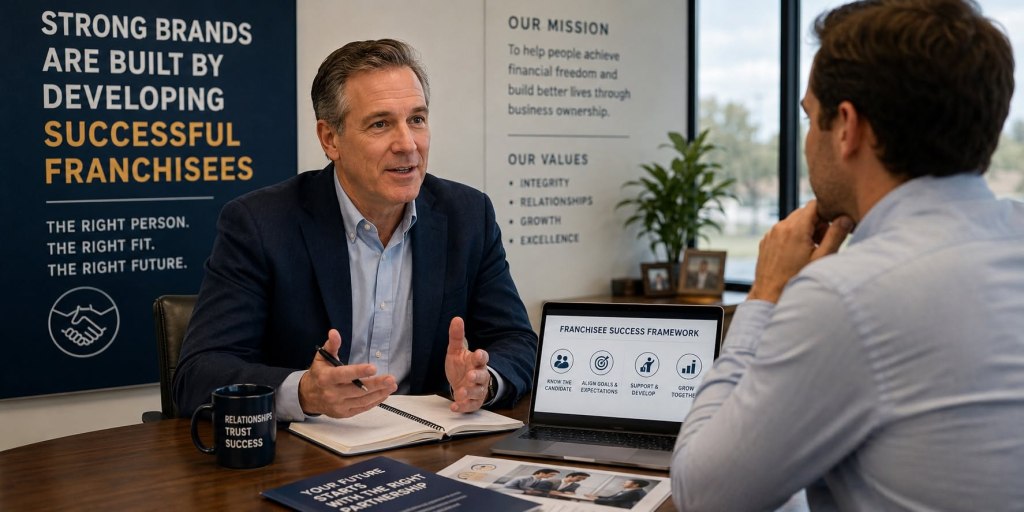
Successful franchise systems don’t simply develop franchises. They develop successful franchisees.

And that process begins long before a Franchise Agreement is ever signed.

Too often, franchise development is viewed primarily as a sales function. Conversations revolve around the brand… its history, operating systems, marketing, technology, training, support, financial performance, and growth plans. While all of those elements are certainly important, they should never overshadow the person sitting across the table.

Unlike selling an independent business, franchising creates a long-term partnership. A franchisor isn’t simply transferring ownership of a business. They are entrusting someone to represent their brand, protect their culture, follow their systems, and contribute to the long-term success of the franchise network.

That relationship deserves a much deeper level of discovery.

Every Franchise Candidate Defines Success Differently

Ask ten franchise candidates why they’re exploring business ownership, and you’ll likely receive ten different answers.

Some are pursuing financial independence.

Others want greater control over their careers and lifestyles.

Some are escaping corporate America.

Others are rebuilding after a layoff or career transition.

Some hope to build a business they can pass along to future generations.

Others simply want the security that comes with operating within a proven business model.

Understanding these motivations changes everything.

A candidate focused on immediate cash flow evaluates opportunities differently than one seeking long-term wealth creation.

Someone pursuing lifestyle flexibility thinks differently than someone intent on building a multi-unit organization.

If we don’t understand what success looks like to the candidate, we cannot determine whether our franchise system is truly the right fit.

Wishes, Hopes, and Dreams vs. Return on Investment

Over the years, I’ve found that most franchise candidates generally fall into one of two broad categories.

The first is the Wishes, Hopes, and Dreams candidate.

This individual is often motivated by personal aspirations. They may dream of becoming their own boss, leaving the corporate world, creating a family business, or pursuing a lifelong goal they’ve postponed for years.

For them, franchise ownership represents much more than an investment.

It represents freedom.

Purpose.

Independence.

A new chapter.

The second is the ROI candidate.

These individuals tend to be more analytical and financially driven. They carefully evaluate market conditions, unit economics, financial performance, scalability, competitive positioning, and long-term return on investment.

Neither candidate is better than the other.

They simply require different conversations.

Understanding which type of candidate you’re working with allows you to better guide the discovery process while helping determine whether your franchise system aligns with their expectations.

Understanding Risk Tolerance

Every franchise investment carries some degree of risk.

The real question is how much uncertainty the candidate is comfortable accepting.

Some candidates are excited by emerging brands where they can help shape the future of the system.

Others prefer mature franchise systems with established operating procedures, experienced leadership, and proven economics.

Some embrace opportunity.

Others prioritize predictability.

Understanding where candidates fall along that spectrum is essential to making successful franchise matches.

Owner-Operator or Executive?

Not every franchise candidate envisions the same role after opening.

Some want to operate the business every day.

Others prefer leading managers while focusing on strategic growth.

Some hope to build multiple locations.

Others seek semi-absentee ownership.

These ownership models require different support, different expectations, and sometimes even different franchise concepts.

Understanding the desired ownership style helps determine whether the candidate and the franchise system are truly compatible.

Looking Beyond Financial Qualifications

Financial qualifications are important.

They are not enough.

A candidate may possess significant liquidity and net worth but have little desire to lead employees, embrace the franchise system, or invest the personal commitment necessary for long-term success.

Conversely, another candidate may have more modest financial resources but possess tremendous leadership ability, operational discipline, resilience, and determination.

The strongest franchisees invest more than money.

They invest themselves.

Family, Partners, and Long-Term Vision

Franchise ownership rarely impacts only one individual.

Will a spouse be involved?

Will children eventually join the business?

Is there a business partner?

Is this intended to become a multi-unit operation?

Is this the beginning of a larger entrepreneurial journey?

These conversations often uncover opportunities and challenges that may never surface during a traditional franchise sales presentation.

Helping Candidates Visualize Success

Perhaps the most valuable thing a franchise development professional can do is help candidates visualize themselves as franchise owners.

Can they picture themselves leading employees?

Representing the brand in their community?

Following proven systems?

Growing additional locations?

Creating opportunities for their family?

One exercise I’ve found especially valuable is helping candidates build a practical ownership roadmap, not a formal business plan, but a vision for what success could realistically look like over the next three, five, and ten years.

Those conversations often reveal whether both parties are making the right decision before either makes a long-term commitment.

Final Thoughts

The best franchise development professionals do far more than award franchises.

They develop franchisees.

They understand people.

Behind every franchise inquiry is an individual or family pursuing opportunity, independence, financial security, personal fulfillment, or a better future.

When we take the time to understand a candidate’s motivations, goals, leadership style, financial expectations, risk tolerance, and long-term vision, we move beyond franchise sales and begin building stronger franchise systems.

Great franchise sales close deals. Great franchise development builds brands.

Successful franchise systems are not built by awarding the most franchises.

They are built by developing the right franchisees.

And that process begins long before Discovery Day.

It begins by truly knowing your franchise candidate.

Call to Action

Whether you’re an emerging franchisor preparing to award your first franchise or an established brand expanding nationwide, remember that franchise development is about far more than selling territories. It’s about identifying individuals who will represent your brand, uphold your culture, and contribute to your long-term success.

Slow down. Ask better questions. Listen more than you speak. Invest as much time in understanding your franchise candidates as you do presenting your opportunity.

The strongest franchise systems aren’t built one franchise sale at a time… they’re built one successful franchisee at a time.

If you’d like to discuss your franchise development strategy, candidate qualification process, or ways to improve franchisee selection and long-term success, I’d welcome the opportunity to have a conversation.

Let’s build stronger franchise systems by developing stronger franchisees.

Stop Acting Like a Five-Unit Franchise System

Many emerging franchise brands mistakenly believe key franchisor responsibilities can wait until they grow. In reality, the moment you franchise, even with just one or five units, you are accountable for providing structure, support, and leadership. These responsibilities don’t scale with size; they exist from day one.

The thinking often goes something like this: “We’re only at five units.” Or perhaps, “Once we get to twenty locations, we’ll put more structure in place.” The assumption is that sophisticated support systems, formal communication channels, franchisee coaching, field support, performance management, and strategic planning are things reserved for larger franchise organizations.

I disagree.

In my experience, the responsibilities of a franchisor are fundamentally the same whether the brand has five franchise units or fifty. The scale may be different. The expectations are not.

The moment a business owner decides to franchise, the role changes. They are no longer simply operating a successful business. They are now responsible for helping others replicate that success. That responsibility does not begin when the system reaches a certain size. It begins with the very first franchise agreement.

In fact, there is a strong argument that the first five franchisees may be the most important franchisees a brand will ever have.

Those early adopters are taking a leap of faith. They are investing in a vision more than a proven system. They are betting on leadership, support, and the promise of future growth. In many cases, they are helping shape the franchise system itself through their feedback, experiences, and willingness to navigate the inevitable challenges that come with an emerging brand.

What many franchisors fail to recognize is that future growth is often determined by the success of those first few franchisees.

Prospective franchise candidates will ask questions. They will want to know how existing franchisees are performing. They will ask about support, communication, training, and the overall relationship between franchisor and franchisee. They will seek validation from those already operating within the system.

If those first franchisees are thriving, they become powerful advocates for the brand. If they are struggling, frustrated, or disengaged, future growth becomes significantly more difficult.

Too often, emerging franchisors become consumed with franchise sales while unintentionally neglecting franchisee success. They focus on recruiting the next franchisee rather than supporting the franchisees they already have. Yet sustainable franchise growth has always been built upon a strong foundation of successful operators.

The reality is that growth rarely fixes problems. More often, growth exposes them.

Weak communication becomes weaker.

Inconsistent training becomes more apparent.

Operational gaps become larger.

Franchisee dissatisfaction becomes harder to contain.

Challenges that may seem manageable with a handful of locations often become magnified as the system expands.

That is why the strongest franchise organizations begin building infrastructure long before they appear to need it. They create systems, processes, and support mechanisms that allow them to scale effectively. They think ahead. They operate as the organization they intend to become, not simply the organization they are today.

For emerging franchisors, that means asking different questions.

Instead of asking, “What do we need right now?” perhaps the better question is, “What would we need if we doubled in size tomorrow?”

Instead of asking, “How do we sell more franchises?” perhaps the better question is, “How do we help our current franchisees become more successful?”

Instead of focusing exclusively on development, perhaps the focus should shift toward building a franchise system worthy of development.

Franchisees want more than a brand name and an operations manual. They want leadership. They want guidance. They want accountability. They want communication. They want confidence that their franchisor is invested in their success as much as they are invested in the brand.

That expectation exists whether there are five franchise units or fifty.

The brands that understand this early often establish a stronger foundation for long-term growth. They recognize that franchise sales and franchise support are not competing priorities. They are inseparable. One drives the other.

Perhaps the greatest irony in franchising is that many emerging brands spend enormous amounts of time and money trying to find the next franchisee while overlooking the tremendous opportunity sitting right in front of them. A successful, profitable, engaged franchisee is often the most effective franchise development strategy a brand can have. Strong franchisees create stronger validation. Stronger validation attracts stronger candidates. Stronger candidates create stronger systems.

The cycle begins with the first few franchisees.

At Acceler8Success America, we often discuss the importance of building businesses that can scale. For emerging franchisors, that conversation begins with a simple realization: the strength of a franchise system is not measured by the number of franchise agreements sold. It is measured by the success of the franchisees who have already placed their trust in the brand.

If you are an emerging franchisor with five franchise units—or even fewer—don’t fall into the trap of believing you can wait until you have fifty before acting like a true franchisor. The habits, systems, leadership, and support mechanisms you establish today will largely determine what your organization looks like tomorrow.

The reality is that many emerging franchisors know where they want to go but struggle with the practical realities of getting there. Building a franchise system that can scale requires far more than franchise sales. It requires leadership, infrastructure, accountability, communication, and an unwavering commitment to franchisee success.

Don’t wait until today’s challenges become tomorrow’s obstacles to growth.

Now is the time to take an honest look at your franchise system, your support structure, and your long-term growth strategy. You may discover opportunities, resources, and solutions that you have not yet considered.

At Acceler8Success America, we help emerging franchise brands strengthen their foundation, improve franchisee performance, enhance support systems, and develop scalable growth strategies designed for long-term success.

Your first franchisees are shaping your future every day. Their success, engagement, and satisfaction will influence your reputation, your ability to attract future franchisees, and ultimately the trajectory of your growth.

If you’re ready to explore new possibilities and discuss strategies for building a stronger franchise organization, I’d welcome the conversation.

Reach out to me directly at paul@acceler8success.com and let’s discuss how to turn your first five franchisees into the foundation for your next fifty.

Can Franchise Brands Still Achieve Explosive Growth in Today’s Market?

Explosive growth in franchising has always carried a certain mystique. It suggests momentum, demand, brand heat, and the kind of scalability that defines category leaders. But in today’s business climate where labor challenges persist, capital is more selective, and consumers are both value-driven and experience-focused—the question isn’t just whether explosive growth is possible. It’s whether it can be achieved responsibly, sustainably, and with intention.

The short answer is yes, a franchise brand can still achieve explosive growth. But not in the way many once imagined. The era of growth for growth’s sake is over. What replaces it is a more disciplined, structured, and deliberate approach… one that requires brands to earn their expansion rather than chase it.

The first reality is that explosive growth today must be built on strong unit economics. Without this, nothing else matters. A brand can generate interest, sign franchisees, and even open locations quickly, but if those units are not profitable, or at least predictably trending toward profitability, the system will fracture. Franchisees will struggle, validation will weaken, and growth will stall as quickly as it began. Today’s sophisticated franchise candidates are asking deeper questions. They want transparency. They want data. They want to understand not just the opportunity, but the risk. Brands that cannot confidently present this foundation will not sustain momentum.

That evolution in the franchise candidate is not new. It is something I first recognized back in 2008, when I stated that candidates were becoming more knowledgeable, more sophisticated, and more technologically advanced than ever before. At the time, that realization was eye-opening. It marked a shift in how brands needed to present themselves, how they needed to communicate, and how they needed to support their systems. Fast forward 18 years, and that shift has accelerated beyond what most could have imagined… assuming it is even fully recognized. Today’s candidates are not just informed; they are highly analytical. They research deeply, compare aggressively, and leverage technology in ways that fundamentally change the dynamic between franchisor and franchisee. Brands are no longer simply offering an opportunity; they are being evaluated with a level of scrutiny that demands precision, transparency, and credibility at every level.

Closely tied to this is operational infrastructure. Growth is not just about selling franchises; it is about supporting them. The brands that scale effectively are those that have invested early in systems, training, supply chain alignment, and field support. Without this, rapid expansion becomes a liability. Locations open, but consistency erodes. Customer experience varies. Brand integrity weakens. In today’s environment, where online reviews and social media amplify every misstep, inconsistency can do more damage than slow growth ever could.

Another critical factor is clarity of positioning. The market is crowded. Consumers have more choices than ever, and franchise candidates are evaluating multiple opportunities at once. A brand that hopes to grow quickly must stand for something distinct and relevant. It cannot be a slightly better version of something that already exists. It must be clearly understood, easily communicated, and consistently delivered. Whether that differentiation comes from product, experience, operational model, or target market, it must be undeniable.

Equally important is the quality of the franchisee. Explosive growth fueled by the wrong partners is one of the fastest ways to undermine a brand. The pressure to expand can lead to compromises in franchisee selection, but those decisions rarely age well. Strong brands are disciplined in awarding franchises. They look for alignment, capability, and commitment—not just capital. They understand that every franchisee is a steward of the brand, and that long-term growth depends on the collective strength of the system.

All that said, it raises a question that is becoming more relevant with each passing year: is there even a place in franchising today for the single-unit franchisee?

The answer is yes, but the role is evolving. The single-unit franchisee is no longer the default growth engine for most emerging or scaling brands. Instead, many franchisors are prioritizing multi-unit operators and area developers who bring capital, infrastructure, and experience. This shift is driven by efficiency, speed to market, and the ability to scale with fewer, more sophisticated partners.

However, to dismiss the single-unit franchisee would be a mistake. In many ways, they remain the backbone of franchising, particularly at the community level. Single-unit operators often bring a level of passion, local engagement, and hands-on ownership that is difficult to replicate at scale. They are deeply invested in their business, their team, and their customer base. They can be exceptional brand ambassadors.

Where the shift has occurred is in expectations. Today’s single-unit franchisee must operate with the mindset of a multi-unit operator, even if they only own one location. They must be disciplined, data-driven, and operationally sound. They must embrace technology, understand their numbers, and execute consistently. In other words, the bar has been raised.

For franchisors, the challenge is alignment. Not every concept is suited for single-unit ownership, and not every candidate is suited for multi-unit development. The most effective brands are those that clearly define their ideal franchisee profile and build their growth strategy accordingly. Some will lean heavily into multi-unit development to accelerate expansion. Others will intentionally cultivate strong single-unit operators in targeted markets to build density and brand integrity.

Capital strategy also plays a more nuanced role today. Access to funding still exists, but it is more scrutinized. Lenders and investors are looking closely at performance, leadership, and scalability. Brands seeking rapid expansion must be prepared to demonstrate not only their current success, but their ability to replicate it across markets. This often means having a thoughtful development strategy, targeting specific regions, building density, and avoiding overextension. The concept of “saturate, then scale” has never been more relevant.

Technology has also become a force multiplier. From POS systems and data analytics to digital marketing and customer engagement platforms, the right technology stack can accelerate growth by improving efficiency, enhancing the customer experience, and providing actionable insights. However, technology alone is not the answer. It must be integrated into the broader operational strategy and supported by proper training and execution at the unit level.

Brand storytelling and marketing cannot be overlooked. Explosive growth requires demand, not just from consumers, but from prospective franchisees. The brands that capture attention today are those that communicate a compelling narrative. They connect emotionally while delivering rational value. They show not only what they are, but why they matter. This is where public relations, content strategy, and social proof play a critical role in building credibility and momentum.

Perhaps the most overlooked element of explosive growth is leadership discipline. Growth introduces complexity. It tests systems, people, and decision-making. Leaders must be prepared to make difficult choices, to say no when necessary, and to protect the long-term integrity of the brand over short-term gains. This requires a mindset shift from chasing opportunity to curating it.

There is also an important distinction to be made between fast growth and explosive growth. Fast growth can be linear. Explosive growth suggests acceleration, often driven by a combination of strong fundamentals, market timing, and strategic execution. It is not accidental. It is engineered. And more often than not, it follows a period of deliberate preparation that may not appear “explosive” at all from the outside.

In today’s environment, the brands that will achieve this level of growth are those that embrace a paradox. They move quickly, but think long-term. They pursue scale, but prioritize stability. They generate excitement, but remain grounded in fundamentals. They are aggressive in vision, but disciplined in execution.

So yes, explosive growth is still possible in franchising. But it looks different. It is less about speed alone and more about alignment… alignment between economics, operations, brand, leadership, and franchisees. When those elements come together, growth can accelerate in a way that is not only impressive, but enduring.

And within that framework, both multi-unit developers and single-unit franchisees still have a role to play, provided they evolve with the expectations of the modern franchising landscape.

The brands that understand this will not just grow. They will define what growth looks like in the next era of franchising.

The question is, where does your brand stand today, and more importantly, where is it truly prepared to go?

If you’re evaluating growth, recalibrating your strategy, or questioning whether your brand is positioned for disciplined, scalable expansion, now is the time to take a step forward with clarity and intention. Let’s start the conversation. Connect directly with me to explore how your brand can build, scale, and accelerate the right way. My email is paul@acceler8success.com.

Building the American Dream Locally

Why Local Franchise Brands, clustering, and deliberate franchising will define the future of entrepreneurship.

There’s a hard truth in franchising that too often gets ignored: you don’t build a national brand first and hope it works locally… you prove it locally first, then earn the right to grow. And yet, across the industry, the instinct to scale continues to outpace the discipline to validate. It raises an uncomfortable but necessary question: Have we, in many cases, confused expansion with success?

Why is it that so many brands feel compelled to franchise before they have truly earned the right to do so? Why is growth still so often measured by the number of units sold rather than the strength of the markets built? Why do we continue to see systems introduced into franchising with limited operating history, incomplete infrastructure, and unproven economics, only to watch them struggle under the weight of their own ambition?

Developing as a local brand should not be viewed as a temporary stage on the way to something bigger. It should be the strategy. Not because it is easier, but because it is harder and because it forces the kind of discipline that sustainable growth demands. The alternative, launching into franchising with the expectation that the model will somehow refine itself across multiple markets, is not strategy at all. It is hope. And hope, no matter how well intentioned, has never been a substitute for execution.

The local-first approach changes the entire trajectory of a brand. It shifts the focus from expansion to establishment, from projection to proof, from vision to validation. It asks a brand to answer the questions that truly matter before asking others to invest in the answers. What actually drives revenue? Where do margins hold, and where do they break? What does it take to deliver a consistent customer experience day in and day out? How does the operation perform not once, but repeatedly, under real-world conditions?

These are not theoretical exercises. They are realities that can only be understood through time, repetition, and pressure. And that is where the concept of clustering becomes not just relevant, but essential. The goal is not to open as many locations as possible in as many places as possible. The goal is to build density within a market, to create presence, to become known. There is a profound difference between a brand that has one location in five cities and a brand that has five locations in one city. The former is visible. The latter is embedded.

And this leads to a question that challenges one of the industry’s most common assumptions:

Who says a brand must expand nationally to be successful?

Who cares if a brand doesn’t expand nationally if it is able to saturate a local market?

Is having 20 units scattered across 15 states better than having twenty across the Greater Houston Area?

Think about the ability to support those franchisees.
Think about the strength of brand awareness.
Think about marketing efficiency and local dominance.
Think about operational consistency and leadership accessibility.

And then think about what comes next.

Because once a brand truly owns a market, once it has built density, awareness, and operational strength, it is no longer guessing how to grow. It has a blueprint.

So what happens when that same model is taken from Houston to Dallas?

What happens when another 15 to 20 units are developed with the same discipline, the same clustering strategy, the same focus on saturation before expansion?

Isn’t that a far more powerful form of growth?

And can you get any more “local” than that?

When a brand builds in clusters, it accelerates learning in a way that scattered growth never can. Operational challenges are identified and addressed more quickly. Training systems are refined through repetition. Leadership is developed with intention. Marketing becomes more efficient, more targeted, more impactful. Most importantly, brand awareness begins to take hold. The business moves beyond being a place people try and becomes a place people return to, recommend, and rely on. It becomes part of the community

A Local Franchise Brand is not defined by how many units it has, but by how deeply it has penetrated its market. It is defined by whether the community recognizes it, trusts it, and supports it. It is defined by whether the operation performs consistently across multiple locations and whether the infrastructure exists to support continued growth without compromising quality. If those elements are not yet in place, then the question must be asked, why expand?

Too often, franchising is treated as a milestone, as if the act of franchising itself somehow validates the concept. But franchising is not validation. Validation comes first. It comes from building something that works, something that holds up under pressure, something that can be repeated with confidence. Only then does franchising become what it is meant to be, a multiplier of success, not a mechanism for discovering it.

This is where the transition from Local Franchise Brand to Emerging Franchise Brand truly occurs. It is not triggered by reaching a certain number of units or entering a certain number of markets. It happens when a brand has developed the strength, the systems, and the self-awareness to replicate itself intentionally. When it can take what has been built in one market and apply it, with discipline, to another. When it understands not just what it does, but why it works.

At that point, expansion is no longer a gamble. It is a strategy.

And in this moment, that strategy carries even greater significance. As we move into Q2 2026, we find ourselves just one quarter away from America’s 250th birthday. It is a milestone that, at its core, represents far more than history. It represents the spirit of entrepreneurship that has defined this country from the beginning, the belief that individuals can build something of their own, create opportunity, and contribute to their communities in meaningful ways.

But it also forces us to confront a difficult reality. Is that dream still as accessible as it once was? Or is it, as many have suggested, slipping out of reach?

Just yesterday, March 31, 2026, JPMorgan Chase announced its American Dream Initiative, an expansion of its commitment to local economic opportunity, with a goal of helping 10 million small businesses thrive. As Jamie Dimon stated, “The American Dream is alive, but it’s slipping out of reach for too many people—and for future generations.” That observation is not just economic. It is deeply entrepreneurial. Because access to business ownership, particularly at the local level, remains one of the most powerful pathways to restoring that dream.

And this is precisely where International Franchise Association’s Franchising Means Local Initiative takes on even greater importance.

Franchising has always been local, but the industry doesn’t always act like it.

Every franchise location is locally owned. Every franchisee is part of their community. Every unit creates jobs, supports local economies, and contributes to the neighborhoods they serve. The IFA’s initiative reminds us of that truth.

But Local Franchise Brands live it from the beginning.

They don’t just operate locally.
They are built locally.

And when they scale through clustering and disciplined expansion, they don’t lose that local identity—they replicate it, market by market.

This is where Acceler8Success America is leaning in with intention.

There is a continued push to elevate Local Franchise Brands, to support local business growth, and to drive a resurgence of economic activity across Small Town USA. But just as importantly, there is a focus on strengthening brands before they scale.

Because what happens if a brand expands before its culture is clearly defined?
What happens if marketing lacks clarity and consistency?
What happens if sales are not driven by strategy?
What happens if profitability is not fully understood?

These are not minor issues. These are the fault lines where brands break.

Acceler8Success America is committed to helping local brands solidify their foundation, building the right culture, refining marketing to drive awareness and engagement, strengthening sales through disciplined execution, and improving profitability at the unit level.

Because growth does not fix weaknesses.
It magnifies them.

But when a brand gets this right locally, when it builds strength within a market, it creates something entirely different.

It creates a model that can be repeated.

So what if the industry shifted?

What if more brands focused on owning a market before entering the next?
What if franchising became the result of discipline, not the pursuit of it?
What if Local Franchise Brands became the standard?

Local Franchise Brands represent the American Dream in its most authentic and accessible form. They are built by individuals and families who take risks, who commit to their communities, who learn through doing. They are proven not through projections, but through performance. And when they are developed with intention through clustering, through discipline, through a relentless focus on getting it right, they create a foundation that can be scaled without losing what made them successful in the first place.

Each new market becomes more than expansion.
It becomes an extension of the American Dream.

So the question remains: Are we building franchise systems for growth, or are we building them for longevity?

Because those are not always the same thing.

Local should not be where a brand starts because it has to. It should be where it starts because it is the most effective way to build something that endures. Build locally. Develop clusters. Earn awareness. Prove the model. Strengthen culture. Refine marketing. Drive sales. Improve profitability. Then—and only then—scale with intention.

That is how Local Franchise Brands evolve into Emerging Franchise Brands.
That is how we align with Franchising Means Local not just in message, but in practice.
That is how we practice deliberate franchising.
And that is how we accelerate the American Dream.

If you are exploring franchise development or refranchising, or questioning whether your brand is truly ready to grow, now is the time to take a disciplined approach, one that aligns national ambition with local execution. At Acceler8Success America, the focus is clear: take what is often approached broadly at a national level and hyper-focus it locally, building real strength before scaling, while strengthening culture, elevating marketing, driving sales, and improving profitability where it matters most.

Start the conversation at paul@acceler8success.com.

A Case for Multi-Brand Franchising: The Evolution of a Franchisee Into an Entrepreneur

There is a point in franchising where the narrative shifts. It is subtle at first, almost imperceptible, but once it happens, everything changes.

The operator who once followed a system begins to think beyond it. The individual who once executed begins to build.

This is not accidental. It is the natural progression of a franchisee who has moved beyond a single unit, beyond a single brand, and into something more deliberate.

This is the evolution of a franchisee into an entrepreneur.

At the single-unit level, even for the most capable operators, the role is largely defined. You are executing a proven model. You are managing people, controlling costs, delivering a product or service consistent with brand standards. Success is measured in operational excellence. Discipline matters. Consistency matters. But the ceiling, while often attractive, is still defined by the box you operate within.

Multi-unit ownership begins to stretch that ceiling. It introduces leverage. It forces the operator to move from working in the business to working on the business. You can no longer be everywhere. You can no longer make every decision. You begin to build infrastructure. You develop leaders. You create systems within the system.

At this stage, many believe they have arrived as entrepreneurs.

In reality, they have only begun the transition.

The true inflection point occurs when a franchisee moves beyond a single brand.

Multi-brand franchising changes the game entirely.

Now, you are no longer simply scaling a model. You are allocating capital across different models. You are comparing performance across brands, across dayparts, across customer segments. You are evaluating not just how to run a business, but which business to run.

That is entrepreneurship in its purest form.

A multi-brand operator begins to think like a portfolio builder.

One concept may dominate breakfast and lunch. Another may win in dinner and late-night. One brand may deliver high margins with lower volumes. Another may drive top-line revenue with tighter margins but stronger brand equity.

The entrepreneur sees how these pieces fit together, not as isolated businesses, but as a coordinated strategy.

Real estate decisions become more sophisticated. Site selection is no longer about the next location, but about market coverage, brand adjacency, and cannibalization avoidance. Talent development evolves from store-level management to organizational design. Capital allocation becomes intentional. Growth is no longer about adding units. It is about building value.

And perhaps most importantly, risk is reframed.

A single-brand, even multi-unit operator, is exposed to the fortunes of that one brand. Brand missteps, changing consumer preferences, or shifts in unit economics can have a material impact.

The multi-brand entrepreneur diversifies that risk. Not recklessly, but deliberately. They understand that no brand is immune to cycles. They build accordingly.

This is where mindset separates operators from entrepreneurs.

The operator asks: How do I run this brand better?

The entrepreneur asks: Where should I deploy capital next, and why?

The operator focuses on execution.

The entrepreneur focuses on strategy, structure, and long-term value creation.

None of this diminishes the importance of operational excellence. In fact, it amplifies it. A multi-unit, multi-brand portfolio only works if each unit performs. But the center of gravity shifts. The business is no longer defined by a single set of operating standards. It is defined by the decisions made above them.

There is also a leadership evolution that cannot be overlooked.

In single-unit and early multi-unit operations, leadership is often proximity-based. The owner is close. Present. Involved.

In multi-brand environments, leadership becomes cultural. It must scale without constant presence. It must be taught, reinforced, and lived through others. This requires intentionality. It requires clarity. It requires a willingness to let go of control in order to gain scale.

Many franchisees aspire to own more units. Fewer are prepared to think across brands. Fewer still are willing to accept the responsibility that comes with it.

Because with multi-brand ownership comes a different level of accountability.

You are no longer just a steward of a brand.

You are a builder of an enterprise.

That is the distinction.

Franchising provides the pathway. It offers the model, the systems, the support. But entrepreneurship emerges when the individual begins to make decisions that shape outcomes beyond a single brand’s framework.

Multi-unit ownership teaches scale.
Multi-brand ownership teaches strategy.

And at that intersection, the franchisee becomes something more.

Not by title, but by behavior.
Not by aspiration, but by action.

An entrepreneur.

If you’re a multi-unit operator beginning to think beyond a single brand, or a franchisor evaluating how your best operators evolve into multi-brand groups, this is where the conversation changes.

Growth is no longer about adding locations. It becomes about structure. Alignment. Intentional expansion. Long-term value creation.

And most importantly, making the right decisions before you scale further.

If you’re navigating that shift—or preparing for it—let’s start a conversation. Reach out to me at paul@acceler8success.com.

Growth Without Structure Is Not a Strategy: Rethinking Franchise Development

Franchise development is not a sales goal. It is not “we want to sell 15 units in the next 12 months.” That statement is a wish. It may be an aspiration. It may even be a board-level mandate. But it is not a strategy.

If franchise development is not integrated into the broader business plan of the brand, it becomes expensive guesswork. And guesswork in franchising is one of the fastest ways to create brand damage that takes years to unwind.

Franchise development must begin with a far more uncomfortable question than “How many units do we want to sell?” The real question is, “How many units should we sell, in which markets, with what profile of operator, supported by what infrastructure, and at what pace that protects unit economics and franchisee performance?”

Growth without alignment is not growth. It is exposure.

The Development Plan Must Be Anchored to the Business Plan

If a brand’s three-year business plan calls for strengthening supply chain efficiencies, building regional density in two priority markets, and improving average unit volumes by 8%, then the franchise development plan must directly support those objectives.

Development cannot live in isolation from operations, training, marketing, real estate, and field support. If you sell 15 units into markets where you have no operational infrastructure, you have not accelerated the brand. You have stretched it.

Every development plan should answer:

Where are we growing geographically and why?

Do we have the operational support structure in place for that growth?

Is our supply chain ready for increased volume?

Can our training department onboard the number of franchisees we intend to award?

What does growth do to our existing franchisees’ territories, performance, and morale?

If development is outpacing support, the math will catch up with you.

Understanding the Numbers Is Not Optional

Franchise development is a funnel. A measurable, trackable, predictable funnel.

If you do not know how many raw leads convert to qualified candidates, how many qualified candidates convert to Discovery Day attendees, how many Discovery Days convert to awards, and how many awards actually open, you are not managing development. You are hoping.

Let’s say historically you know:

1,000 raw leads
300 qualified conversations
75 serious candidates
25 Discovery Days
10 franchise agreements
8 openings

That is a 0.8% lead-to-opening ratio.

If your goal is eight openings in the next 12 months and your historical performance holds, you need approximately 1,000 quality leads. Not impressions. Not clicks. Leads.

Now the next question becomes: what does it cost to generate 1,000 qualified leads?

If your blended cost per lead is $125, that is $125,000 in lead generation investment before factoring in internal development team compensation, CRM systems, travel, legal, and onboarding costs.

If you do not understand this math, your “15 units this year” target is not a plan. It is a number written on a whiteboard.

Not All Lead Sources Are Equal

Another mistake brands make is assuming that one lead source behaves the same as another.

Portal leads may convert at one rate. Expo leads at another. Referral leads from existing franchisees at a much higher rate. Broker networks at yet another. Social media may not convert directly at all, but it may increase credibility and lower friction at later stages of the funnel.

For example:

Expo leads may be fewer in volume but higher in intent.
Portal leads may be high in volume but lower in qualification.
Referral leads often have the highest closing ratios.
Broker-referred candidates may close faster but at higher commission cost.

Social media, PR, and thought leadership content may not produce measurable leads immediately, but they strengthen brand perception, which improves conversion across the entire funnel.

A development strategy must identify:

Which channels generate volume
Which channels generate quality
Which channels support credibility
Which channels reduce overall acquisition cost

Each channel has a role. None should be arbitrary.

Development Is Also a Financial Model

Too often, money is thrown at franchise development because “we need to sell X franchises by X date.”

That mindset is dangerous.

Franchise development must be budgeted like any other investment initiative. If your franchise fee is $45,000 and your average total development cost per award is $18,000, you must determine whether your net economics support reinvestment into brand infrastructure.

Selling franchises to fund operations is not a long-term strategy. It is a short-term survival tactic that erodes brand integrity.

Development revenue should support:

Operational field support expansion
Training capacity
Marketing infrastructure
Technology systems
Leadership depth

If franchise fee revenue is being used to plug operational losses, growth will eventually expose structural weaknesses.

The Impact on Existing Franchisees

Every franchise awarded changes the system.

Existing franchisees are watching. They evaluate new development based on three silent questions:

Will this strengthen the brand?
Will this dilute my territory or my sales?
Will corporate still support me with the same intensity?

If development outpaces performance, current franchisees lose confidence. When that happens, validation weakens. And when validation weakens, development slows.

The healthiest franchise systems grow in a way that improves franchisee economics. New units create brand awareness, increase regional advertising efficiency, improve supply chain leverage, and create multi-unit operators who understand the system.

But poorly planned growth creates cannibalization, operational strain, and cultural dilution.

Development must protect the ecosystem.

Territory Strategy and Profile Discipline

Another common failure is awarding franchises to anyone with a checkbook.

Development must define the ideal operator profile. Not just financially qualified, but culturally aligned and operationally capable.

Are you seeking owner-operators?
Multi-unit developers?
Semi-absentee investors?
Strategic regional operators?

Each requires different onboarding, different support structures, and different performance expectations.

Territory strategy matters just as much. Growth should create density. Density reduces marketing cost per unit, improves operational efficiency, and strengthens brand awareness.

Scattered growth across isolated markets may generate franchise fees, but it rarely creates long-term system strength.

Support After the Sale

Awarding a franchise agreement is not success. Opening successfully and achieving unit-level performance benchmarks is success.

Your development plan must be aligned with your onboarding capacity. If you award 20 units but can only properly support 10 openings, your pipeline becomes congested and franchisee frustration builds.

Field support ratios matter. Training schedules matter. Real estate timelines matter.

Development should be paced according to operational readiness, not optimism.

Development Must Be Deliberate

Franchise development is not about selling. It is about building.

It requires:

Clear geographic priorities
Defined operator profiles
Documented funnel metrics
Understood cost per lead
Blended channel strategy
Infrastructure readiness
Alignment with financial objectives
Respect for existing franchisees

When development is deliberate, growth compounds. When it is reactive, growth destabilizes.

Franchise brands that succeed long term treat development as a strategic discipline. They understand the math. They respect the operational realities. They align growth with infrastructure. They protect franchisee economics.

Planning must be more than wishes, hopes, and dreams.

It must be anchored in numbers, supported by structure, and integrated into the entire enterprise.

Because in franchising, growth is not the objective.

Sustainable, profitable, system-wide performance is.

Have you built a development strategy or simply set a sales goal? If this all sounds uncomfortably familiar, it may be time to reassess your development strategy.

Franchise development should be engineered, not improvised. It should be grounded in numbers, supported by operational capacity, aligned with your long-term valuation objectives, and protective of existing franchisees.

If you are ready to pressure-test your development funnel, clarify your cost-per-lead economics, align growth with infrastructure, and build a strategy that supports sustainable performance, let’s have that conversation.

Reach out directly at paul@acceler8success.com and let’s discuss how to move from selling franchises to building a system worthy of scale.