Tag: Social Media

What is Your Social Media Marketing Strategy?

The following was my response to a business executive that posted the following discussion on LinkedIn in a non-franchise group:

How are you and your business using social media to drive business and gain awareness? With the social media landscape becoming increasingly fragmented and complicated, how are you managing to gain the most from this medium?

“All of my clients are within the franchise industry which is a more difficult environment in which to effectively utilize social media because there are different elements to the relationship between franchisor, franchisee and customer as opposed to just B2B or B2C. That being said, it can and is being done quite effectively. However, it takes a very concentrated focus, or as I fondly describe as [E-IDEA], the acronym for franchisEssentials five step process to social media success:

social media types1. Exploring different aspects of Social Media, including Social Networking and key Web 2.0 technology that creates excitement and brand awareness within your industry segment.
2. Identifying primary and secondary targets – Who will be targeted to purchase and/or visit your franchise locations? How deep do the target groups go and are there collateral groups that can be tapped?
3. Developing a Strategy and Plan of Action – Customized to specific targets in accordance with franchise development goals and objectives?
4. Executing the Plan – Putting the plan in motion including monitoring, managing the process including new content and updates. Keep it fresh!
5. Analyzing & Quantifying the Results – Is it working? Do you continue straight ahead or repeat the process from the beginning? What are actual results in franchise sales and system revenue?

Yes, there are many aspects of social media and more being added every day. That doesn’t mean it’s being fragmented. Instead, it’s providing more tools in which to cross-reference and link together. Unlike traditional marketing that is more or less a straight line, social media marketing, used most effectively, is a cross-platform, multi-tiered strategy that uses multiple Web 2.0 tools to cross in front of the targeted audience multiple times and from different directions.

It’s akin to the businesses with limited marketing budgets that only advertise on TV once or twice a month, at one specific time but on multiple channels simultaneously. Then, when the consumer changes the channel upon seeing the commercial, again and again, the perception is “this business is everywhere and must be spending a fortune on advertising. Therefore, it must be good.”

Unfortunately, social media marketing is not a one-size-fits-all strategy. The strategy must conform to the organization’s goals and objectives and must target the appropriate audience by the appropriate means (Web 2.0 tools). For instance, if the target is young adults age 15-18, MySpace would be an essential component of your strategy. Couple that with a lot of video and audio, as this age group gets bored very easily.

On the other hand, if the targets are businesses in the insurance industry, your strategy might include developing a blog for industry professionals and then linking the same through LinkedIn to insurance groups. Simultaneously, you may develop a Facebook page to refer interested parties to visit and/or join.

A key factor in an effective social media strategy is to be sure to integrate the same with your traditional marketing. As an example, if your company frequently uses direct mail, be sure to include the company’s various social network links, blog links, etc. In a B2B environment, do the same with your blast email campaigns. And, in a corporate environment where you may be attempting to attract a consulting client, personalize your traditional strategy with social network interaction and enhance it with video and audio messages.”

Now that you have read this article, I’ll ask you straight up, “What is your social media marketing strategy?”


Bookmark and Share

Is The Internet Super Highway Destined to Become a Toll Road?

Could the the flow of traffic on the internet frequently slow down or come to a stop like traffic on I-95 during rush hour? Will the internet continue to be a free digital highway or will it turn into a turnpike of sorts, complete with tolls and speed limits? What’s next, internet troopers giving out speeding tickets? To learn more I suggest you read the following article and keep an eye on the mighty Federal Trade Commission Board, consisting of only five people, that is the ultimate decision-maker. However, I cringe at the thought that just three decision-makers (majority vote) can control the future of internet traffic. God, I hope they value the internet as much as I do…
FCC at Crossroads of Internet’s Future
By David Hendricks, San Antonio Express-News

When a federal appeals court in Washington ruled last month that the Federal Communications Commission lacked the authority to regulate Internet networks, many operators thought at first it was great news.

The networks could continue to grow in size, flexibility and applications as fast as they had the past 15 years or so without government interference.

Then the networks realized the court ruling could backfire. The FCC has the option to reclassify Internet networks. The agency could declare the networks a public utility and then regulate them with rules similar to landline telephone services.

All it would take is a majority decision of the five-member FCC board.

If you care about the future of Internet speeds and accessibility, then you should watch what the FCC does next.

The FCC wants to stick to a good, but ultimately harmful, goal called net neutrality. Net neutrality calls for equal access to all websites, which restricts network operators, such as AT&T Inc. and cable companies, from favoring some website traffic over others with better access.

Large-traffic websites such as Google, eBay and YouTube favor net neutrality. They pay the same low rate for Internet network access as the smallest users.

The FCC tried to stick to the net neutrality concept with a hands-off approach. The agency two years ago, however, slapped sanctions on Comcast after the cable giant slowed traffic to BitTorrent, a file-sharing site that used a vast amount of broadband capacity at the expense of other Internet users.

The federal appeals court said March 6 the FCC never gave itself the authority to issue sanctions.

Now the network operators fear the FCC will give itself the authority. They have a solid concern.

READ MORE HERE


Bookmark and Share
l

Squeezing ROI From Social Media Marketing

Recently, Christopher Petix, President at Clash-Media US wrote an article about the changing world of Digital Marketing and how it would evolve in 2010. The article, The World of Digital Marketing 2.0, touches upon how brands utilizing social media marketing must establish baselines and understand metrics as part of their social media marketing strategy Doing so is paramount to their marketing success.

The past couple of years have been all about squeezing as much Return on Investment as possible from every marketing effort. As a result, advertisers and marketers have a new set of parameters and broad goals for establishing a campaign. The good news for these groups is that there are a number of tools and techniques available to help them achieve these goals.

He goes on to talk about how brands are partnering up with digital marketers and focusing efforts on evaluating their campaigns. Doing so helps them achieve optimum efficiency as they can turn on a dime if they’re need achieving their goals and objectives. Sure, conversion rates will fluctuate during a campaign, but quick reactions can improve the campaign’s performance.

Another point Petix makes is about niche websites and networks. As today’s consumer (and franchise candidates) are more technologically advanced and social media savy, more time is being spent outside the realm of typical social media circles of Facebook, LinkedIn and Twitter. Instead, being more diligent is more the norm rather than the exception. Diligence that takes marketing targets to industry sites, brand-specific social networks and blogs to gather even more information. More importantly, it takes them to places of interaction and information sharing between and among others with similar goals and objectives.

Using Social Media as written by Christopher Petix

Burger King’s “Sacrifice Whopper” was one of the most infamous campaigns of 2009 to have created a social media buzz. One of the biggest on-going hot spots for 2010 will be how can more companies tap into the vast resource of social media.

Social media accurately gauges consumer brand perception and sentiment, though the avenue for more direct marketing and advertising opportunities is harder to navigate. The key to using social media for marketing and customer acquisition is targeting, which helps ensure that the highly coveted user experience is not affected.

Individual organizations can use several approaches to identify customers through social media, they include: post-registration offers, banner advertising, Facebook CPC or social media apps. All of these ensure consumer exposure, but which ones deliver measurable and effective results is individual to every organization. Those advertisers that have learned what they need to look for in a campaign should be a step ahead as they explore new avenues of customer engagement – so by the end of 2010, most will have a coherent social media strategy producing bottom line dollars.

Christopher Petix serves as the President of Clash-Media working in the US office. With over 15 years of online experience he brings a wide variety of knowledge working at company’s including Double-Click Media in the start-up, founding his own tri-lingual travel site, heading up Vendare Media’s team on the East coast, as well as CoregMedia. His emphasis on client services and retention have allowed him to cultivate numerous longstanding business relationships in the online advertising industry.


Bookmark and Share

Social Media Enhances Email Marketing

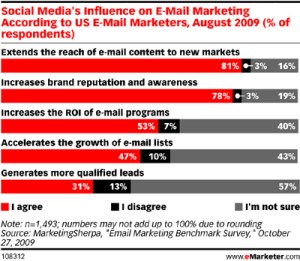
In 2009, e-mail marketers started to get social, but 2010 will be the year social media makes e-mail marketing more powerful, according to eMarketer.

Social media is a partner, not a threat, to e-mail marketing because it provides new avenues for sharing and engaging customers and prospects.

Even though people are spending more time using social media, they are not abandoning e-mail. The two channels can help each other, offering the opportunity for marketers to create deeper connections.

Source: Adweek


Bookmark and Share

Social Media, Web 2.0 and Internet Stats: Astonishing, to say the least!

The following social media, Web 2.0 and internet statistics were recently posted on The Future Buzz.

Google search stats:

1,000,000,000,000 (one trillion) – approximate number of unique URLs in Google’s index (source)

2,000,000,000 (two billion) – very rough number of Google searches daily (source)

$110,000,000 – approximately amount of money lost by Google annually due to the “I’m Feeling Lucky” button (source)

24,400 – number of people employed by Google (December, 2008)

68,000,000 – the average number of times people Googled the word Google each month for the last year (source:  keyword tool)

$39.96 – the average cost per click for the phrase “consolidation of school loans” in AdWords (source:  keyword tool)

1,430,000 – the number of Google results for “Robert Scoble”

136,000 – the number of Google results for “Admiral Ackbar”

Wikipedia stats

2,695,205 – the number of articles in English on Wikipedia

684,000,000 – the number of visitors to Wikipedia in the last year

75,000 – the number of active contributors to Wikipedia

10,000,000 – the number of total articles in Wikipedia in all languages

260 – the number of languages articles have been written in on Wikipedia

(source)

YouTube stats

70,000,000 – number of total videos on YouTube  (March 2008)

200,000 – number of video publishers on YouTube (March 2008)

100,000,000 – number of YouTube videos viewed per day (this stat from 2006 is the most recent I could locate)

112,486,327 – number of views the most viewed video on YouTube has (January, 2009)

2 minutes 46.17 seconds – average length of video

412.3 years – length in time it would take to view all content on YouTube (March 2008)

26.57 – average age of uploader

13 hours – amount of video are uploaded to YouTube every minute

US $1.65 billion in Google stock – amount Google Inc. announced that it had acquired YouTube for in October 2006

$1,000,000 – YouTube’s estimated bandwidth costs per day

(sources here, here and here)

Blogosphere stats

133,000,000 – number of blogs indexed by Technorati since 2002

346,000,000 – number of people globally who read blogs (comScore March 2008)

900,000 – average number of blog posts in a 24 hour period

1,750,000 – number of RSS subscribers to TechCrunch, the most popular Technology blog (January 2009)

77% – percentage of active Internet users who read blogs

55% – percentage of the blogosphere that drinks more than 2 cups of coffee per day (source)

81 – number of languages represented in the blogosphere

59% – percentage of bloggers who have been blogging for at least 2 years

source

Twitter stats

1,111,991,000 – number of Tweets to date (see an up to the minute count here)

3,000,000 – number of Tweets/day(March 2008) (from TechCrunch)

165,414 – number of followers of the most popular Twitter user (@BarackObama) – but he’s not active

86,078 – number of followers of the most active Twitter user (@kevinrose)

63% – percentage of Twitter users that are male (from Time)

Facebook stats

200,000,000 – number of active users

100,000,000 – number of users who log on to Facebook at least once each day

170 – number of countries/territories that use Facebook

35 – number of different languages used on Facebook

2,600,000,000 – number of minutes global users in aggregate spend on Facebook daily

100 – number of friends the average user has

700,000,000 – number of photos added to Facebook monthly

52,000 – number of applications currently available on Facebook

140 – number of new applications added per day

source

Digg stats

236,000,000 – number of visitors attracted annually by 2008 (according to a Compete survey)

56% – percentage of Digg’s frontpage content allegedly controlled by top 100 users

124,340 – number of stories MrBabyMan, the number one user, has Dugg (see updated number here)

612 – number of stories from Cracked.com that have made page 1 of Digg (see all 41 pages of them here)

36,925 – number of Diggs the most popular story in the last 365 days has received (see story here)

Even more web 2.0, social media and internet stats, facts, figures and numbers:

Blogging Stats, Facts And Data:  2009 Blog Statistics By The Numbers

Future Marketing Trends:  By The Numbers

Internet Marketing Tactics – What’s Hot And What’s Not


Bookmark and Share

Males vs Females in Social Media: A Change in Tide?

The following was posted on the Online Media Gazette site about a recent survey that indicates the tide is changing when it come to social media usage by men and women. I found the most interesting fact is that women are still ahead in embracing and using the more mainstream social media such as Facebook and Twitter whereas the men seem to be more interested in the lesser-known, and possibly more complicated social media such as Slashdot which boasts itself as, “News for Nerds. Stuff that Matters.”

According to Liberty Mutual’s latest survey, they found that men embrace and use social networking sites much more than women do. Men are more active in social media “across the board” according to the survey.

The national survey was part of the firm’s Responsibility Project where they hope to give an insight to what people think are responsible ways to use social networking technologies at work, school and in relationships.

The results showed that 57% of men are more likely than 50% of women to have more than one social networking account on websites such as Facebook and Twitter. On top of that, 51% of men find it reasonable for their boss to tweet about their company compared to 37% of women.

The results are so much different from Pingdom’s survey done on November 2009. Before that, the ratio between male and female demographics in social networks was 47% and 53% respectively. Here’s a chart from the site to review the past statistics. (Make note: the chart is of PAST statistics, not of the current survey. Go figure…)


Bookmark and Share

The Many Faces of Social Media

Many within business circles, including franchising, initially believe social media is only LinkedIn, Facebook and Twitter and have a difficult time grasping the many other forms of social media that are alive and well. Certainly, very valuable resources when integrated with each other and then integrated with (and within) traditional marketing. The following is an excerpt from Wikipedia.com that includes links to various Wikipedia pages relating to the many different forms of social media.

Social media can take many different forms, including Internet forums, weblogs, social blogs, wikis, podcasts, pictures, video, rating and social bookmarking. Technologies include: blogs, picture-sharing, vlogs, wall-postings, email, instant messaging, music-sharing, crowdsourcing, and voice over IP, to name a few. Many of these social media services can be integrated via social network aggregation platforms like Mybloglog and Plaxo.

Examples of social media software applications include[citation needed]:

Communication
Collaboration
Multimedia
Reviews and opinions
Entertainment
Other


Bookmark and Share

Social Media Marketing Tracking Tools

1) http://BackTweets.com : A search engine for Twitter. See who’s tweeting your links and more. Can also sign up for email alerts of new findings.

2) http://Addictomatic.com : A little different than the others , you type in a keyword, topic or phrase and out it goes searching the top blogs, news sites, Google, Technorati, Ask, YouTube, Flickr, Digg, Topix and more. You’ll be given a personalized results page to bookmark with everything it finds related to your topic.

3) http://Buzzoo.net : All about Internet buzz, it tracks several different websites to bring you what’s “hot” right now.

4) http://Surchur.com : Search for the latest and greatest on topics that are popular right now. Type in a keyphrase and it searches blogs, social news sites, photo and video sites for your chosen topic.

5) http://Commentful.Blogflux.com : This service watches for comments on blog posts, Digg, Flickr, and others and notifies you of any findings.

6) http://AlertRank.com : A better way to organize and sort Google alerts. Get a daily report emailed to you in a spreadsheet format of what it finds.

7) http://BoardTracker.com : A search engine for forums only. Monitor discussion boards and be notified by email when a thread matching your search terms is discovered. Free to use.

8) http://www.google.com/alerts : I’ve been using this “secret weapon” for years. Simply type in your name or company name and receive daily emails of results found. They do the work, you receive the links. Free and nice.

9) http://BrandsEye.com : An online reputation management tool with a real-time, concise overview of your online reputation. Multiple levels of services and pricing available. Starting at $1.00.

10) http://Twazzup.com : Another Twitter only search engine.

11) http://SiteMention.com : Type in your url and find out what’s being said about you. The results returned are gathered from Google Blog Search, Twitter, FriendFeed, YouTube, MySpace, Digg, Delicious and many more.

12) http://Brandwatch.net: This service tracks your brands, companies, even the competition. Sign up for free weekly updates on any brand. Their detailed reports break down what sites like you, your most talked about features, weekly summary of all blogs and forum activity. Very similar to the old “press clipping” service.

13) http://Trackur.com : A tool that scans many websites including blogs, news, image and video sites, forums and notifies you of any mention of your brand, products/services. Easy to use and affordable. Prices vary depending on need, a personal account is only $18.00 a month, corporate account $88.00 a month with other options also available. Try a “personal” account free for 14 days.

14) http://FiltrBox.com : This one searches online news sources, Twitter and others to find out what’s being said about you or your company. Pricing is based on the number of users, but there is a free version that provides “5 filters” and 15 days of what they call “article history”.

15) http://SocialMention.com/alerts : Just like Google Alerts but for social media. Enter your keyword phrase and email address to be notified of any new findings. Searches blogs, microblogs like Twitter, bookmarks, comments, events, images, news, videos and more.

16) http://BlogPulse.com : A search engine that searches only for data posted to blogs. Enter your keyword, hit submit and off it goes to gather results.

17) http://BackType.com : Billing itself as a “conversational search engine” they index millions of conversations from social networks, blogs and other social media.

18) http://sm2.techrigy.com : Industry insiders claim this to be the leading social media monitoring solution online. Choice of free or paid version. Free is limited to five searches and 1,000 results. There are three paid professional levels: Gold, Diamond, or Platinum.

19) http://ReputationDefender.com : This paid service finds out everything there is to know about you online, and if negative information is found they try to have it removed. Different types of plans are available such as “My Reputation”, “My Privacy”, starting at only $14.95 a month.

20) http://Topsy.com : Topsy will track your tweets that have been retweeted so you can find out who’s been sending you all that “link love”. Type in your Twitter user name and you’ll be amazed at what you find.

Originally posted on AddMe.com


Bookmark and Share

Forrester Research Projects Increase in Social Media Marketing Budgets

Social Media Marketing Spending to Hit $3.1 Billion by 2014
As originally posted on Mashable.com

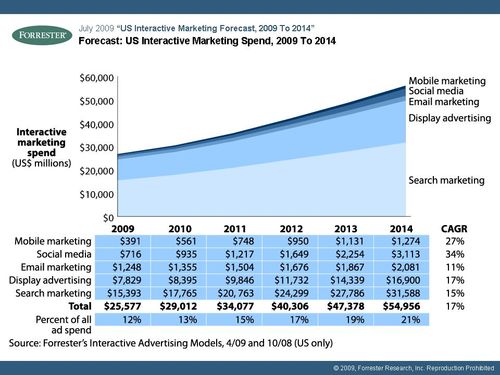
We already knew that social media marketing budgets were on the rise, but now we know by how much. Forrester Research is out with their Interactive Marketing Forecast for the next five years, and estimates social media marketing to grow at an annual rate of 34 percent – faster than any other form of online marketing and double the average growth rate of 17 percent for all online mediums.

Of course, social media is starting from a smaller base. Forrester estimates that $716 million will be spent on the medium this year, growing to $3.1 billion in 2014. At that point, social media will be a bigger marketing channel than both email and mobile, but still just a fraction of the size of search or display advertising ($31.6B and $16.9B, respectively).

Not surprisingly, some of this growth comes at the expense of offline advertising. Forrester estimates that online advertising will grow from 12 percent of total marketing spend this year to 21 percent by 2014, meaning that offline ad spend will fall. In fact, Forrester concludes that “overall advertising budgets will decline,” meaning efficiencies are being had by shifting money to the Web.

In any event, it’s hard to argue that the numbers don’t paint a fairly rosy picture for the future of social media marketing.


Bookmark and Share

Social Media Activity Adds to Real-Time Search Results

Google Adds a Real-Time Wrinkle
As reported in Website Magazine

Beginning in early December 2009, Google took another giant leap by releasing Real-Time Search Now, for some queries, the first page of results shows a scrolling box with real-time search results – many of which come from users’ social updates and content. Real-Time Search has major implications and further alters the SEO landscape.

Read more about this important news and how it affects SEO at Website Magazine.

Check out this Google YouTube Video


Bookmark and Share