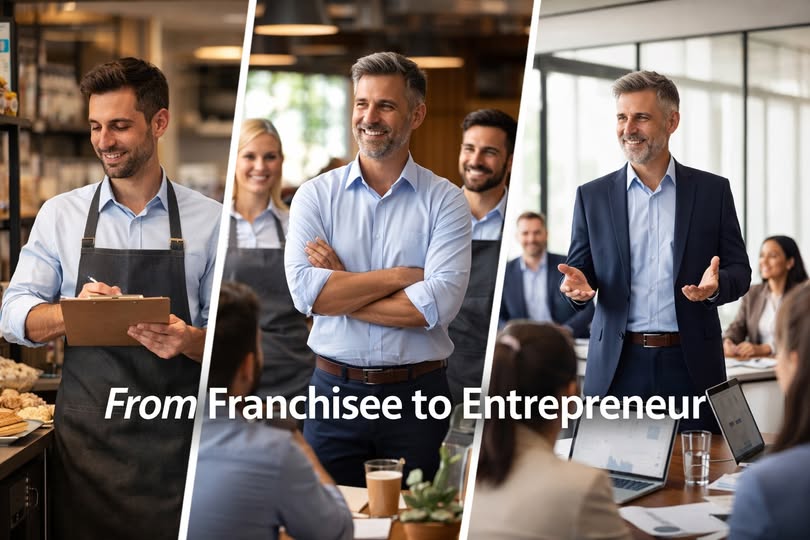
There is a point in franchising where the narrative shifts. It is subtle at first, almost imperceptible, but once it happens, everything changes.
The operator who once followed a system begins to think beyond it. The individual who once executed begins to build.
This is not accidental. It is the natural progression of a franchisee who has moved beyond a single unit, beyond a single brand, and into something more deliberate.
This is the evolution of a franchisee into an entrepreneur.
At the single-unit level, even for the most capable operators, the role is largely defined. You are executing a proven model. You are managing people, controlling costs, delivering a product or service consistent with brand standards. Success is measured in operational excellence. Discipline matters. Consistency matters. But the ceiling, while often attractive, is still defined by the box you operate within.
Multi-unit ownership begins to stretch that ceiling. It introduces leverage. It forces the operator to move from working in the business to working on the business. You can no longer be everywhere. You can no longer make every decision. You begin to build infrastructure. You develop leaders. You create systems within the system.
At this stage, many believe they have arrived as entrepreneurs.
In reality, they have only begun the transition.
The true inflection point occurs when a franchisee moves beyond a single brand.
Multi-brand franchising changes the game entirely.
Now, you are no longer simply scaling a model. You are allocating capital across different models. You are comparing performance across brands, across dayparts, across customer segments. You are evaluating not just how to run a business, but which business to run.
That is entrepreneurship in its purest form.
A multi-brand operator begins to think like a portfolio builder.
One concept may dominate breakfast and lunch. Another may win in dinner and late-night. One brand may deliver high margins with lower volumes. Another may drive top-line revenue with tighter margins but stronger brand equity.
The entrepreneur sees how these pieces fit together, not as isolated businesses, but as a coordinated strategy.
Real estate decisions become more sophisticated. Site selection is no longer about the next location, but about market coverage, brand adjacency, and cannibalization avoidance. Talent development evolves from store-level management to organizational design. Capital allocation becomes intentional. Growth is no longer about adding units. It is about building value.
And perhaps most importantly, risk is reframed.
A single-brand, even multi-unit operator, is exposed to the fortunes of that one brand. Brand missteps, changing consumer preferences, or shifts in unit economics can have a material impact.
The multi-brand entrepreneur diversifies that risk. Not recklessly, but deliberately. They understand that no brand is immune to cycles. They build accordingly.
This is where mindset separates operators from entrepreneurs.
The operator asks: How do I run this brand better?
The entrepreneur asks: Where should I deploy capital next, and why?
The operator focuses on execution.
The entrepreneur focuses on strategy, structure, and long-term value creation.
None of this diminishes the importance of operational excellence. In fact, it amplifies it. A multi-unit, multi-brand portfolio only works if each unit performs. But the center of gravity shifts. The business is no longer defined by a single set of operating standards. It is defined by the decisions made above them.
There is also a leadership evolution that cannot be overlooked.
In single-unit and early multi-unit operations, leadership is often proximity-based. The owner is close. Present. Involved.
In multi-brand environments, leadership becomes cultural. It must scale without constant presence. It must be taught, reinforced, and lived through others. This requires intentionality. It requires clarity. It requires a willingness to let go of control in order to gain scale.
Many franchisees aspire to own more units. Fewer are prepared to think across brands. Fewer still are willing to accept the responsibility that comes with it.
Because with multi-brand ownership comes a different level of accountability.
You are no longer just a steward of a brand.
You are a builder of an enterprise.
That is the distinction.
Franchising provides the pathway. It offers the model, the systems, the support. But entrepreneurship emerges when the individual begins to make decisions that shape outcomes beyond a single brand’s framework.
Multi-unit ownership teaches scale.
Multi-brand ownership teaches strategy.
And at that intersection, the franchisee becomes something more.
Not by title, but by behavior.
Not by aspiration, but by action.
An entrepreneur.
If you’re a multi-unit operator beginning to think beyond a single brand, or a franchisor evaluating how your best operators evolve into multi-brand groups, this is where the conversation changes.
Growth is no longer about adding locations. It becomes about structure. Alignment. Intentional expansion. Long-term value creation.
And most importantly, making the right decisions before you scale further.
If you’re navigating that shift—or preparing for it—let’s start a conversation. Reach out to me at paul@acceler8success.com.
Discover more from Acceler8Success Cafe
Subscribe to get the latest posts sent to your email.

You must be logged in to post a comment.