Tag: Franchise Sales

Your Brand. Their Investment. Your Responsibility.

The FTC’s action involving Premier Martial Arts and Franchise FastLane—and the IFA’s response—should prompt a deeper examination of how franchise opportunities are sold.
Special op-ed supplement to the four-part Acceler8Success Café series examining market strategy, franchisee readiness, recruitment practices, and development accountability, inspired by “What Is Your Franchise Sales & Development Company Really Doing for Your Emerging Franchise Brand?”

Before a franchise agreement is signed, a prospective owner has usually begun building an imagined future around it. A departing executive pictures a career with greater control. A couple considers a business their family might build together. An investor envisions several locations supported by capable managers. The opportunity becomes more than a business proposition. It becomes a possible answer to questions about security, independence, purpose, and the years ahead.

That is why the words used to sell a franchise matter so much. They help shape decisions that may involve savings, debt, career changes, and commitments extending well beyond the initial investment. Franchising offers a meaningful path to entrepreneurship, but the confidence required to pursue it should rest on an honest understanding of the business, including the work ownership demands.

The Federal Trade Commission’s action involving Premier Franchising Group, the franchisor of Premier Martial Arts, and its former franchise sales organization, Franchise FastLane, brings that responsibility into sharper focus. The FTC announced proposed settlements requiring combined payments of $1.85 million over allegations of misleading representations and Franchise Rule violations. The proposed relief also includes an option for certain franchisees to cancel agreements without penalty. The agency’s announcement notes that stipulated orders acquire legal force when approved and signed by the court.

The complaint alleges that the opportunity was promoted as one in which people without martial arts experience could profitably operate one or multiple studios while working fewer than 15 hours a week. It also challenges earnings representations involving existing studios that allegedly differed materially from those new franchisees were expected to operate. These remain allegations presented in an enforcement proceeding and proposed settlements, rather than findings following a contested trial. An industry discussion should respect that distinction while taking the underlying questions seriously. search.ftc.gov

The International Franchise Association’s response deserves attention. In its statement, the IFA welcomed the enforcement action and described it as the FTC’s first against a third-party franchise sales organization for an alleged Franchise Rule violation. IFA President and CEO Matt Haller emphasized that prospective franchisees deserve an accurate understanding of the investment, risks, and participants, and that brands and their sales representatives share responsibility for establishing transparent relationships. International Franchise Association

I agree with that principle. Its value will depend on how thoroughly it enters the daily work of franchise development. A statement of support can establish direction. Founders, sales organizations, brokers, and advisers must then examine what their own conversations, incentives, and approval processes are producing.

Over the past four articles at Acceler8Success Café, I have explored where emerging brands should grow, who is prepared to operate them, how appropriate candidates should be recruited, and what development accountability should reveal. This case gives those discussions added urgency. All four depend on the same foundation: the opportunity presented to a prospective franchisee must remain connected to the business that person will actually be expected to own.

That connection can weaken when a compelling ownership narrative advances faster than the operating evidence supporting it. A candidate hears that a manager will handle daily execution and begins imagining limited personal involvement. A founder points to a successful location and assumes its results establish what a new operator can accomplish. A development team sees enthusiasm and available capital and interprets both as evidence of readiness. Each step can appear reasonable in isolation while leaving important assumptions unexamined.

Consider the difference between hiring a manager and having a business capable of functioning reliably under that manager’s leadership. The latter requires recruiting, training, oversight, accountability, and continuity when circumstances change. Someone must make decisions when staffing breaks down, service deteriorates, or the manager leaves. A prospective owner needs to understand who that someone will be. Describing ownership involvement is consequential because candidates use that information to decide whether the opportunity fits their lives.

The same scrutiny belongs in discussions of business performance. A mature operation led by an experienced owner may benefit from relationships, judgment, routines, and a customer base developed over years. A newly recruited franchisee may be entering a different market, using a different format, and learning the business while building a team. Leadership should understand those differences before treating existing performance as evidence for a materially different ownership arrangement.

For restaurant founders, this should feel familiar. The original location may depend on the founder’s ability to spot a problem before it appears in a report, recruit through established relationships, or make dozens of small decisions almost instinctively. Replication requires discovering those dependencies and determining how they will be transferred. Documentation and training help, but so does an honest assessment of what the next operator must bring. Feasibility deserves a central place in that work because declaring a business ready for expansion does not establish that its essential capabilities can travel with it.

Hiring a franchise sales organization can strengthen an emerging brand. Experienced professionals may contribute relationships, qualification discipline, coordinated outreach, and resources a founder could not efficiently build alone. Their involvement should make leadership better informed about its opportunity and candidates. The founder still needs to understand how the business is explained in introductory calls, presentations, webinars, and follow-up conversations.

The FTC complaint describes Franchise FastLane’s participation in introductory, financial, validation, and discovery activities, while alleging that the franchisor retained candidate-approval authority and reviewed promotional materials. My broader leadership conclusion is that outside participation should prompt deliberate oversight of the candidate’s experience. Founders should know what questions are being asked, what answers are being given, and what expectations are taking shape before an application reaches final approval.

An approved presentation cannot capture every impression formed during recruitment. Candidates interpret tone, examples, assurances, and the apparent confidence of the people guiding them. Leadership should therefore ask what candidates believe about involvement, earnings, staffing, and support. When those beliefs exceed what the model can substantiate or deliver, the discrepancy needs attention before the relationship advances.

That may mean losing an award. I believe a sound development process must be willing to reach that outcome. A candidate’s money cannot fill every gap in their operating plan, and enthusiasm cannot make an unsuitable arrangement viable. Some gaps can be addressed through preparation or an experienced operating partner. Others may require a smaller commitment or a different opportunity. Qualification deserves enough independence to make those distinctions without being pressured to explain concerns away.

This also requires a candid discussion of compensation. Performance-based arrangements can reward substantial recruitment work and create access to expertise. They can also produce tension when the payment event occurs at signing while the consequences of a poor match emerge later. Raising that concern does not establish that commissions caused the conduct alleged here. It asks whether our structures give sufficient weight to the quality of the relationship being created.

Who can pause a candidate’s progression? Can operations challenge readiness without being treated as an impediment to growth? Does leadership value a well-supported recommendation to decline an applicant? These questions deserve answers under any fee structure. Changing compensation without changing oversight may leave the same weaknesses intact. A stronger approach connects incentives with clear approval authority, documented qualification, and a culture that recognizes sound judgment even when it reduces the immediate award count.

The IFA statement acknowledges the useful role of sales organizations and brokers while warning that too many connections are poor fits. It also calls for updated disclosure practices, stronger enforcement resources, and improved state registration processes. International Franchise Association Those policy discussions matter. At the brand level, fit still has to be established through careful work involving the candidate’s capabilities, objectives, market, and proposed operating structure.

Candidates should understand the commercial relationships behind that work. They should know whether the person guiding them works for the franchisor, an outside sales organization, or a referral business. They should understand the role each participant performs and who can answer questions about operating requirements and support. In my view, those explanations belong in ordinary language, accompanied by appropriate review of disclosure obligations with counsel. Clarity helps people evaluate the information they receive.

The IFA also points to voluntary education efforts, including a developing curriculum for third-party franchise sellers modeled on its Certified Franchise Executive program and Fran-Guard compliance training. International Franchise Association Education can improve competence and establish expectations. Its practical test comes when a representative encounters an unsupported claim, an unsuitable candidate, or pressure to move an opportunity forward. Training should equip people to recognize those situations and respond appropriately.

Formal licensing of franchise sales professionals is also a legitimate subject for discussion. I would welcome a serious examination of qualifications, oversight, enforcement, and whether such a system would improve protection. That is my proposal for debate, not an existing requirement established by this case or an endorsement attributed to the IFA. Whatever direction that discussion takes, brands can already set stronger expectations for the people representing them.

Due diligence must also have room to reach an uncomfortable conclusion. Candidates should seek independent advice, speak with operating franchisees, and examine whether the opportunity fits their circumstances. The people presenting the opportunity should support that inquiry. If existing owners describe responsibilities that differ from the recruitment message, the difference deserves examination. If candidates repeatedly misunderstand the ownership role, leadership should reconsider how it is being communicated.

For founders, meaningful accountability reaches beyond a pipeline stage or an award total. It includes what candidates understand, what remains unresolved, and how operations will receive the relationship after signing. A development report should help leadership see whether the proposed operator is identified, management assumptions are credible, and expectations have been examined. That information allows the organization to act while there is still time to improve preparation or reconsider the decision.

Franchising has helped many people build businesses, careers, and family legacies. Protecting that opportunity requires a willingness to examine our own practices. I believe the industry strengthens its credibility when it welcomes responsible scrutiny and turns it into better execution. The IFA’s statement provides a useful starting point. The work now belongs in individual brands’ development meetings, candidate conversations, and approval decisions.

Final Thoughts

The lasting significance of this case should be measured partly by the questions it causes franchisors to ask themselves. Do we understand the ownership story being presented? Have we established the basis for the expectations it creates? Are we selecting candidates who can fulfill the operating commitment? Are we prepared to support the relationship after the sales process ends?

Those questions connect this special addition to the four-part series that preceded it. Market discipline, candidate readiness, coordinated recruitment, and transparent reporting are practical expressions of responsible growth. Each helps leadership determine whether the next award advances a supportable franchise system.

The people considering that award may be placing years of work and substantial personal resources behind their decision. They deserve a process that helps them understand the opportunity clearly enough to choose it—or decline it—with confidence grounded in reality.

You can outsource franchise sales. You can engage experienced professionals whose contribution makes your organization stronger. You must still take responsibility for the story told in your name and the system expected to deliver on it.


Let’s examine what your franchise development effort is building.

Acceler8Success America offers a complimentary consultation for emerging franchise brands to discuss market priorities, candidate targeting, development readiness, and the work needed to support their next stage of growth.

As part of that consultation, you can receive an actual proposed scope of work, redacted to protect the brand’s identity and confidential information, so you can review the level of planning, execution, and accountability a focused franchise sales and development engagement can include.

Email paul@acceler8success.com with the subject line “Emerging Franchise Brand Consultation,” or call or text (832) 797-9851.

Bring your growth goals, current development challenges, and questions. Let’s discuss a practical path forward for your brand.

This special op-ed supplements the four-part Acceler8Success Café series expanding on “What Is Your Franchise Sales & Development Company Really Doing for Your Emerging Franchise Brand?.”
Beyond Leads and Signed Agreements: Holding Franchise Development Accountable

Emerging franchisors need visibility into the work, the quality of the pipeline, and the decisions required to turn development activity into a supportable franchise system.

The monthly development report arrives.

There are new leads, completed calls, scheduled meetings, and candidates described as interested. Marketing activity is summarized. A few opportunities are highlighted. The team is continuing to follow up.

But what should the founder do with that information?

Can leadership determine which candidates fit the brand? Can it see why opportunities are advancing or stalling? Does the report identify work that remains incomplete, decisions requiring attention, or expectations that need to change?

A report can contain considerable activity while providing very little basis for a decision.

For an emerging franchise brand, that is a problem worth addressing early. Development consumes money, leadership time, and organizational attention. The awards it produces create obligations that continue long after the sales conversation ends.

In my recent op-ed, “What Is Your Franchise Sales & Development Company Really Doing for Your Emerging Franchise Brand?,” I challenged founders to examine the practical work behind their development efforts. The first three articles in this series explored market priorities, candidate readiness, and coordinated recruitment.

This final article brings those discussions together through accountability.

Founders should be able to understand what has been done, what has been learned, what is progressing, and what needs their attention. That visibility helps them judge whether the development effort is strengthening the system they intend to build.

Start with a Scope You Can Evaluate

Accountability begins before the first campaign launches.

The franchisor and its development partner should establish a scope that explains the assignment, the responsibilities, and the work leadership can expect to review.

What market planning is included? Who develops candidate criteria? Who prepares outreach materials? What recruitment channels will be activated? Who manages qualification, documents conversations, and coordinates the handoff after an award?

Those responsibilities should be clear enough to evaluate without reconstructing the arrangement each month.

An initial development plan might identify candidate-profile work, preliminary market recommendations, approved messaging, referral-partner briefings, campaign preparation, and pipeline reporting. Each deliverable should have an owner and an expected completion date.

Those are commitments to perform defined work. Forecasts of candidate progression or franchise awards involve additional variables and should be discussed separately.

Leadership needs to understand both. A forecast can inform planning, while a documented scope establishes what the partner has agreed to execute.

Make the Pipeline Understandable

A list of names is a starting point. A usable pipeline explains the status of each relationship.

Where did the candidate come from? What market interests them? Who would operate the business? What has been established about their experience and resources? What questions remain unanswered?

The record should also identify the most recent substantive interaction, the next agreed action, the person responsible, and the expected timing.

Those details allow leadership to participate intelligently.

A candidate described as “very interested” may be awaiting clarification of ownership involvement. Another may have relevant experience but be seeking a market outside current priorities. A third may be prepared to proceed once leadership evaluates the proposed operating partner.

Each situation requires a different decision.

Pipeline transparency makes those differences visible. It also reduces the risk that enthusiasm, repeated contact, or an outdated stage label will be mistaken for readiness.

Agree on What Each Stage Means

Development teams should use stage definitions that everyone understands.

An inquiry establishes that someone has expressed interest. Qualification requires further examination of the candidate against the brand’s criteria. Approval involves the franchisor’s decision-making process. An executed agreement establishes a contractual commitment. An opening introduces the business into operation.

These stages represent different kinds of progress.

A candidate should advance because the relevant work has been completed and documented. Attending a webinar or receiving a presentation may be useful, but neither establishes operating readiness.

Clear definitions also help prevent reports from combining unrelated measures. Signed unit commitments under a development agreement should be reported separately from locations actually opened. Individual candidates should be distinguished from inquiries or duplicate submissions.

When leadership understands what the numbers represent, it can interpret them more responsibly.

Without that clarity, a growing pipeline can create confidence that the underlying work does not yet support.

Examine Candidate Quality Alongside Volume

Inquiry volume helps explain reach. Candidate quality helps explain whether recruitment is serving the assignment.

If the brand is seeking experienced operators in a priority market, leadership should be able to see how many candidates fit those requirements and what evidence supports that assessment.

It should also understand why others do not fit.

Perhaps a campaign is attracting people seeking passive ownership when the model requires active involvement. Perhaps a referral partner is introducing candidates with insufficient management resources. Perhaps qualified operators are interested, but the markets they want remain outside the approved plan.

These patterns deserve discussion.

They can indicate a need to adjust the message, audience, partner briefing, or market expectations. They may also reveal that leadership needs to reconsider an assumption about its intended franchisee.

A development partner contributes value by recognizing those patterns and recommending a response.

Counting inquiries without examining their relevance leaves an important part of the work unfinished.

Require an Explanation for Stalled Opportunities

Candidates will pause. Some will withdraw. Others will need time to resolve personal, financial, or operating questions.

The concern is whether the team understands what is happening.

“Still following up” offers little guidance when the same candidate remains in the same stage for weeks.

What was the last meaningful conversation? What decision remains outstanding? Has the candidate explained their hesitation? Is the delay within the development team’s control, the franchisor’s control, or the candidate’s circumstances?

Consider a candidate waiting for clarification of management requirements. If the question has not been answered, more contact attempts will not resolve the underlying issue.

Another candidate may have changed career plans and no longer intend to pursue ownership. Keeping that person listed as active distorts the pipeline.

A useful review should establish whether there is a credible next step, a reason to pause, or a basis to close the opportunity.

That distinction helps the team allocate attention and gives leadership a more realistic view of near-term possibilities.

Look for Sales-System Gaps Before Adding More Spend

Weak results can lead quickly to a recommendation for more advertising.

Sometimes additional reach is appropriate. First, however, leadership should understand what happens to the interest already being generated.

Are inquiries receiving timely responses? Do materials explain the ownership role clearly? Is the candidate journey organized? Are questions being answered consistently? Does someone take responsibility for moving each conversation toward an informed decision?

A campaign can expose a weak process rather than solve it.

If prospects repeatedly arrive with the same misunderstanding, the messaging deserves attention. If candidates disengage after a presentation, the team should examine what they were expecting and what they encountered. If follow-up is inconsistent, the process needs correction.

Substantial repair or repositioning should be defined with its own deliverables, responsibilities, and timing.

Founders deserve to know what needs improvement, how the work will be performed, and when they will be able to review the result.

The development partner should be willing to make those gaps visible.

Use a Reporting Rhythm That Supports Decisions

Weekly pipeline updates and monthly strategy reviews can serve different purposes.

A weekly update should help the team manage active work. It can identify candidate movement, overdue actions, upcoming meetings, unresolved questions, and decisions requiring prompt leadership attention.

A monthly review can examine broader patterns. Which sources are producing relevant candidates? Where are people disengaging? What is being learned about market interest? Are agreed deliverables being completed? What should change during the next period?

The usefulness of the review depends on the discussion it supports.

A detailed report can still fail if no one identifies the implications. A concise report can be valuable if it connects the evidence to clear decisions.

Leadership should leave the review knowing what has changed, who is responsible for the next actions, and what will be assessed at the following meeting.

That rhythm creates continuity between reporting and execution.

Accountability Includes the Franchisor’s Responsibilities

A development partner cannot complete every part of the assignment independently.

The franchisor may need to approve materials, provide current information, clarify operating expectations, participate in candidate meetings, or make award decisions.

Those responsibilities should be tracked with the same clarity applied to the partner’s work.

If leadership has not resolved territory priorities, the team may struggle to communicate availability. If approved materials are delayed, campaign preparation may stall. If ownership expectations remain inconsistent, qualification becomes difficult.

A candid development partner should identify these dependencies promptly and explain their effect.

The founder should be willing to address them.

Accountability becomes more useful when it reveals where the process needs attention across the organization. It should help both parties perform their responsibilities and make realistic adjustments when circumstances change.

Be Clear About Access and Continuity

Founders should understand how development records and materials will remain available to the brand.

Who can access the pipeline? Where are candidate interactions documented? What approved materials are in use? How will the franchisor receive current records if responsibilities change?

These practical matters deserve attention when the engagement is established.

The team should also know which version of a presentation, opportunity briefing, or campaign message has been approved. When information changes, there should be a clear process for updating the people and channels using it.

Visibility into approved materials and candidate history helps leadership assess the work and maintain continuity.

It also helps a new team member or operational contact understand what has already been discussed, reducing the need for candidates to repeat information or reconcile conflicting explanations.

A development relationship should leave the organization better informed about its own pipeline.

An Award Should Trigger a Thorough Handoff

A signed agreement is a meaningful milestone. It also begins work that the recruitment process should have prepared the organization to support.

Training and operations need a clear understanding of the franchisee’s ownership structure, intended operator, relevant experience, management plan, approved market, and development commitment.

They should know which preparations remain incomplete and what concerns were identified during qualification.

A first-time owner may need particular emphasis on daily management disciplines. An experienced group may need to clarify how its existing personnel will support the new concept. A relocating franchisee may still be establishing local resources.

Those distinctions should accompany the franchisee into the next stage.

The handoff should include a documented review and clear acceptance of responsibilities by the receiving team. Expectations communicated during recruitment should be understood, and unresolved issues should have an owner.

Otherwise, the franchisee may encounter a support team working from a different set of assumptions.

Learn from What Happens After the Award

Development and operations should maintain a feedback loop.

Did the franchisee arrive at training with an accurate understanding of ownership? Was the proposed operator available as expected? Did management resources materialize? Which questions should have been addressed earlier?

These observations can improve future qualification and recruitment.

Opening delays and operating challenges can have many causes. They should be examined carefully rather than automatically attributed to sales or candidate selection.

However, recurring gaps between the proposed operating plan and actual readiness deserve attention. If new owners consistently misunderstand involvement requirements, recruitment messaging may need to change. If management plans repeatedly prove incomplete, qualification may need greater depth.

The purpose is to learn from the relationship between what was established before the award and what the operating team encounters afterward.

That learning helps the brand make better decisions as it grows.

Evaluate the Partner’s Contribution in Context

An emerging brand may complete substantial preparatory work before recording an award. That work can be valuable when it is agreed, delivered, and clearly connected to the development strategy.

Conversely, an award count may look encouraging while masking unresolved concerns about market fit, operating readiness, or support demands.

Founders need a balanced evaluation.

Has the partner completed its commitments? Is the pipeline relevant and understandable? Are stalled opportunities being addressed? Are problems identified candidly? Do recommendations reflect what the team is learning? Are awards followed by thorough coordination with operations?

Results matter. So does the quality of the work producing them.

At Acceler8Success America, we believe founders should receive enough visibility to assess both. Development engagements should make the assignment, execution, candidate progression, and leadership decisions reviewable.

A partner’s contribution should be apparent in the clarity it brings and the responsibilities it fulfills.

Final Thoughts

Throughout this series, the central question has remained consistent: What is your franchise development effort helping you build?

Market planning establishes where the brand can grow responsibly. Candidate evaluation examines who can carry the operating commitment. Coordinated recruitment helps appropriate people understand and explore the opportunity.

Accountability connects that work to evidence leadership can review.

Before your next development meeting, look beyond the totals. Ask what the pipeline reveals, why candidates are advancing, where decisions are delayed, and how the organization is preparing for the commitments it may approve.

Expect clear answers. Be prepared to fulfill the responsibilities that belong to you.

Your development partner should help you understand the work well enough to make informed decisions about your brand’s future.

An emerging franchise system is built through those decisions, one market, one candidate, and one operating commitment at a time.

The reporting should make that work visible.


Let’s examine what your franchise development effort is building.

Acceler8Success America offers a complimentary consultation for emerging franchise brands to discuss market priorities, candidate targeting, development readiness, and the work needed to support their next stage of growth.

As part of that consultation, you can receive an actual proposed scope of work, redacted to protect the brand’s identity and confidential information, so you can review the level of planning, execution, and accountability a focused franchise sales and development engagement can include.

Email paul@acceler8success.com with the subject line “Emerging Franchise Brand Consultation,” or call or text (832) 797-9851.

Bring your growth goals, current development challenges, and questions. Let’s discuss a practical path forward for your brand.

This is the fourth and final article in an Acceler8Success Café series expanding on “What Is Your Franchise Sales & Development Company Really Doing for Your Emerging Franchise Brand?.”
Connect Your Recruitment to Your Growth Strategy

The markets you prioritize and the operators you need should shape how your franchise opportunity reaches the right people.

Your franchise opportunity is being promoted.

It appears on a franchise portal. Social media posts are circulating. A digital campaign is generating inquiries. Information has been sent to brokers, and someone is following up with prospective candidates.

There is activity. There may even be encouraging interest.

But who is actually recruiting your next franchisee—and what do they understand about the business you are trying to build?

That question reaches beyond who answers the phone or manages the advertising account. It concerns the people being pursued, the relationships being activated, the message being delivered, and the coordination that turns an introduction into a meaningful ownership conversation.

In my recent op-ed, “What Is Your Franchise Sales & Development Company Really Doing for Your Emerging Franchise Brand?,” I challenged emerging franchisors to examine the development work behind their sales efforts. The first two articles in this series addressed where a brand should grow and whether a candidate is prepared to operate the business.

This third article examines how those decisions should shape recruitment.

Once you understand your priority markets and the capabilities your franchisees need, the next question becomes practical: How will you reach people who fit that assignment?

Begin with the Recruitment Assignment

“Find us franchisees” leaves too much open to interpretation.

A development partner needs to understand what leadership has approved and what the operating model requires. That includes priority markets, ownership expectations, relevant experience, financial requirements, and the development commitments the organization is prepared to support.

A restaurant brand seeking an experienced multi-unit operator for a defined metropolitan market has a different assignment than a service concept seeking active first-time owner-operators.

Those differences should influence outreach lists, referral relationships, campaign language, educational events, and qualification conversations.

Without that clarity, recruitment can drift toward whoever responds most readily. An interested candidate begins asking about a market the brand has not evaluated. An investor expects a level of operating independence the model does not support. A referral partner promotes a multi-unit opportunity when leadership intends to concentrate on selective single-unit awards.

Each conversation requires time. When the underlying assignment is unclear, the development team spends that time resolving misunderstandings that could have been addressed earlier.

A clear assignment gives the recruitment effort direction and gives candidates a more accurate starting point.

Understand the Candidate’s Reasons for Considering Your Brand

Knowing the intended franchisee means understanding more than their financial profile.

An experienced operator may be evaluating whether your concept complements an existing portfolio. A transitioning executive may be exploring a new professional direction. A local business owner may see an opportunity to apply existing management resources. A development group may be considering whether the brand fits its market strategy.

Those people will bring different questions to the conversation.

The experienced operator may want to understand management requirements, supply arrangements, and the franchisor’s support capabilities. The executive may need a clearer picture of daily ownership responsibilities. The development group may be particularly concerned with site requirements, opening schedules, and the resources needed to execute a commitment.

Recruitment materials should help those candidates understand the opportunity in terms relevant to their decisions.

The brand’s story can establish interest. The substance of the ownership opportunity helps people decide whether to continue.

A compelling restaurant concept is still an operating business. Recruitment should make that business understandable.

Direct Outreach Should Have a Reason Behind It

A database can provide access to prospective candidates. Its usefulness depends on the relevance of the people in it and how they are approached.

Sending the same message to every contact may create responses, but it offers little evidence that the effort reflects your development plan.

Targeted outreach starts with a reason for contacting someone.

An operator may have experience in a related category. An ownership group may already have resources in your priority market. A business owner may have expressed interest in expansion. A professional may have identified goals that fit an active ownership model.

That context should inform the introduction.

The message should explain why the opportunity may merit consideration, identify the approved market focus, and invite a substantive conversation. It should avoid assuming that professional success, an existing franchise portfolio, or apparent wealth automatically establishes suitability.

Direct outreach also needs ownership. Someone must be responsible for responding, recording what is learned, and determining an appropriate next step.

A contact list becomes useful through informed engagement.

Referral Partners Need More Than a Brochure

Franchise brokers, business brokers, advisers, and other professional contacts can introduce candidates a brand might otherwise never reach.

Their effectiveness depends partly on how well they understand the assignment.

A brochure may explain the concept and investment range while leaving important questions unanswered. Who is expected to operate the business? Which markets are priorities? What experience matters? What type of development commitment is appropriate? What should a candidate understand before an introduction?

An informed referral partner should have a consistent, approved explanation of those points.

The development team should also learn about the partner’s relationships. Do they work primarily with first-time owners, experienced franchisees, restaurant operators, or investors? What information do they typically establish before making an introduction?

Those discussions help determine where the relationship fits.

A smaller group of engaged partners who understand the opportunity may produce more useful conversations than broad distribution to contacts who have little familiarity with the brand.

The relationship requires continuing attention. When introductions repeatedly reveal the same misunderstanding, the briefing or targeting may need to change.

Market Relationships Can Create Useful Introductions

Recruitment can benefit from relationships with people who understand the business activity in a priority market.

Commercial real estate professionals may know operators seeking expansion space. Developers may be working with ownership groups evaluating new concepts. Local business organizations and economic development contacts may offer insight into commercial growth and introductions to relevant professionals.

These relationships can help the development team understand the market as well as reach potential candidates.

However, an introduction should be treated as the beginning of evaluation. Someone’s interest in a site does not establish their ability to operate your concept. Their familiarity with local development does not resolve questions about management, funding, or ownership involvement.

The purpose is to create informed access and better context.

For an emerging restaurant brand, conversations in the market may reveal where experienced operators are expanding, which developments fit the concept’s requirements, and what practical obstacles deserve attention.

That information can improve recruitment planning without replacing candidate qualification or the franchisor’s real estate approval process.

Digital Campaigns Should Reflect the Business Being Offered

Digital marketing can extend reach, create awareness, and give interested people a way to begin a conversation.

The campaign should reflect the same market priorities and ownership expectations used elsewhere in the recruitment process.

If the brand requires active operating involvement, the message should make that expectation understandable. If initial development is concentrated in an approved region, the landing page should explain the geographic focus. If experienced operators are the intended audience, the content should address the questions that matter to them.

The candidate should encounter a consistent opportunity as they move from an advertisement to a landing page to a conversation.

Controlled campaign tests can help the team evaluate whether the message reaches appropriate people. The useful questions extend beyond how many forms were submitted.

What did respondents understand about the opportunity? How many fit the intended ownership profile? Are they interested in approved markets? What recurring questions suggest that the message needs clarification?

That feedback should influence targeting and content.

A campaign that produces fewer inquiries may still merit attention if it generates more relevant, productive conversations. Leadership needs enough visibility to understand that distinction.

Content and Webinars Should Prepare Candidates for the Conversation

Educational content gives a brand an opportunity to explain the work behind ownership before asking someone to advance through the process.

A webinar for prospective first-time owners may address involvement, training, opening preparation, and the relationship with the franchisor. A session for experienced operators may focus more closely on development requirements, management resources, and the brand’s approach to supporting expansion.

Both should help participants assess whether the opportunity fits their objectives.

The strongest content anticipates questions candidates will need to answer. What would ownership change in their daily lives? Who would lead operations? What preparations would be necessary? How would their experience apply?

Approved information and realistic expectations should guide the presentation.

The follow-up matters as much as the event. An attendee who asks a substantive question should receive a response that recognizes it. Someone exploring a future market should understand the current priorities. Someone whose goals do not fit the model should receive a candid explanation.

Education makes recruitment more useful when it helps people make informed decisions.

Put the Brand and the Candidate in the Same Room

In-person engagement can add depth to a process that begins online or through a referral.

A visit to an operating location can help candidates observe the business beyond a presentation. A market tour can make development requirements more concrete. A meeting with the proposed ownership group can clarify responsibilities that remained vague during early calls.

These activities should have a purpose.

If a candidate intends to rely on an operating partner, meeting that person matters. If the group proposes several locations, a discussion of management availability and development sequencing matters. If the candidate is entering an unfamiliar market, the conversation should examine how local involvement will be established.

A polished meeting cannot substitute for disciplined evaluation. It can create opportunities to ask better questions and test assumptions.

Emerging brands need that depth as they select the people who will represent the concept in new locations.

Coordinate the Channels Around One Candidate Journey

Recruitment becomes confusing when each channel operates with its own message and follow-up practices.

A broker introduces a candidate. The same person submits an online inquiry. Another team member sends a different presentation. Leadership joins a call without knowing what has already been discussed.

The candidate may begin receiving inconsistent explanations of the opportunity. The franchisor may believe progress is being made while basic responsibilities remain unresolved.

Coordination requires clear ownership of the conversation, shared records, approved materials, and a common understanding of the next step.

Different channels can support the same relationship. A candidate might first encounter an article, attend a webinar, speak with a referral partner, and then visit the market. The development team should be able to connect those interactions.

The candidate should feel that the organization understands their interest and circumstances as the discussion develops.

That continuity helps both sides use their time more effectively.

Follow-Up Should Advance Understanding

“We are following up” is an incomplete explanation of recruitment work.

What remains unanswered? What has the candidate learned? What does leadership still need to understand? Is there a meaningful next step?

A conversation may need to clarify who will operate the business. Another may require further discussion of market priorities. A candidate may be waiting for information necessary to evaluate the opportunity.

Useful follow-up addresses those needs.

It also recognizes when circumstances have changed. A candidate may need more time, a different commitment, or an opportunity that better fits their goals.

Keeping someone in the pipeline indefinitely does little for either party if the underlying fit has not been established.

Recruitment should create progress toward an informed decision, including a decision to stop.

Your Development Partner Should Be Able to Connect the Work

Ask your development partner to explain how its recruitment activities serve the approved strategy.

Why are these people being approached? What do referral partners understand about the brand? How do digital campaigns reflect the ownership model? What is being learned in the market? Who is responsible for maintaining continuity as candidates advance?

The answers should describe a coordinated effort.

At Acceler8Success America, we believe targeted outreach, informed relationships, purposeful marketing, and direct engagement should work together around the needs of the brand.

That requires more than launching channels. It requires preparing them, managing them, learning from them, and connecting their activity to the candidates and markets leadership has prioritized.

The next article in this series will examine how founders can evaluate that work through clearer reporting and meaningful accountability.

Final Thoughts

Your next franchisee may begin the conversation through an advertisement, a referral, a direct introduction, or an encounter with your content.

Each route should lead to a consistent explanation of the opportunity and a thoughtful assessment of fit.

The markets you have prioritized should influence whom you pursue. The operating responsibilities should influence what you communicate. The candidate’s questions should influence how the conversation develops.

An emerging brand deserves a recruitment effort that understands those connections.

Before your next development meeting, ask who is being approached, why they fit the assignment, and how each channel contributes to the process. Then examine whether the people representing your opportunity understand the business and responsibilities behind it.

Recruitment helps establish the expectations upon which the franchise relationship will begin.

Those expectations deserve the same care you apply to selecting the next market and approving the next owner.


Let’s examine what your franchise development effort is building.

Acceler8Success America offers a complimentary consultation for emerging franchise brands to discuss market priorities, candidate targeting, development readiness, and the work needed to support their next stage of growth.

As part of that consultation, you can receive an actual proposed scope of work, redacted to protect the brand’s identity and confidential information, so you can review the level of planning, execution, and accountability a focused franchise sales and development engagement can include.

Email paul@acceler8success.com with the subject line “Emerging Franchise Brand Consultation,” or call or text (832) 797-9851.

Bring your growth goals, current development challenges, and questions. Let’s discuss a practical path forward for your brand.

This is the third article in a four-part Acceler8Success Café series expanding on “What Is Your Franchise Sales & Development Company Really Doing for Your Emerging Franchise Brand?.”
The Ability to Buy a Franchise Is Only the Beginning

Financial qualification opens the conversation. Operating readiness should help determine whether it moves forward.

The candidate has the money.

For an emerging franchise brand eager to gain traction, that statement can change the tone of a development meeting. Conversations become more animated. A territory receives closer attention. The possibility of an award begins to feel real.

The candidate may also be enthusiastic, professionally accomplished, and personally impressive. They understand the presentation, ask thoughtful questions, and speak confidently about growth.

But who will operate the business?

That question deserves an answer with the same level of scrutiny given to the candidate’s financial qualifications.

In my recent op-ed, “What Is Your Franchise Sales & Development Company Really Doing for Your Emerging Franchise Brand?,” I challenged emerging franchisors to examine the practical development work behind their recruitment efforts. The first article in this series explored where a brand should grow. This second article considers the people expected to carry that growth forward.

A candidate’s ability to fund the investment is essential. It does not, by itself, establish the ability to build a team, open a location, manage operations, or fulfill a development commitment.

Those capabilities deserve attention before the agreement is signed, when there is still time to clarify expectations, address gaps, and determine whether the relationship should proceed.

Financial Qualification Should Start a Deeper Conversation

Financial screening helps establish whether a candidate has resources appropriate to the opportunity. It is a necessary part of evaluating a prospective franchisee.

However, founders should be careful about how much confidence they attach to the result.

A balance sheet does not tell you whether someone can recruit a capable general manager. Available liquidity does not establish whether an ownership group has agreed on decision-making authority. A willingness to invest does not explain how the candidate will respond when staffing problems, operating demands, and unexpected expenses arrive together.

The development conversation should connect financial capacity with the actual work required. What responsibilities will ownership carry? What experience prepares the candidate for those responsibilities? What resources will be available locally? What must be put in place before opening?

An effective process gives leadership a clearer understanding of the person or group behind the application. It also gives the candidate a more realistic understanding of what they are considering.

Define the Ownership Role Before Evaluating the Owner

An emerging brand should be able to explain what participation in its system will require.

Will the franchisee operate the business personally? Will a designated operating partner lead it? Can an investor ownership structure work within the model? What experience is required of the person responsible for daily performance?

Those expectations should be clear before recruitment campaigns begin.

Otherwise, the sales conversation can create room for assumptions. The franchisor expects active involvement. The candidate expects to hire a manager and review results. Both believe they have discussed ownership, but they are imagining different arrangements.

That misunderstanding may remain hidden until training begins or an opening approaches.

For a restaurant franchise, daily leadership can include staffing, scheduling, food quality, service execution, inventory discipline, and attention to guest concerns. A candidate needs to understand how those responsibilities will be fulfilled, even when someone else will perform much of the work.

If the model allows management-led operations, the evaluation should address the proposed manager, the owner’s oversight, and the process for resolving performance problems. If the model requires an active owner-operator, that expectation should be communicated consistently and reflected in the qualification decision.

Experience Matters When It Connects to the Assignment

Professional achievement can provide valuable skills. A transitioning executive may understand budgets, organizational structure, accountability, and team development. An experienced entrepreneur may bring resilience, commercial judgment, and familiarity with business ownership.

The question is how those capabilities apply to this business.

Someone who has led a large corporate division may be accustomed to established departments and experienced staff. A new franchise operation may require that same person to make decisions with a small team, limited administrative support, and immediate customer demands.

An experienced restaurant manager may understand daily execution but need development in cash management, ownership responsibilities, or opening a new location.

A multi-unit franchisee may have strong operating infrastructure while facing constraints in management availability or competing development obligations.

Qualification should explore the relevance and limits of the candidate’s experience.

Ask about situations they have actually managed. How have they addressed employee turnover? What happened when a manager underperformed? How have they maintained standards across shifts or locations? What responsibilities have they personally carried?

Specific examples can reveal judgment and capability that a résumé alone cannot.

A Management Plan Needs People Behind It

“We’ll hire a good manager” can sound reasonable during an early conversation.

It becomes less reassuring when the candidate cannot explain the role, compensation, recruitment process, training requirements, or timing.

A management plan should become progressively more concrete as the candidate advances. Who is expected to lead the business? Is that person already identified? What qualifications will be required? Who will evaluate them? How will ownership supervise their performance?

The answers do not all need to be finalized during the first call. By the time leadership is considering an award, however, unresolved management assumptions should be visible and addressed.

Consider an investor who plans to own a restaurant while maintaining a demanding career elsewhere. That arrangement may be workable for a brand that permits it, provided the operating structure is credible.

But the development team needs to understand who will make daily decisions, how the owner will stay informed, and who will step in if the manager leaves.

A single capable manager can be an important resource. A business also needs a plan for continuity when that person is unavailable.

Capital Must Be Allocated Across the Work Ahead

Having enough money to enter the opportunity and allocating it appropriately are connected but distinct issues.

The candidate needs to understand the demands of development, opening preparation, staffing, training, and ongoing operations. They also need to consider their personal financial responsibilities and the timing of other commitments.

A discussion centered only on the franchise fee and initial investment can leave important questions unanswered.

How much of the available capital is already committed elsewhere? What assumptions support the opening schedule? How will the ownership group respond if development takes longer than anticipated? What resources are available to support operations while the business establishes itself?

These discussions should be grounded in the brand’s disclosed information and the candidate’s circumstances. The development team should avoid suggesting a universal financial cushion or promising how quickly the business will support its owner.

The objective is to understand whether the candidate has a thoughtful funding plan and recognizes the demands that plan must accommodate.

For multi-unit development, the analysis should also address how later locations will be funded. An attractive first-unit funding plan does not automatically establish the ability to carry out a larger commitment.

Local Capability Deserves Its Own Evaluation

A candidate may understand the business model while having limited familiarity with the market where they intend to operate.

That does not necessarily disqualify them. It does create questions worth exploring.

Who will establish local real estate relationships? How will the business recruit employees? What knowledge does the ownership group have of the customer base? Who will coordinate development activity and remain accessible during opening preparation?

An operator expanding from another region may bring capable people and established processes. A relocating entrepreneur may be prepared to build local relationships personally. Either approach should be supported by a credible plan.

The first article in this series emphasized that broad recruitment can serve focused geographic development. That strategy depends on evaluating the candidate’s ability to execute in the approved market.

An address on an application tells you where someone lives. It does not tell you how they will lead the business where it opens.

Match the Development Commitment to Demonstrated Capacity

Larger commitments can be appealing to emerging franchisors.

One qualified group willing to develop several locations may appear to offer a more efficient path to growth. It may also create expectations that exceed the group’s available resources.

A commitment should reflect operating capacity, management depth, funding, and a realistic development schedule.

An owner who can operate one restaurant effectively may not yet have the people needed to oversee three. An established group may have substantial infrastructure, but much of it may already be committed to other brands or openings.

Leadership should ask what will be available for this assignment.

Who will supervise the first location while the second is being developed? Who will recruit and train additional managers? What competing obligations could affect the schedule? How will ownership evaluate readiness for each subsequent opening?

A capable candidate may be better served by a manageable commitment that allows the organization to demonstrate performance and build depth.

The number written into an agreement should have a reason behind it.

Coachability and Accountability Affect the Relationship

Operating readiness also involves how a candidate responds to expectations, feedback, and the responsibilities of participating in a system.

Franchisees are independent business owners. They bring experience, judgment, and entrepreneurial ambition. A strong relationship gives those qualities room to contribute while maintaining the standards necessary to protect the brand.

The recruitment process offers opportunities to observe that balance.

Does the candidate engage seriously with operating requirements? Do they ask for clarification when something is unfamiliar? Can they discuss a past mistake and what changed afterward? Do they complete agreed next steps or explain promptly when circumstances prevent them?

An informed candidate should ask difficult questions. Thoughtful scrutiny of the opportunity is healthy. The concern is when someone dismisses important requirements without examining why they exist, or repeatedly makes commitments they do not fulfill.

The franchisor must demonstrate accountability as well. Candidates should receive clear information, consistent communication, and an honest explanation of the support available.

Qualification is more useful when both parties can assess the relationship realistically.

The Founder’s Instinct Should Be Supported by a Process

Founders often develop a strong instinct for people. Years of hiring, negotiating, serving customers, and building a business can sharpen that judgment.

Still, enthusiasm about a candidate can influence how unanswered questions are interpreted.

A polished presentation may make an incomplete operating plan seem more developed than it is. Shared interests may create confidence before important responsibilities have been clarified. Pressure to achieve the first awards may make leadership reluctant to slow the conversation.

A structured process helps bring those questions into view.

Candidate criteria should reflect the brand’s operating model. Conversations should document relevant experience, ownership responsibilities, management plans, financial assumptions, and development interests. Where appropriate, references and additional discussions can help assess claims about operating capability.

The process should also identify gaps openly. Some may be addressed through training, a qualified operating partner, or a revised commitment. Others may indicate that the candidate is poorly suited to the opportunity.

Consistency in evaluation protects the quality of the decision while giving the founder’s judgment a stronger foundation.

The Qualification Work Should Inform the Operational Handoff

Important information can be lost when the development team treats an award as the end of its involvement.

Training and operations should understand the ownership structure, the intended operator, the candidate’s relevant experience, and the gaps identified during qualification. They should know what expectations have been established and which preparations still require attention.

That information helps the support team plan its work.

A first-time restaurant owner may need different emphasis during preparation than an experienced operator adapting to a new concept. An ownership group entering a new market may need particular attention to local coordination. A candidate relying on a designated manager may need support focused on the relationship between ownership and daily leadership.

A thorough handoff gives operations a clearer starting point.

It also helps prevent the franchisee from discovering that the people responsible for supporting them have a different understanding of the arrangement than the people who recruited them.

Your Development Partner Should Know Who Will Operate the Business

A franchise sales and development partner should be able to explain more than a candidate’s investment capacity and preferred territory.

Who will lead operations? What experience supports that role? What management resources are available? How will the business be funded through its development stages? Why does the proposed commitment fit this candidate?

If those answers remain vague, the qualification work needs further attention.

At Acceler8Success America, we believe candidate targeting and evaluation should connect directly to the operating responsibilities of the brand and its approved development strategy.

That requires conversations with substance, documentation that helps leadership make decisions, and a willingness to identify limitations even when a candidate has the money and wants to proceed.

An emerging brand’s early franchisees help shape its operating culture, support demands, and future credibility. Their selection deserves deliberate attention.

Final Thoughts

The ability to buy a franchise creates an opportunity to explore ownership. What follows requires an honest examination of the work ahead.

Someone will need to lead the team, maintain standards, manage resources, make difficult decisions, and remain accountable when the business becomes demanding.

Before your next award, understand who that person will be and how the ownership structure will support them.

Evaluate the experience behind the enthusiasm. Examine the management plan behind the investment. Connect the development commitment to the people, funding, and local capabilities available to carry it out.

There may be a strong candidate ready to proceed. There may be a promising candidate who needs additional preparation or a different commitment. There may be someone whose goals and capabilities fit another opportunity more appropriately.

A disciplined process should make those distinctions clearer.

Your next franchisee is making a consequential decision. So are you.

Both deserve a conversation that reaches well beyond whether the check can clear.


Let’s examine what your franchise development effort is building.

Acceler8Success America offers a complimentary consultation for emerging franchise brands to discuss market priorities, candidate targeting, development readiness, and the work needed to support their next stage of growth.

As part of that consultation, you can receive an actual proposed scope of work, redacted to protect the brand’s identity and confidential information, so you can review the level of planning, execution, and accountability a focused franchise sales and development engagement can include.

Email paul@acceler8success.com with the subject line “Emerging Franchise Brand Consultation,” or call or text (832) 797-9851.

Bring your growth goals, current development challenges, and questions. Let’s discuss a practical path forward for your brand.

This is the second article in a four-part Acceler8Success Café series expanding on “What Is Your Franchise Sales & Development Company Really Doing for Your Emerging Franchise Brand?.”
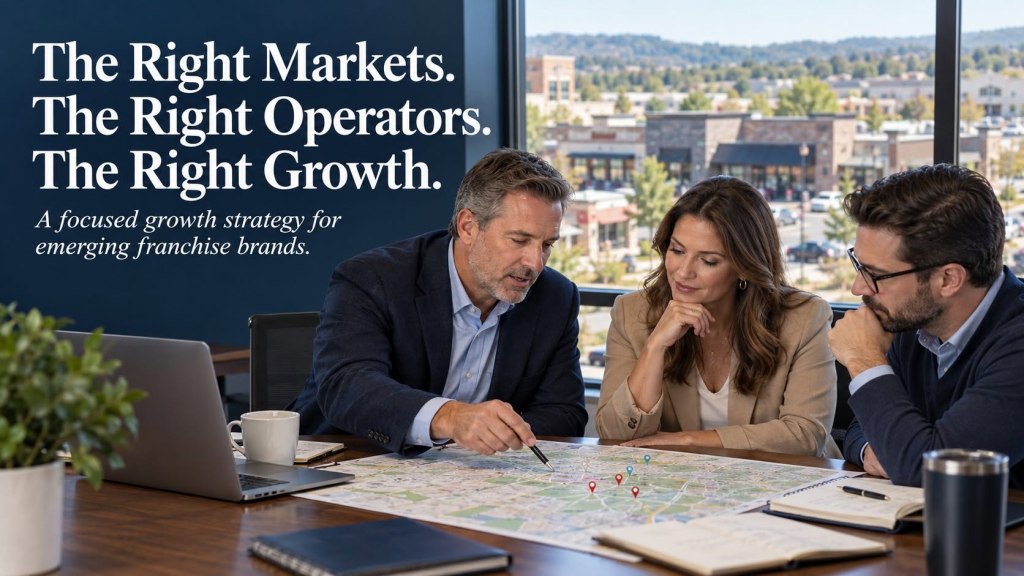
Before You Sell the Next Franchise, Decide Where Your Brand Should Grow

An emerging franchise brand’s expansion strategy should begin with the markets it can develop and support responsibly.

There is a moment in the life of an emerging franchise brand when interest from a prospective franchisee can feel like confirmation that everything is finally coming together. The business has been prepared for franchising. The investment has been made. The opportunity has been introduced to the marketplace. Someone sees the potential and wants to become part of the vision.

Then comes the question: Where would you like to open?

For too many emerging brands, that question arrives before leadership has sufficiently answered a more consequential one: Where should we be growing?

In my recent op-ed, “What Is Your Franchise Sales & Development Company Really Doing for Your Emerging Franchise Brand?,” I challenged founders to examine how their development efforts connect franchise recruitment with building a stronger system. Market selection deserves particular attention because every award creates obligations that extend well beyond the sales process.

The location of your next franchise will influence how you train, support, supervise, supply, and communicate with its owner. It will affect the demands on your leadership team and the resources available for the franchisees who follow.

Before celebrating the next award, you should understand what its geography will require of your organization.

National Ambition Requires a Practical Starting Point

Most founders do not enter franchising with a modest vision. They see opportunities in other cities, other states, and eventually across the country. That ambition can provide the energy needed to move through the difficult work of building a franchise organization.

But ambition needs a sequence.

A brand can aspire to national recognition while concentrating its next stage of development in one metropolitan area or a manageable region. That focus gives leadership an opportunity to learn how the concept performs under different owners, strengthen training, refine support, and establish the relationships needed for continued expansion.

Think about a founder who has operated two successful restaurants in one market. Those restaurants may benefit from the founder’s personal relationships, daily involvement, reputation, and ability to solve problems quickly. Moving into franchising changes the operating arrangement. Moving into a distant market adds another layer of complexity.

The founder’s familiarity with the original business does not automatically establish the organization’s ability to support a franchisee several states away.

The practical question is what the brand must demonstrate, build, and resource before taking that step.

A Map of Signed Agreements Can Conceal a Support Problem

Imagine two emerging franchise brands, each with six newly awarded locations.

One has concentrated those awards within a region its leadership team can visit regularly. The other has awarded locations across six distant markets. Viewed through a sales report, the brands may appear to have made similar progress.

Viewed through the work ahead, they face different demands.

The dispersed brand may need to coordinate separate real estate relationships, supplier arrangements, training trips, local marketing efforts, and opening schedules. A problem in one market can compete for attention with an opening in another. Leadership may spend substantial time traveling while the home-office team tries to keep development moving.

The concentrated brand still faces significant challenges. Proximity does not fix inadequate training, weak unit economics, or poor franchisee selection. However, it may make hands-on support more practical and allow the organization to develop deeper familiarity with the markets it serves.

Geographic concentration also has limits. Too many locations in a poorly understood trade area can create competition within the system. Concentration must be supported by demand analysis, appropriate spacing, and thoughtful opening schedules.

A development map should show more than where agreements have been signed. It should help leadership understand whether the resulting businesses can form a viable, supportable system.

Support Capacity Belongs in the Market-Selection Discussion

Founders often evaluate new markets by looking at population, household income, competition, and the apparent appeal of the concept. Those considerations matter. So does the organization’s ability to deliver what franchisees will need.

Who will conduct initial training? Who will assist with opening preparation? Who will visit when an operator struggles? Who will help adapt approved marketing to local conditions? What happens when two franchisees need intensive assistance at the same time?

These questions should influence market priorities before candidates receive enthusiastic assurances about territory availability.

An organization with a small leadership team and limited field support may need a different geographic approach than one with experienced regional personnel. A restaurant concept with complex opening requirements may need a different rollout sequence than a business with a simpler launch process.

Support capacity can grow. It should grow deliberately, with responsibilities, staffing, and funding connected to the development plan.

If the strategy assumes that resources will somehow become available after agreements are signed, leadership should examine that assumption carefully. Franchisees will be preparing to invest, hire, and open on their own timelines. They need an organization prepared to meet its commitments.

Market Planning Should Begin Before Lead Generation

When franchise recruitment begins without defined market priorities, candidate interest can gradually become the expansion strategy.

An inquiry arrives from one state. Another prospect asks about a distant metropolitan area. A broker introduces someone interested in a territory leadership has never seriously evaluated. Each conversation seems worth pursuing, especially when the brand needs its first awards.

Over time, the organization may find itself considering a collection of opportunities with little connection to one another.

Preliminary market planning gives those conversations a clearer purpose.

For a restaurant brand, that work may include examining residential growth, employment centers, customer demand, traffic patterns, competitive concepts, labor availability, and occupancy costs. It should consider the brand’s format, customer profile, investment requirements, and operating needs.

A market with substantial population growth may still present challenges if suitable sites are scarce, rents undermine the model, or the labor requirements are difficult to meet. A smaller market may merit attention if the customer fit and operating conditions are stronger.

Preliminary planning cannot establish the suitability of every site or guarantee performance. It provides a reasoned basis for determining where to focus further work.

With that foundation, recruitment can pursue candidates capable of executing a defined plan in approved markets.

A Territory Is a Commitment to an Operating Environment

A territory discussion often centers on boundaries, availability, and how much room exists for future units. Those issues matter, but the underlying operating environment deserves equal attention.

Two territories of similar size may offer very different opportunities. One may contain growing residential communities, accessible retail space, and customer patterns suited to the concept. Another may have fragmented demand, difficult access, or development costs that challenge the economics.

Leadership should understand the assumptions behind the territory’s appeal.

For multi-unit development, the analysis becomes more demanding. A candidate’s willingness to commit to several locations does not establish that appropriate sites can be secured or that openings can be completed on the proposed schedule.

Real estate availability, construction timelines, management recruitment, and phased capital needs should inform the commitment.

The market plan, the candidate’s capabilities, and the development schedule must be considered together. Each affects the feasibility of the others.

Recruit Broadly While Developing Deliberately

A focused geographic strategy does not require a narrowly geographic recruitment strategy.

The right candidate for a priority market may live elsewhere. An experienced franchise operator may already have businesses and management resources in that region. A development group may be seeking a complementary concept. An entrepreneur may be planning a relocation and have a credible path to local operating involvement.

Where a candidate lives and where the brand should develop are separate questions.

A development partner should be able to explain the market priorities clearly while reaching candidates whose experience and resources fit the assignment. That requires understanding who will operate the business, how the ownership group will establish a local presence, and what responsibilities must be fulfilled before opening.

Candidates interested in future markets can remain part of a longer-term pipeline. However, expectations should be clear. Interest should not be allowed to create the impression that a territory is approved or that expansion timing has been established.

Broad recruitment is useful when it helps the brand execute its strategy.

Sequence Openings Around What the System Can Absorb

Even within an approved market, the pace of development matters.

Several signed agreements may create an encouraging pipeline. Several simultaneous openings may overwhelm the same organization.

Training teams have limits. Opening support has limits. Leadership attention has limits. New franchisees may need assistance at precisely the moment another location requires an intensive launch effort.

A practical rollout plan considers these competing demands.

For example, an early opening may provide lessons that improve training or launch preparation for subsequent locations. Leadership may discover that a supplier arrangement needs refinement or that a marketing approach requires adjustment. A thoughtful sequence creates room to incorporate those lessons.

That does not mean every brand should adopt the same opening schedule. It means the schedule should reflect the work required, the people available, and the readiness of each operator.

An award creates a development obligation. An opening puts the operating model to the test. The strategy needs to account for both.

Establish Conditions for the Next Stage of Expansion

Geographic focus becomes more useful when leadership also defines what would justify expanding beyond it.

Those conditions might include evidence that franchisees can operate effectively using the established systems, that support responsibilities are being fulfilled consistently, and that the organization has the personnel and resources needed for additional markets.

Leadership should also consider what it has learned from the first development cluster. Were site assumptions sound? Did openings follow realistic timelines? What assistance did franchisees need beyond what had been anticipated? Which parts of the model depended too heavily on the founder?

The answers can guide the next stage.

Performance in one region does not guarantee performance in another. It can, however, provide a more informed basis for deciding what needs to be evaluated or adapted before expansion proceeds.

The decision to enter a new market should follow a readiness discussion, supported by operating experience and a clear plan for additional obligations.

Your Development Partner Should Be Able to Explain the Geography

If your franchise sales and development company recommends a market, ask for the reasoning.

Why does this market fit the concept? How does it connect with existing operations? What work has been completed to understand demand and development conditions? What would the award require from your team? How does the candidate’s operating plan fit those requirements?

The answers should be specific enough to support a decision.

At Acceler8Success America, we believe market priorities, candidate targeting, development structure, and support readiness should be considered together. The recruitment effort should reflect the business the franchisor is building and the responsibilities that growth will create.

Founders should expect their development partner to help make those connections visible.

Leadership retains responsibility for approving the strategy and making award decisions. A capable partner provides the analysis, coordination, and candid discussion that help leadership exercise that responsibility thoughtfully.

Final Thoughts

The next franchise award can feel like a milestone because it is one. Someone has chosen to invest in your brand and participate in its future.

That decision deserves a development strategy worthy of the commitment.

Before you sell the next franchise, decide where your brand should grow. Understand why that market fits, what the operator will need, how the opening will be supported, and how the location contributes to the system you intend to build.

You may discover that the strongest next move is closer to home than expected. You may identify a compelling opportunity farther away. Either conclusion should emerge from a deliberate evaluation of the market, the candidate, and your organization’s readiness.

National growth can remain the vision. Every next step should have a practical reason behind it.

When a prospective franchisee asks whether a territory is available, your answer should reflect more than an open space on a map. It should reflect a plan.


Let’s examine what your franchise development effort is building.

Acceler8Success America offers a complimentary consultation for emerging franchise brands to discuss market priorities, candidate targeting, development readiness, and the work needed to support their next stage of growth.

As part of that consultation, you can receive an actual proposed scope of work, redacted to protect the brand’s identity and confidential information, so you can review the level of planning, execution, and accountability a focused franchise sales and development engagement can include.

Email paul@acceler8success.com with the subject line “Emerging Franchise Brand Consultation,” or call or text (832) 797-9851.

Bring your growth goals, current development challenges, and questions. Let’s discuss a practical path forward for your brand.

This is the first article in a four-part Acceler8Success Café series expanding on “What Is Your Franchise Sales & Development Company Really Doing for Your Emerging Franchise Brand?.”

What Is Your Franchise Sales & Development Company Really Doing for Your Emerging Franchise Brand?

Your franchise sales and development company is generating leads. Your opportunity appears on franchise portals. Someone is running digital campaigns, distributing information to brokers, and following up with inquiries.

But what is actually being developed?

A growing contact list? A collection of interested prospects scattered across the country? Or a deliberate path toward a stronger franchise system?

For an emerging franchise brand, these questions deserve serious attention. The earliest franchise awards help establish the operating culture, support demands, market presence, and relationships upon which future growth will depend.

Yet too often, the conversation centers on how many franchises can be sold before anyone has sufficiently addressed where those franchises should be developed, who should operate them, or how the franchisor will support them.

If your development partner cannot explain why a particular candidate, market, and development structure fit your brand, you should be asking what you are paying for.

A National Ambition Needs a Practical Starting Point

There is nothing wrong with wanting to build a national franchise brand. The concern is whether national expansion has become the immediate sales strategy simply because the opportunity can be advertised nationwide.

For many emerging brands, local and regional development should receive the first and strongest emphasis.

Consider the difference between several franchise locations concentrated in a manageable region and the same number spread across distant states. The franchise award count might look identical. The demands on training, field support, travel, supplier coordination, and local marketing can look very different.

Concentrated development can give leadership more opportunities to stay close to franchisees, recognize problems early, build market familiarity, and refine the systems needed for expansion.

Scattered development can stretch an emerging organization before those systems are ready.

Neither geography nor proximity guarantees success. But support capacity should help determine the growth strategy. A territory should not become a priority merely because someone there is willing to sign an agreement.

The question is straightforward: Where can this brand responsibly build its next stage of growth?

Local Focus Does Not Require Local-Only Recruitment

A focused development strategy can still attract candidates from a broad geographic area.

An experienced operator in another state may be well positioned to expand into your priority market. An established franchise group may already have the leadership, capital, and real estate relationships needed to develop there. An entrepreneur considering relocation may bring relevant experience and a credible operating plan.

The distinction is between where you recruit candidates and where you intend to develop the brand.

Those decisions serve different purposes.

A development company should be able to reach beyond your immediate region while keeping franchise awards aligned with your approved market priorities. It should also maintain a separate pipeline for candidates interested in future markets, with clear expectations about availability and timing.

Broad recruitment can support concentrated growth. It does not have to dictate scattered expansion.

Your Brand Deserves More Than a Standard Sales Package

Emerging brands differ in meaningful ways.

A restaurant concept requires a different candidate conversation than a home services business. A brand pursuing multi-unit operators needs a different outreach strategy than one built around active owner-operators. A concept entering a new region faces different challenges than one expanding around an established customer base.

Your sales and development effort should reflect those differences.

Who is the intended franchisee? What experience matters? What operating responsibilities will ownership require? Which markets fit the concept? What resources must a candidate have beyond the initial investment? What can the franchisor’s team realistically support?

These questions should shape the campaign before advertising begins.

At Acceler8Success America, our approach is to connect franchise sales with the practical work of development. A recent restaurant franchise proposal illustrates what that can include, without identifying the brand or suggesting that proposed activities are completed results.

Start by Mapping the Market

In that proposal, we recommended concentrating initial development in one priority metropolitan market while preparing a broader regional candidate pipeline.

The proposed work begins with a preliminary development map and rollout recommendation.

That means evaluating population and household growth, employment centers, residential development, traffic patterns, competitive supply, and relevant customer demand. It also means considering access, visibility, parking, labor availability, occupancy costs, and development timelines against the brand’s requirements.

Just as important, the planning considers how potential locations could form manageable clusters and how openings might be sequenced to support supervision, training, and local awareness.

This work does not replace the franchisor’s real estate team or final site approval. It gives recruitment a purpose.

Instead of asking, “Who wants a franchise somewhere in this state?” the effort can ask, “Who has the capability to execute this approved development plan?”

Match the Development Commitment to the Operator

The same proposal outlines a sequence of development priorities: evaluate a qualified area developer for the approved market, pursue manageable commitments of three to five restaurants, and consider selective single-unit awards that complement the overall plan.

That sequence is specific to the proposed assignment. It should not be copied automatically into every emerging brand’s strategy.

Its broader lesson is that development structure should be intentional.

An area development commitment requires more than enthusiasm and available capital. It requires a leadership bench, phased funding, regional operating capability, and a credible opening schedule.

A multi-unit commitment requires enough management depth to supervise existing operations while developing additional locations.

A single-unit award deserves equal discipline in assessing ownership responsibilities, operating readiness, and market fit.

A larger commitment is only valuable when the candidate can reasonably carry it out.

Pursue Candidates Who Can Operate the Business

Financial qualification is essential. It is also incomplete.

For a restaurant franchise, our proposed screening emphasizes operating experience, management resources, staffing plans, site development capability, capital allocation, and accountability.

Targeted outreach may include experienced restaurant operators, multi-unit and multi-brand franchisees, development groups, and investors with an acceptable operating structure.

A transitioning executive may be a viable candidate, but corporate experience alone does not establish restaurant operating readiness. An investor may have substantial resources, but someone still needs to lead the business.

Your development partner should investigate the people and resources behind the application.

The ability to buy a franchise and the ability to develop and operate one are different qualifications. Both matter.

Build Relationships Around the Market

Digital campaigns can support recruitment, but they should be part of a coordinated effort.

Our proposed scope combines direct database outreach with select business and franchise broker relationships, commercial real estate introductions, developer relationships, webinars, content, and local meetings.

Each channel has a purpose.

Business brokers may know established owners considering another operating business. Franchise brokers may have relationships with experienced franchisees. Commercial real estate professionals may know operators seeking expansion opportunities. Developers and municipal economic development contacts may provide useful local intelligence.

Those relationships require active management: approved opportunity briefings, clear candidate criteria, documented introductions, consistent follow-up, and reviews of referral quality.

For an emerging brand, a smaller group of informed, productive referral partners may provide more value than broad distribution to people who barely understand the concept.

Put People in the Market

There is practical value in meeting candidates, touring markets, and speaking with the people involved in local development.

Our Texas presence supports proposed in-person candidate meetings, market tours, and coordination with real estate and development contacts.

A conversation in the market can reveal questions that an online inquiry form never will. Who will oversee operations? How well does the candidate understand the area? What competing commitments exist? What local resources can the ownership group actually access?

Local presence creates opportunities to test assumptions and strengthen relationships.

Emerging brands need that depth of engagement as they establish their first development clusters.

Make Marketing Accountable to Candidate Quality

Content, social media, paid campaigns, and webinars should communicate a consistent, approved explanation of the brand and ownership opportunity.

Our proposed approach includes coordinated messaging, audience selection, landing pages, tracking, and follow-up. Paid campaigns begin with controlled tests, with expansion based on the quality and progression of candidates generated.

That is a different conversation from celebrating impressions and inquiry volume alone.

A webinar for experienced operators should address different questions than an introductory session for prospective first-time owners. Outreach to development groups should reflect their interest in market capacity, management requirements, and opening schedules.

Brand-specific marketing should help appropriate candidates recognize the opportunity—and help others understand when it does not fit their objectives.

Demand Visibility Into the Work

Franchise development should not disappear into a monthly report that says, “We are continuing to follow up.”

Our proposed reporting includes weekly pipeline updates and monthly strategy reviews, with visibility into candidate sources, qualifications, development interests, stages, next actions, stalled opportunities, and decisions requiring leadership attention.

It also separates different measures of progress.

An inquiry is not a qualified candidate. A qualified candidate is not an approved franchisee. A signed development commitment is not an opened business.

Each matters, but they should be reported distinctly.

The proposed initial 90-day plan also identifies reviewable work: candidate criteria, preliminary market planning, outreach lists, campaign preparation, documented qualification activity, pipeline assessments, and next-quarter priorities.

These are planning milestones, not promises of awards or openings. They allow leadership to evaluate whether the development effort is being executed thoughtfully and consistently.

Sometimes the Sales System Needs Work First

More advertising will not necessarily resolve an unclear franchise offering, weak sales materials, inconsistent follow-up, or an incomplete candidate journey.

A responsible development partner should be willing to identify those gaps.

At Acceler8Success America, when substantial sales-system repair or repositioning is needed, our approach is to define that work separately, with agreed deliverables and timing.

Founders deserve to understand what needs attention before committing additional resources to attracting candidates.

They also deserve a partner who respects brand approval authority, documents candidate interactions, coordinates with franchise counsel, and makes a thorough handoff to development and operations after an award.

The relationship does not become less important when the agreement is signed. That is when the operating commitment begins.

Final Thoughts

Emerging franchisors should expect their sales and development partner to understand the business behind the franchise opportunity.

That understanding should be visible in the markets prioritized, the candidates pursued, the relationships activated, the questions asked, and the work reported.

National growth may remain the destination. For many emerging brands, a focused local and regional strategy offers a more practical foundation for getting there.

Before your next development meeting, ask:

“Show me how your work is helping us build the right franchise system, in the right markets, with the right people.”

You should receive a specific answer supported by a specific scope of work.

If you cannot, it may be time to reassess your approach.

Let’s put your franchise development strategy under the same scrutiny you would apply to any other major business investment.

Acceler8Success America offers a complimentary consultation for emerging franchise brands to discuss market priorities, candidate targeting, development readiness, and the work needed to support your next stage of growth.

As part of that consultation, you can receive an actual proposed scope of work, redacted to protect the brand’s identity and confidential information, so you can see the level of planning, execution, and accountability for yourself.

Email paul@acceler8success.com with the subject line “Emerging Franchise Brand Consultation” or call or text (832) 797-9851.

Bring your growth goals, your current development challenges, and your questions. Let’s examine what a focused franchise sales and development effort should look like for your brand.

Is September Becoming Franchise Sales’ Annual Shuffling of the Deck?

For the past several years, I have noticed what appears to be a growing pattern across the franchise community: as summer winds down and September approaches, LinkedIn and other industry channels begin filling with announcements from franchise sales and development professionals sharing that they have joined a new brand, accepted a new leadership role, or moved on to their next opportunity. Certainly, movement among franchise sales professionals is nothing new. It has always been a relationship-driven business, and talented people naturally move from one organization to another as brands expand, leadership teams change, development strategies evolve, or better opportunities present themselves. What seems different, however, is the frequency and concentration of these announcements, almost as though September has become an unofficial annual shuffling of the deck within franchise development. In some years, the activity appears even more noticeable than the traditional January movement we often associate with new budgets, new plans, new leadership structures, and New Year career changes. The question is whether this is simply perception created by the visibility of social media, or whether September has actually become a meaningful transition point within the franchise sales cycle.

There are several reasons why the timing would make sense. By late August, summer vacations are largely behind us, children are back in school across much of the country, business routines begin returning to normal, and people who have spent the summer thinking about change may finally be ready to act. From the candidate side, September has traditionally felt like a reengagement period. Prospective franchisees who may have delayed conversations during June, July, and August suddenly begin looking ahead again, and for many of them the calendar creates a natural sense of urgency. If someone wants to make a career change, leave corporate America, acquire a business, open a franchise, or otherwise take control of what the next chapter of their professional life looks like, September provides roughly four months to investigate opportunities, secure financing, complete due diligence, make decisions, and potentially enter the new year with something already in motion. The psychology of January matters long before January arrives. People frequently want to begin a new year differently, but accomplishing that requires decisions to be made months earlier. September may therefore represent the moment when consideration starts turning into action.

If candidate activity increases, it would also make sense that franchisors begin examining whether they have the right people, systems, messaging, lead generation strategies, and development resources in place to capitalize on that activity. A franchise brand entering the final four months of the year may be evaluating whether it will hit its development goals, whether its current pipeline is producing, whether leads are converting, and whether its sales team has the experience and relationships necessary to finish the year strongly while building momentum for the next one. For franchise sales professionals, that can create opportunity. Brands preparing for a stronger fourth quarter or planning aggressive expansion for the following year may recruit experienced development executives, brokers, consultants, or sales leaders during August and September so those individuals can immediately begin building pipeline rather than waiting until January. At the same time, professionals who recognize that their current organization may not provide the resources, brand momentum, lead flow, compensation opportunity, or leadership alignment they expected may decide that this is the logical time to make a move. When both sides begin thinking that way at approximately the same time, what looks from the outside like random job movement may actually reflect something deeper happening within the franchise development calendar.

There may also be another dynamic at work. Franchise sales today is under far greater scrutiny than it was even a decade ago. Leads are expensive, candidates are more informed, financing can be challenging, sales cycles can stretch longer, and emerging brands frequently discover that simply having a franchise opportunity does not automatically create franchise buyers. Expectations placed on development professionals can nevertheless remain extremely high. When results fall short, organizations may change sales leadership, restructure outsourced development relationships, adjust broker strategies, or recruit someone believed capable of accelerating results. Conversely, experienced franchise sales professionals increasingly understand the importance of choosing the right brand to represent. A great salesperson attached to an unprepared franchise system, weak unit economics, insufficient marketing, poor franchisee validation, or unrealistic development expectations can only overcome so much. The strongest professionals are often evaluating brands just as carefully as candidates are evaluating franchise opportunities. That naturally creates movement.

Social media may amplify the appearance of this phenomenon as well. Years ago, someone leaving one franchise company for another might have generated a brief industry mention or simply circulated through word of mouth. Today, a new position frequently comes with a polished LinkedIn announcement, congratulations from hundreds of industry contacts, comments from former colleagues, and subsequent posts from the hiring company. We therefore see career movement that previously may have occurred largely below the radar. What may appear to be a dramatic increase in job changes could partly be an increase in visibility. Still, even allowing for that possibility, the concentration of announcements around late summer and early fall is difficult to ignore, and it raises a larger question about whether the franchise industry has developed a seasonal talent cycle that parallels its candidate-development cycle.

It would be especially interesting to hear from franchise sales professionals, franchisor executives, franchise brokers, recruiters, and consultants who operate close to the development pipeline. Do you see candidate activity meaningfully increase after Labor Day? Are more prospective franchisees attempting to have a decision, agreement, financing plan, or business launch underway before the new year? Do franchisors intentionally strengthen or restructure development teams heading into the fourth quarter? Are franchise sales professionals themselves more receptive to new opportunities at this point in the year? Or are we simply seeing normal career movement magnified by the transparency and immediacy of LinkedIn?

There may not be a single explanation, and the pattern may vary considerably by brand, industry segment, investment level, geography, and economic environment. But after observing the franchise community for many years, September increasingly feels less like the end of summer and more like the beginning of another franchise development season. Pipelines wake up, candidates reengage, companies revisit their objectives, budgets receive renewed attention, and people begin asking themselves where they want to be when January arrives. Perhaps the growing number of franchise sales professionals announcing new positions is simply another visible indicator of that shift.

Final Thoughts

If September is becoming a reset point for franchise development, understanding why could tell us something important about how candidates now approach business ownership, how franchisors plan their growth strategies, and how franchise sales professionals view their own careers. I am particularly interested in hearing from those working directly in franchise development: Are you seeing this same September shuffle? Is candidate interest noticeably increasing as vacations end and families return to their regular routines? Are people entering the process now because they want something firmly in place for the new year? Or is something entirely different driving the movement?

I would welcome your insight and perspective. The most interesting part of this conversation may not be whether the pattern exists, but what those closest to franchise development believe is causing it.

When a Franchise Costs as Much as a Home, Should the Sales Process Be Licensed?

Franchising has long positioned itself as one of the most accessible pathways to entrepreneurship. It offers aspiring business owners a proven model, brand recognition, and operational systems designed to reduce risk compared to starting from scratch. Yet for all of its structure, one aspect of franchising remains surprisingly unstructured: the selling of franchises themselves.

Consider for a moment the sale of real estate.

In most jurisdictions, an individual cannot simply decide to sell homes for a living. To represent buyers or sellers, one must obtain a real estate license. That process requires education, testing, adherence to a code of ethics, continuing education, and renewal of the license over time. Real estate professionals typically work under the supervision of a licensed broker who is responsible for oversight and accountability. Complaints can be filed. Boards review conduct. There are standards, and there are consequences for failing to meet them.

Now compare that framework with the sale of franchise opportunities.

Franchise investments can range from $150,000 to well over $2 million depending on the concept, territory, and development commitments. These are often life-changing financial decisions for the people involved. In many cases, entrepreneurs invest their life savings, retirement funds, or take on substantial debt in order to pursue business ownership through franchising.

Yet the individuals selling these opportunities are not necessarily required to be licensed, formally trained, or held to a standardized professional code of conduct.

This is not to say that franchising lacks regulation entirely. The Federal Trade Commission’s Franchise Rule requires disclosure through the Franchise Disclosure Document (FDD), and several states have their own registration and regulatory frameworks. Those rules are important and have provided meaningful protection over the years.

But the regulation largely focuses on disclosure by the franchisor, not necessarily on the professional standards of the individuals selling the opportunity.

That distinction raises an interesting question.

Should franchise sales fall into a category more similar to real estate sales?

What if individuals representing franchise opportunities were required to be licensed? What if they completed foundational education on franchising, financial literacy, franchise law basics, and ethical representation? What if they worked under a licensed franchise broker or supervising entity responsible for oversight? What if continuing education were required to stay current with industry developments?

This is not an argument that franchising is fundamentally broken. Far from it. Franchising remains one of the most powerful economic engines for entrepreneurship and small business development.

But as the industry matures and investment levels continue to rise, the question becomes whether the sales process should evolve as well.

From the perspective of franchisees, such a framework could provide an additional layer of confidence. Prospective franchise owners often rely heavily on the information and guidance provided during the discovery process. While disclosure documents exist, the individuals guiding candidates through the opportunity often shape how the information is interpreted and understood. A licensing structure could help ensure that those individuals possess a baseline level of knowledge and are bound by professional standards.

For franchisors, the benefits could be equally meaningful.

Brands invest significant time and resources developing their franchise systems. Yet the industry has long struggled with inconsistencies in how franchise opportunities are represented in the marketplace. Some sales organizations operate with exceptional professionalism, while others rely on aggressive or overly optimistic marketing approaches that can ultimately harm both franchisees and the brand itself.

A professional licensing framework could elevate the quality of franchise representation and align sales practices more closely with the long-term health of the brand.

It could also help reduce the reputational challenges franchising sometimes faces when deals are made that should never have been made in the first place. Not every candidate should become a franchisee. In fact, one of the most important roles of a responsible franchise development professional is determining when the answer should be no.

Professional standards could reinforce that responsibility.

For the franchising industry as a whole, the introduction of licensing and oversight could signal a broader maturation of the sector. Real estate, financial services, insurance, and securities industries all require licensing precisely because the financial stakes are high and the consequences for consumers can be significant.

Franchise investments fall squarely into that same category.

Imagine an industry where franchise development professionals complete formal training, pass competency exams, adhere to a recognized code of ethics, participate in continuing education, and operate under supervisory oversight similar to brokerage structures.

Such a framework could help standardize professionalism across the industry while reinforcing franchising’s credibility as a serious pathway to business ownership.

Of course, there are reasonable counterarguments. Franchising is already regulated through disclosure requirements. Additional licensing could introduce administrative burdens or slow down development efforts. Some might argue that the market itself should determine who succeeds or fails in franchise sales.

Those are valid considerations.

But the broader question remains whether the growth and complexity of franchising now warrant a higher professional standard for those responsible for introducing entrepreneurs to these opportunities.

After all, when someone buys a home, the law requires that the individual guiding the transaction be licensed.

When someone invests hundreds of thousands of dollars into a franchise business that may shape their financial future for decades, the standards for who represents that opportunity are far less defined.

Perhaps that is simply the nature of franchising.

Or perhaps it is an area where the industry has an opportunity to evolve.

This is not a call for sweeping regulation, but rather a thought worth considering as franchising continues to grow and attract larger investments. If the goal is to strengthen the integrity of the industry, protect aspiring entrepreneurs, and elevate the professionalism of franchise development, the idea of licensing franchise sales professionals may deserve a closer look.

Perhaps the idea of licensing franchise sales professionals has merit. Perhaps it does not. But it is certainly a conversation worth having.

I welcome your thoughts, perspectives, and experiences on this topic. And if you would like to discuss the idea further, I would certainly welcome one-on-one conversations as well.

You can reach me directly at paul@acceler8success.com.

The Most Overlooked Risk in Franchise Development

Franchisors spend thousands, and often hundreds of thousands, of dollars to generate interest in their franchise opportunity. They exhibit at franchise expos, build relationships with franchise broker networks, subscribe to franchise portals, invest in public relations campaigns, run digital advertising, and in some cases utilize traditional media such as radio, billboards, and sponsorships. All of this activity is designed to accomplish one primary objective: to encourage the right candidate to raise their hand and express interest in becoming a franchisee.

But what happens next?

This question is far more important than most franchisors realize.

Lead generation creates opportunity. Lead management determines whether that opportunity becomes sustainable growth or a missed moment that quietly erodes the brand’s future.

As the leader of a franchise organization, you should know exactly what happens the moment a lead enters your system. How quickly are they contacted? Who contacts them? What is said during the initial conversation? How is their experience managed over the following days, weeks, and months? Are they being guided thoughtfully through a discovery process, or are they simply being “sold”?

From the candidate’s perspective, this experience forms their first true impression of your brand’s culture, professionalism, and integrity. Long before they ever sign an agreement or open a location, they are evaluating you just as much as you are evaluating them.

An ineffective franchise sales process does not just result in fewer units sold. It creates confusion, mistrust, and disengagement among otherwise qualified candidates. It sends an unspoken message that the brand lacks structure, leadership, or intentionality. Even candidates who ultimately decide not to move forward will carry their impressions with them, and those impressions often influence how they perceive the brand as consumers, investors, and influencers within their own professional networks.

Franchise development is not merely a transaction. It is the beginning of a long-term partnership. If the process feels disorganized, overly aggressive, impersonal, or unclear, the brand begins that relationship on unstable footing.

Many franchisors evaluate the effectiveness of their franchise sales process by focusing on the number of franchise agreements signed. This is an understandable metric, but it is incomplete and, in many cases, misleading.

A signed agreement does not equal success.

A more meaningful measure is the number of units that actually open. A candidate who signs but never opens represents lost time, lost momentum, and often lost credibility. The brand has invested resources, attention, and opportunity cost into a partnership that never materialized.

More important still is the number of units that remain open and perform successfully over time.

This is where the true effectiveness of the franchise sales process is revealed.

A disciplined and thoughtful franchise sales process is not designed to maximize the number of agreements signed. It is designed to identify, educate, qualify, and ultimately partner with candidates who are aligned with the brand’s culture, expectations, and operational realities. It ensures candidates fully understand what they are committing to, both financially and personally. It allows candidates to self-select into the opportunity with clarity, rather than being persuaded by enthusiasm alone.

When franchisors focus only on short-term development metrics, they often unintentionally prioritize speed over alignment. This leads to franchisees who are underprepared, undercapitalized, or misaligned with the brand’s operational demands. The consequences emerge later in the form of delayed openings, operational struggles, poor unit performance, and ultimately closures.

Closures are not merely operational setbacks. They are brand events.

Consumers notice when locations close. Landlords notice. Suppliers notice. Existing franchisees notice. Prospective franchisees notice. Each closure quietly signals instability, regardless of the underlying cause.

In contrast, a deliberate and structured franchise sales process creates stronger outcomes at every level. Candidates feel respected and informed. Franchisees enter the system with realistic expectations and greater confidence. Units open more smoothly. Franchisees perform more consistently. The brand builds momentum based on stability rather than velocity alone.

This is why franchisors must shift their mindset from franchise sales to franchise development.

Sales focuses on closing agreements. Development focuses on building a network.

Sales asks, “How many did we sell?” Development asks, “How many succeeded?”

Sales measures activity. Development measures outcomes.

Sales ends at the signature. Development begins there.

Every lead represents more than a potential unit. It represents a potential long-term operator, a future ambassador of the brand, and a future contributor to the system’s culture and stability.

Franchisors who understand this invest as much discipline into their lead management and candidate experience as they do into their marketing. They implement structured processes, clear communication pathways, thoughtful discovery phases, and intentional qualification standards. They ensure candidates move forward not because they were persuaded, but because they are aligned.

The most successful franchise brands do not grow the fastest. They grow the strongest.

And strength begins not with the lead itself, but with what happens next.


About the Author

Paul Segreto brings over forty years of real-world experience in franchising, restaurants, and small business growth. Recognized as one of the Top 100 Global Franchise and Small Business Influencers, Paul is the driving voice behind Acceler8Success Café, a daily content platform that inspires and informs thousands of entrepreneurs nationwide. A passionate advocate for ethical leadership and sustainable growth, Paul has dedicated his career to helping founders, franchise executives, and entrepreneurial families achieve clarity, balance, and lasting success through purpose-driven action.


About Acceler8Success America

Acceler8Success America is a comprehensive business advisory and coaching platform dedicated to helping entrepreneurs, small business owners, and franchise professionals achieve The American Dream Accelerated.

Through a combination of strategic consulting, results-focused coaching, and empowering content, Acceler8Success America provides the tools, insights, and guidance needed to start, grow, and scale successfully in today’s fast-paced world.

With deep expertise in entrepreneurship, franchising, restaurants, and small business development, Acceler8Success America bridges experience and innovation, supporting current and aspiring entrepreneurs as they build sustainable businesses and lasting legacies across America.

Learn more at Acceler8SuccessAmerica.com

The Franchise Development Reset Every Franchisor Should Consider in the New Year

For franchisors, few decisions shape the long-term health of a brand more than who represents it during the franchise sales process and how those conversations unfold. Long before a franchisee signs an agreement, pays a fee, or opens their doors, the relationship has already begun. It starts with dialogue, positioning, tone, and expectations. As franchisors look toward a new year, this is not simply a sales issue to manage. It is a leadership issue that directly influences culture, trust, and the integrity of the system.

Franchise development sits at a difficult intersection of optimism and obligation. On one hand, the role is to inspire confidence, communicate opportunities, and attract qualified candidates. On the other, it carries a responsibility to ensure alignment, accuracy, and long-term fit. Franchise sellers must provide information that is accurate, complete, and fully aligned with proper disclosure. Anything stated, implied, or framed in a way that could be interpreted otherwise introduces risk. Culture is shaped not only by what is written in manuals or stated in mission statements, but by how people talk when no one is listening and how opportunities are described when candidates are excited and appear ready to move forward, even prepmaturely.

The most common friction points rarely come from what is written in the Franchise Disclosure Document. They come from everyday conversations. Earnings potential discussed without full context. Ramp-up timelines portrayed as easier or faster than reality. Support levels implied rather than clearly defined. Flexibility is suggested where consistency is required. Over time, these conversations do more than create misaligned expectations. They quietly establish a culture of interpretation rather than clarity. When that happens, franchisees do not just feel misled. They enter the system with a mindset that exceptions are normal and standards are negotiable.

In-house franchise development teams play a powerful role in setting cultural tone. The language they use, the stories they tell, and the behaviors they model signal what truly matters inside the organization. If internal franchise sellers feel pressure to prioritize volume over fit, that pressure becomes embedded in the culture. Franchisees sense it immediately. As franchisors plan for the year ahead, it is worth reflecting on whether development teams are being rewarded for the right outcomes or simply the fastest growth.

Third-party brokers and franchise sellers are often overlooked as cultural ambassadors, yet their impact can be just as significant. Even though they operate outside the organization, they represent the brand at its most influential moment: the decision to invest. If brokers are not aligned with the franchisor’s values, standards, and expectations, they can unintentionally introduce a culture of overpromising, comparison-driven selling, or transactional thinking. That culture does not stop at the sale. It enters the system with the franchisee and influences how they interact with the franchisor, other franchisees, and their own teams.

As important as this is for the franchisor, there is an equally important obligation to the franchisee. Franchise sales are not only about brand protection or system growth. It is about ensuring franchisees move forward informed, prepared, and confident in the reality of the business they are entering. This responsibility exists because franchising is inherently an interdependent relationship. Interdependence in franchising means the franchisor and franchisee rely on one another for success. The franchisor depends on franchisees to execute the brand, protect the customer experience, and represent the system in their local markets. The franchisee depends on the franchisor for the brand, systems, training, support, innovation, and leadership that make the business viable. Culture is the connective tissue that allows interdependence to function effectively.

When franchisees enter the system oversold or underinformed, the interdependent model weakens. Franchisees may become defensive or disengaged. Franchisors may experience increased support strain, resistance to standards, and erosion of trust. That breakdown does not stay contained. It creates a trickle effect. Field teams feel the tension. Operations become reactive. Support resources stretch thin. Other franchisees observe the friction and question alignment. Even customers can feel inconsistency at the unit level. What began as a development issue becomes a system-wide cultural issue.

Strong franchise systems understand that culture is not established after onboarding. It is established during the sales process. The healthiest brands treat franchise development as the first cultural handshake. They ensure that anyone representing the brand, internal or external, understands not just the economics, but the values, expectations, and responsibilities that come with ownership. They create a shared language that emphasizes realism, accountability, and partnership over hype and urgency.

As franchisors look toward a new year, this is an ideal time to reflect on the culture being reinforced through franchise development. Are franchise sellers modeling transparency or optimism at any cost? Are brokers aligned with the brand’s long-term vision or simply its commission structure? Are franchisees entering the system with a mindset of collaboration or entitlement? These questions are cultural in nature, and they deserve thoughtful consideration in annual planning discussions.

Alignment between leadership, operations, legal compliance, franchise development, and third-party sellers does not happen by accident. It requires intention, clarity, and consistent reinforcement. When development messaging mirrors operational reality and cultural expectations, franchisees enter the system grounded and prepared. They are more receptive to coaching, more committed to standards, and more invested in the success of the broader network.

Ultimately, franchise development either establishes a culture of trust and interdependence or one of skepticism and transaction. Every conversation matters. Every promise, implication, or omission contributes to the culture franchisees carry forward into their businesses. As franchisors plan for the year ahead, the most important growth strategy may not be the number of units sold, but the culture being built through the way those units are sold and the ripple effect that culture has on every stakeholder connected to the brand.


About the Author

Paul Segreto brings over forty years of real-world experience in franchising, restaurants, and small business growth. Recognized as one of the Top 100 Global Franchise and Small Business Influencers, Paul is the driving voice behind Acceler8Success Café, a daily content platform that inspires and informs thousands of entrepreneurs nationwide. A passionate advocate for ethical leadership and sustainable growth, Paul has dedicated his career to helping founders, franchise executives, and entrepreneurial families achieve clarity, balance, and lasting success through purpose-driven action.


About Acceler8Success America

Acceler8Success America is a comprehensive business advisory and coaching platform dedicated to helping entrepreneurs, small business owners, and franchise professionals achieve The American Dream Accelerated.

Through a combination of strategic consulting, results-focused coaching, and empowering content, Acceler8Success America provides the tools, insights, and guidance needed to start, grow, and scale successfully in today’s fast-paced world.

With deep expertise in entrepreneurship, franchising, restaurants, and small business development, Acceler8Success America bridges experience and innovation, supporting current and aspiring entrepreneurs as they build sustainable businesses and lasting legacies across America.

Learn more at Acceler8SuccessAmerica.com