Tag: Franchising

Refranchising as a Growth Strategy for Restaurant Operators and Investors… Not Just for Franchisors

The restaurant industry continues to evolve at a rapid, almost frantic pace. Rising labor costs, operational complexity, shifting consumer behaviors, technology integration, delivery platforms, real estate pressures, and changing franchise economics are reshaping the landscape across virtually every segment of foodservice. At the same time, many franchise brands are quietly entering strategic periods of refranchising and experienced restaurant operators and investors should be paying close attention.

Strategic Entry: Why Refranchising May Outperform New Development

Much of the discussion surrounding refranchising is typically framed from the franchisor’s perspective. It is often discussed as a corporate strategy to reduce operational burdens, streamline company structures, improve balance sheets, focus on brand development, or accelerate growth through franchise expansion. While those factors are certainly important, there is another side of the equation that deserves far more attention.

For experienced operators, hospitality groups, multi-unit franchisees, and restaurant investors, refranchising can represent one of the most strategic pathways toward meaningful long-term growth.

Unlike traditional franchise development where operators start with a single new unit and gradually expand over time, refranchising opportunities frequently involve existing operating restaurants with infrastructure already in place. These restaurants often include trained staff, operating systems, established customer bases, brand awareness, vendor relationships, existing sales history, and immediate market presence. For sophisticated operators, this creates the opportunity to accelerate growth from day one rather than spending years building from scratch.

That distinction matters.

The restaurant industry has become increasingly difficult for inexperienced operators entering independently. The cost of startup development, combined with permitting delays, construction expenses, labor shortages, and competitive saturation, can significantly extend the runway before profitability. Refranchising offers a different entry point. It allows experienced operators to focus less on creating operational foundations and more on improving performance, strengthening culture, increasing efficiencies, enhancing guest experience, and strategically scaling.

In many ways, refranchising rewards operational excellence.

Strong operators often see opportunities where others see challenges. An underperforming restaurant may simply require better leadership, improved systems, more disciplined cost controls, stronger local marketing, or enhanced community engagement. Experienced restaurant groups understand that restaurant success is rarely determined solely by the brand itself. Unit-level execution remains one of the greatest differentiators in the industry.

This is especially important in today’s environment where sophisticated operators are increasingly building portfolios rather than simply owning restaurants.

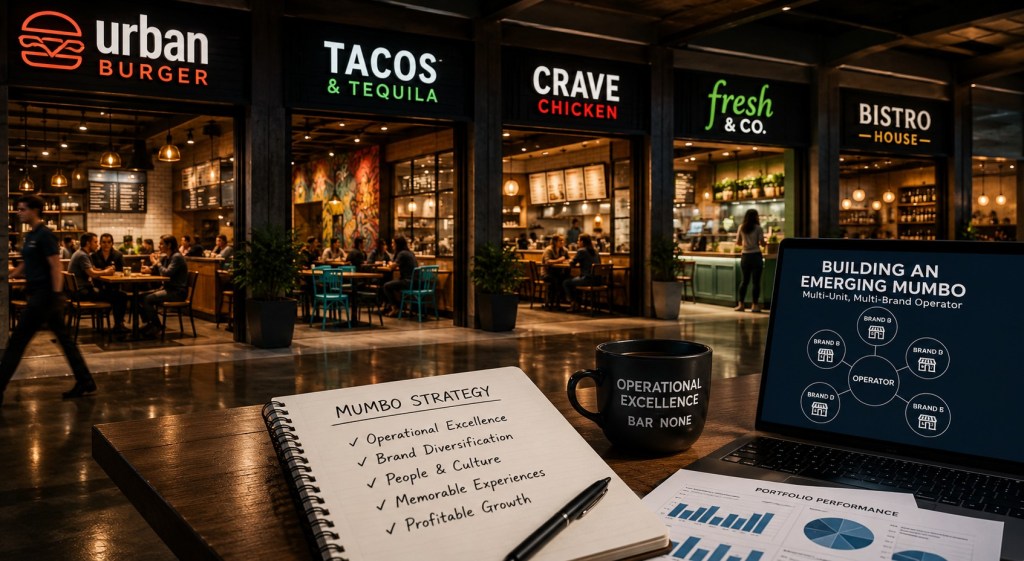
The rise of Multi-Unit Multi-Brand Operators, commonly referred to as MUMBOs, has dramatically reshaped the franchise restaurant landscape over the past decade. These operators are not approaching growth one restaurant at a time. They are building diversified operating platforms designed around scalability, infrastructure, leadership development, market density, and long-term enterprise value creation.

For MUMBOs, refranchising opportunities can be exceptionally attractive.

The Emerging MUMBO: Building a Portfolio Before the Spotlight

Acquiring existing operating restaurants within established brands allows sophisticated operators to integrate new units into existing infrastructures far more efficiently than startup development. Shared leadership teams, regional management structures, centralized recruiting, training systems, accounting departments, technology platforms, marketing support, supply chain leverage, and operational oversight can often be expanded across newly acquired units with significant efficiency gains.

This creates operational leverage.

Rather than building entirely new infrastructures for each growth initiative, experienced MUMBO groups can strategically layer additional brands and locations into existing operational ecosystems. In many cases, the addition of complementary brands can improve utilization of leadership talent, commissary operations, distribution networks, marketing capabilities, and administrative support systems.

MUMBO operators also understand the value of diversification.

Different brands can offset varying economic cycles, dayparts, demographics, consumer preferences, and real estate profiles. A diversified portfolio may include fast casual, QSR, polished casual, beverage concepts, breakfast brands, or specialty dining segments operating within the same geographic markets. Refranchising often provides access to established legacy brands with strong historical consumer awareness, creating additional opportunities for operational turnaround, modernization, repositioning, and renewed growth.

For many sophisticated operators, refranchising is no longer simply an acquisition strategy.

It is an enterprise-building strategy.

The most successful restaurant groups are thinking strategically about density, infrastructure, logistics, leadership development, and market saturation. They understand the advantages of clustering units within geographic regions to improve operational oversight, reduce distribution inefficiencies, strengthen recruiting efforts, enhance training systems, and maximize marketing effectiveness. Refranchising opportunities can fit exceptionally well within these long-term development strategies because they often allow operators to acquire multiple locations simultaneously within established markets.

That creates scale much faster.

Scale matters in restaurants. Purchasing power improves. Shared management becomes more effective. Technology integration becomes more efficient. Marketing becomes more impactful. Talent development strengthens. Vendor negotiations improve. Regional brand awareness expands. Unit economics often improve as operational systems mature across multiple locations.

For investors entering the restaurant space, refranchising can also provide a more measured and strategic path toward growth compared to speculative startup concepts. Existing operating units offer real operational history, real consumer behavior patterns, and real financial performance metrics that can be evaluated during due diligence. While every acquisition still carries risk, refranchising opportunities frequently provide far greater visibility into operational realities than brand-new development projects.

Equally important, refranchising can become a cornerstone of a much broader long-term development strategy.

Many experienced operators use refranchising as the initial foundation for future expansion. Acquiring existing restaurants creates immediate operational infrastructure that can later support additional new development. Leadership teams are built. Training systems are refined. Market knowledge deepens. Supply chain efficiencies emerge. Once a solid operational base is established, operators are often in a far stronger position to strategically add new units within surrounding trade areas.

In essence, refranchising can become the bridge between acquisition and long-term expansion.

This is particularly relevant today as many legacy restaurant brands continue reevaluating corporate ownership structures while simultaneously seeking experienced operators capable of elevating market performance. Brands increasingly understand that the right franchisee is often more important than maintaining company ownership of restaurants. Sophisticated operators who possess strong operational disciplines, hospitality culture, financial resources, and long-term vision are becoming highly valuable strategic partners within franchise systems.

The most successful refranchising groups are not simply buying restaurants.

They are building regional operating platforms.

They are creating scalable infrastructures capable of supporting continued growth for years to come. They are approaching acquisitions with long-term vision rather than short-term transactional thinking. They are identifying brands, markets, and operational opportunities that align with broader strategic objectives.

And perhaps most importantly, they understand that restaurants remain a people business.

Operational systems matter. Technology matters. Financial discipline matters. But culture, leadership, hospitality, consistency, and execution continue to separate average operators from exceptional ones.

Refranchising is not for everyone. It requires experience, capital, operational sophistication, patience, and strategic discipline. But for the right operators, investors, and MUMBO groups, refranchising can represent far more than simply acquiring restaurants.

It can become one of the most effective long-term growth strategies in modern restaurant franchising.

As more brands continue restructuring and optimizing their systems over the next several years, experienced operators who position themselves strategically today may find themselves at the center of some of the industry’s most compelling growth opportunities tomorrow.

Acceler8Success America is currently representing a number of refranchising and strategic restaurant growth opportunities involving established legacy brands in multiple markets across the United States. These opportunities may include existing operating restaurants, multi-unit packages, development opportunities, and strategic market expansion initiatives designed for experienced operators, hospitality groups, franchisees, and qualified investors seeking long-term growth.

For more information regarding current refranchising opportunities, strategic partnerships, or confidential discussions regarding restaurant acquisitions and expansion opportunities, visit Acceler8Success America or connect directly with me via a direct message or by email to paul@acceler8success.com.

Updated Advertisement:

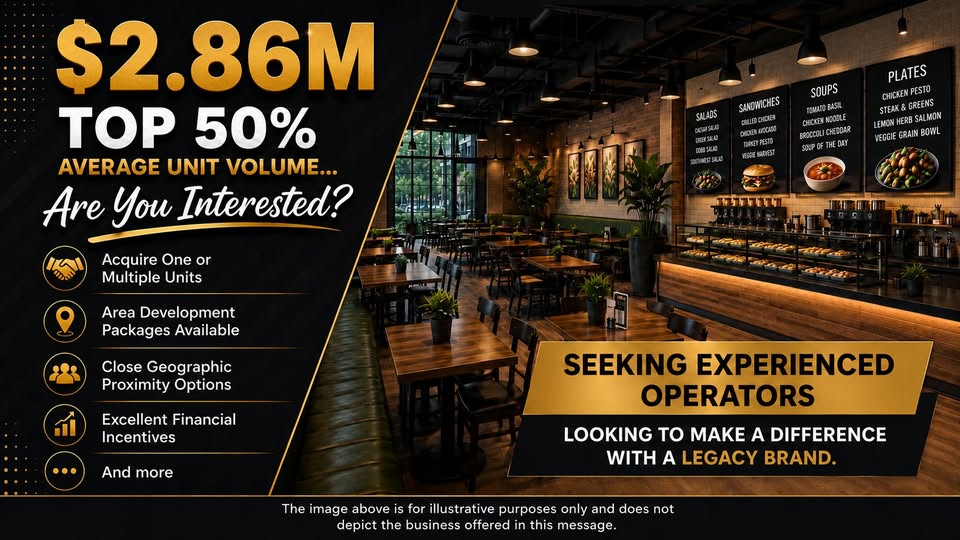
Acceler8Success America is representing a legacy fast casual restaurant brand in connection with a rare multi-unit acquisition and growth opportunity for experienced operators, hospitality groups, and qualified investors seeking strategic expansion.

This opportunity includes established operating restaurants in major U.S. markets with strong brand awareness, loyal customer bases, existing infrastructure, and immediate operational presence, allowing qualified groups to accelerate growth from day one rather than build from scratch.

The opportunity also presents the ability to strategically add multiple locations to existing portfolios while positioning for future market expansion and long-term scalability.

We are seeking serious discussions with qualified groups that possess the operational expertise, financial capability, and strategic vision to capitalize on this unique growth opportunity.

Confidential inquiries are welcome via direct message or by email to paul@acceler8success.com.

The Brands That Survive Will Be the Ones That Evolve: A Look Into the Future of Franchising

There are moments when I find myself thinking deeply about the future of franchising. Perhaps that comes naturally after spending more than four decades in and around the franchise community. I first entered franchising in 1982, and the industry I stepped into then looks almost unrecognizable compared to what we see today.

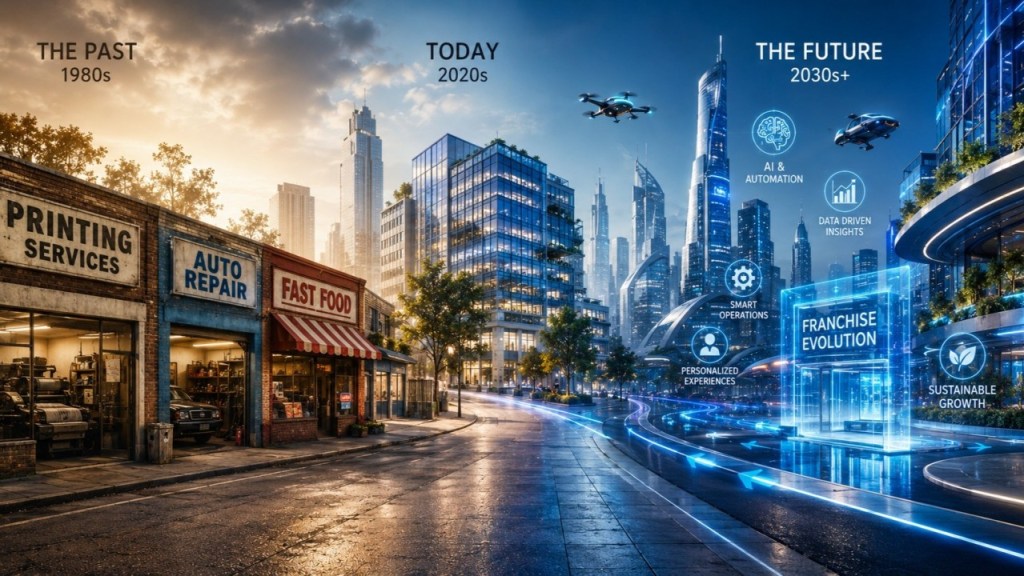
Back then, at least from my perspective and experience, franchising was heavily defined by a handful of highly visible categories. Fast food dominated the conversation. Automotive repair was everywhere. Printing services were growing rapidly as businesses relied on local commercial printers for virtually everything. Of course, there were many other franchise segments at the time, but those were the ones that stood out to me most clearly.

The franchise model itself felt different. Growth was often driven by physical visibility, operational consistency, and market saturation through brick-and-mortar expansion. Technology existed, but it certainly was not driving the business. Data was limited. Marketing was local. Customer engagement was personal and face-to-face. Convenience meant something very different than it does today.

Then came wave after wave of change.

The internet changed consumer behavior. Mobile technology changed expectations. Delivery transformed restaurants. Digital marketing disrupted traditional advertising. Social media shifted how brands communicate and build trust. Automation changed operations. Artificial intelligence is now beginning to reshape decision-making, customer service, recruitment, training, and operational efficiency in ways many could not have imagined even ten years ago.

And yet, despite all of that change, I still believe we are only scratching the surface of what franchising will eventually become.

When I think about the future of franchising, I am less focused on predicting the next hot category and more focused on understanding how the very structure of franchise businesses may evolve. Many current franchise segments will still exist in the future, but they may look completely different than they do today.

Restaurants may become smaller, more automated, and more delivery-centric while simultaneously becoming more experiential for dine-in guests. Fitness concepts may continue shifting toward wellness ecosystems that include nutrition, recovery, mental health, diagnostics, and personalized health data. Service brands may increasingly rely on AI-powered customer interaction, predictive maintenance systems, robotics, and remote support models.

Retail franchising may continue evolving away from traditional inventory-heavy storefronts and toward hybrid showroom, fulfillment, and experiential models. Education franchises may become deeply integrated with virtual learning, workforce development, entrepreneurship training, and AI-supported personalization. Senior care franchises may expand far beyond home care into broader aging-in-place solutions supported by technology, monitoring systems, and coordinated wellness platforms.

And perhaps most interesting of all, entirely new franchise categories will emerge that many of us cannot yet fully envision.

Forty years ago, who could have predicted large-scale franchising in areas like IV therapy, cryotherapy, esports, drone services, virtual reality entertainment, or highly specialized wellness concepts? Innovation has always found its way into franchising because franchising itself is ultimately a vehicle for scaling solutions to consumer demand.

But here is what I believe matters most.

The brands that survive long term will not simply be the biggest brands. They will be the brands willing to evolve before they are forced to evolve.

That distinction matters.

Too many businesses wait until disruption is already damaging their relevance before they begin adapting. By then, the market has often moved ahead of them. Consumer expectations have changed. Competitors have innovated. Technology has reshaped the playing field.

History is filled with brands that once appeared untouchable until they became obsolete because they failed to look ahead. They protected what worked yesterday instead of preparing for what consumers would want tomorrow.

The strongest franchise organizations of the future will likely be those that continuously ask difficult questions today.

What will our customer expect five years from now?

Will our current operating model still be relevant?

How will technology reshape our customer experience?

Will our physical footprint still make sense?

What parts of our business should become more automated and what parts should remain deeply human?

How do we maintain culture and personal connection in an increasingly digital world?

How do we remain operationally efficient without losing brand identity?

How do we future-proof the franchisee experience itself?

Those are not questions for tomorrow. Those are questions for today.

One of the greatest mistakes any brand can make is believing that current success guarantees future relevance. It does not. Markets evolve. Consumers evolve. Technology evolves. Expectations evolve. And franchising must continue evolving alongside them.

What excites me most, however, is that franchising remains one of the most adaptable business models ever created. At its core, franchising is entrepreneurship combined with systems, scalability, and local ownership. That flexibility gives franchising an incredible ability to reinvent itself generation after generation.

I believe the future of franchising will be smarter, faster, more data-driven, more personalized, and more integrated into consumers’ daily lives than ever before. But I also believe the brands that ultimately thrive will still understand the timeless fundamentals of people, culture, trust, leadership, and customer experience.

Technology may reshape the tools, but human connection will still define the strongest brands.

The future is coming whether brands prepare for it or not.

The question is not whether franchising will evolve further.

The question is whether your brand will evolve with it.

The Future Begins Tomorrow

It is never too early for franchise brands to begin looking ahead. In fact, the brands that start thinking about the future before they are forced to react are often the ones that position themselves for long-term sustainability and growth.

The brands that failed to prepare for changing consumer behavior, emerging technologies, operational disruption, and evolving expectations often became case studies in obsolescence rather than examples of innovation.

The future belongs to the brands willing to think beyond today.

If you would like to discuss how your franchise brand should begin preparing for the future of franchising, from growth strategy and operational evolution to positioning, culture, technology integration, and long-term sustainability, I welcome the conversation.

Authentic Leadership Is the Ultimate Competitive Advantage

Effective leadership within a franchise organization has very little to do with the number of units a brand operates, the amount of systemwide sales it generates, or whether the brand is considered emerging or legacy.

True franchise leadership reveals itself in far different ways.

It reveals itself through visibility.

Through accessibility.

Through consistency.

Through culture.

And most importantly, through genuine connection with franchisees, employees, vendors, partners, and customers.

Over my many years in franchising, I have had the opportunity to meet and interview some of the most respected leaders in the industry. Looking back, one thing becomes incredibly clear. The franchise brands that rise above the competition and achieve extraordinary levels of success almost always have leadership that remains front and center regardless of how large the organization becomes.

I think back specifically to the years between 2012 and 2015 when I first met Peter Cancro of Jersey Mike’s Subs, Dina Dwyer Owens of The Dwyer Group (now Neighborly), and Shelly Sun, now Shelly Berkowitz, of BrightStar Care.

All three leaders were already highly successful at the time. Their brands were growing aggressively and gaining national attention within franchising and business overall. Yet what stood out most to me had very little to do with awards, rankings, growth charts, or unit counts.

They were approachable.

In fact, approachable may actually be an understatement.

They were present. They were visible. They were engaged. They genuinely cared about the people within their organizations. Whether interacting with franchisees, employees, media, vendors, or customers, there was authenticity in the way they led and represented their brands.

Even then, it was easy to understand why their organizations were growing at levels many founders only dream about achieving.

The lesson was obvious.

People follow leaders they believe in.

That is especially important in franchising because franchisees are not simply employees. They are entrepreneurs. They are investors. They are individuals and families putting their trust, finances, careers, and futures into the hands of a leadership team and a brand vision.

That responsibility should never be underestimated.

The best franchise leaders understand this deeply.

They understand that leadership visibility is not a public relations exercise. It is not a marketing strategy. It is not about appearances at conferences or carefully scripted presentations.

It is about culture.

It is about trust.

It is about making franchisees feel connected to something larger than themselves while simultaneously making them feel heard, respected, and valued.

The strongest franchise organizations are built from the inside out. Culture starts at the top and ultimately flows throughout the entire organization.

Franchisees feel it.

Employees feel it.

Customers feel it.

And customers absolutely recognize authenticity, even if they cannot specifically define it.

One of the biggest misconceptions within franchising is that great brands become successful simply because of product, service, technology, advertising, or rapid expansion. While those things certainly matter, they rarely sustain long-term success without strong leadership behind them.

Growth itself does not create great brands.

Growth simply magnifies what already exists.

If leadership is disconnected early, larger scale only magnifies the disconnect.

If culture is weak early, expansion amplifies the weakness.

If franchisees feel unsupported early, rapid growth often accelerates frustration throughout the system.

But when leadership is authentic, engaged, humble, and accessible from the beginning, scale magnifies strength.

And what makes the success stories of leaders like Peter Cancro, Dina Dwyer Owens, and Shelly Sun even more impressive is that their brands did not begin as dominant legacy organizations with unlimited resources and decades of built-in market leadership.

Each had a very different beginning.

For Peter Cancro, it all started in 1972 when, at just 14 years old, he took a job at Mike’s Subs in his hometown of Point Pleasant, New Jersey. Only three years later, when the store came up for sale, Cancro borrowed $125,000 from his high school football coach to purchase the business himself. From that single location would eventually emerge Jersey Mike’s Subs, one of the most respected and fastest-growing brands in franchising.

For Dina Dwyer Owens, leadership was rooted in continuing and elevating the vision of her father, the late Don Dwyer Sr., the entrepreneur and visionary who founded the franchising company known today as Neighborly. Dina not only embraced that vision, but helped take it to entirely new heights through leadership grounded in culture, values, and franchisee relationships.

And for Shelly Sun, the inspiration behind BrightStar Care came from something deeply personal. In 2002, after struggling to find dependable, high-quality in-home care for her husband’s grandmother, she became frustrated by the lack of trustworthy and personalized care options available. Recognizing a major gap in the marketplace, Shelly built BrightStar Care around a commitment to delivering a higher standard of care, ultimately creating one of the most respected brands in franchised healthcare services.

Different journeys.

Different industries.

Different starting points.

Yet all three leaders shared something incredibly important from the very beginning — vision, authenticity, accessibility, and an unwavering commitment to people and culture.

That is exactly what many of the greatest franchise organizations have accomplished.

And what makes their stories even more compelling is that their brands emerged into highly competitive categories filled with strong established players that many believed would be nearly impossible to challenge.

Jersey Mike’s entered one of the most crowded segments in foodservice, competing against massive sandwich chains with enormous advertising budgets and widespread national recognition. Yet somehow the brand created something deeper than product differentiation alone. It created emotional connection and brand loyalty built around authenticity, culture, and leadership.

BrightStar Care entered a healthcare category where trust, operational excellence, and credibility are absolutely critical. Building a scalable franchise system within healthcare is extraordinarily difficult, yet the brand established itself as a respected leader within the industry.

Neighborly built and scaled multiple home service brands across a wide variety of industries while maintaining culture, operational standards, franchisee relationships, and leadership consistency throughout substantial growth.

None of this happens accidentally.

And none of it happens through leadership isolation.

The strongest franchise leaders never disappear behind the brand as the brand grows.

In many ways, they become even more present.

They attend conventions and spend meaningful time with franchisees.

They visit locations.

They walk restaurants.

They listen.

They learn.

They answer difficult questions.

They remain humble.

Most importantly, they remain human.

That human connection creates trust throughout the organization.

Trust creates alignment.

Alignment strengthens culture.

And strong culture creates long-term scalability that competitors often struggle to replicate.

Today, many emerging franchise brands understandably focus heavily on development growth, private equity interest, valuation, technology, automation, and rapid expansion strategies.

Those things matter.

But leadership matters more.

Because eventually every franchise system reaches moments of challenge. Economic shifts happen. Competition intensifies. Operations become more complex. Franchisees face stress and uncertainty. Customers become more demanding.

During those moments, franchisees are not simply evaluating the strength of the brand itself.

They are evaluating leadership.

They want to know who is guiding the organization.

They want to know whether leadership truly understands what franchisees experience every day.

And perhaps most importantly, they want to know whether leadership genuinely cares.

The franchise brands that answer those questions successfully are often the brands that rise above their competition, even when the odds initially seem stacked against them.

Franchising has always been about people first.

The greatest leaders never lose sight of that reality no matter how large their organizations become.

If you are a franchisor, emerging brand founder, executive leader, or multi-unit operator looking to strengthen your franchise organization, culture, franchisee relationships, operational alignment, and long-term brand positioning, leadership visibility and engagement may be one of the most important areas to evaluate.

Effective leadership positively impacts every aspect of a franchise organization including franchisee confidence, culture, customer experience, retention, recruitment, operational consistency, scalability, and long-term enterprise value.

The strongest franchise brands are rarely built solely through marketing campaigns, technology platforms, or development strategies alone.

They are built through leadership that people genuinely believe in.

If you would like to discuss how effective leadership, franchise culture, operational alignment, and strategic positioning can positively impact your emerging franchise brand and future growth, I welcome the opportunity to connect.

The Case for Franchising as a Recognized Industry

For decades, franchising has quietly operated as one of the most powerful economic engines in America while somehow remaining professionally misunderstood by much of the general public.

That alone should raise an important question:

Why isn’t franchising recognized as an industry unto itself?

Think about it for a moment. Fill out almost any online form, business profile, networking platform, or database. Scroll through the list of industries and categories. You’ll see hospitality, retail, healthcare, technology, manufacturing, construction, transportation, real estate, entertainment, and countless others.

But franchising?

Rarely listed.

And yet franchising touches nearly every one of those industries.

That disconnect says a lot.

Franchising is often viewed by outsiders as simply a “business model” or a licensing structure. Technically, yes, that’s true. But professionally, economically, operationally, culturally, and strategically, franchising has evolved into something far greater than that definition suggests.

Franchising is an entire professional ecosystem.

It is made up of franchisors, franchisees, multi-unit operators, area developers, franchise executives, consultants, attorneys, accountants, brokers, franchise suppliers, technology providers, marketing agencies, construction firms, architects, lenders, private equity groups, training organizations, and operational support professionals.

Entire careers are built within franchising.

Not simply jobs.

Careers.

There are executives who have spent 30 or 40 years growing franchise brands. There are entrepreneurs who have built generational wealth through franchise ownership. There are professionals whose expertise exists almost exclusively within franchise operations, franchise development, franchise law, franchise marketing, franchise finance, or franchise technology.

Universities teach franchising.

Organizations advocate for franchising.

Conferences revolve around franchising.

Media platforms focus entirely on franchising.

Communities are built around franchising.

If that doesn’t resemble an industry, what does?

Perhaps part of the challenge is that franchising exists inside so many verticals that people fail to recognize the connective tissue holding it all together.

A restaurant franchise operates differently than a fitness franchise.

A home services franchise differs from a healthcare franchise.

A salon franchise differs from a staffing franchise.

Yet beneath all of them exists a common professional framework centered around scalability, systems, operational consistency, leadership development, culture, training, replication, and entrepreneurship.

That common framework is franchising.

And because the public often fails to see franchising as its own professional category, misperceptions continue to exist.

Some still view franchising as “buying yourself a job.”

Others incorrectly assume franchise owners lack independence or entrepreneurial spirit.

Some believe franchising is only about fast food.

Others assume franchisees simply follow instructions from a corporate office.

Nothing could be further from reality.

Successful franchising requires sophisticated leadership, operational discipline, financial management, marketing execution, people development, strategic planning, and often an incredible ability to scale organizations across multiple locations and markets.

In many ways, franchising creates one of the purest forms of entrepreneurship available.

Why?

Because franchising sits at the intersection of independence and structure.

It allows entrepreneurs to build businesses for themselves while leveraging systems, branding, infrastructure, support, and operational models designed to improve the likelihood of success.

That is not “less entrepreneurial.”

In many cases, it is simply more deliberate entrepreneurship.

The franchise community also deserves far more professional recognition for the role it plays in economic development, workforce development, and local communities.

Franchise businesses create local jobs.

They occupy retail centers.

They support local charities.

They sponsor youth sports teams.

They provide career paths.

They train first-time managers.

They create opportunities for immigrants, veterans, aspiring entrepreneurs, and families seeking generational growth.

Franchising may operate nationally, but its impact is deeply local.

And increasingly, global.

International franchising continues to expand rapidly across markets around the world, creating opportunities not only for large established brands, but also for emerging concepts and entrepreneurial leaders seeking scalable growth beyond their home markets.

Franchising has become an international language of entrepreneurship.

Brands born in one country now operate successfully across continents.

International entrepreneurs invest in American franchise brands.

American entrepreneurs expand internationally through franchising.

Global partnerships are formed through franchising.

Cultures, ideas, operational systems, and innovation are exchanged through franchising.

In many ways, franchising has become one of the most powerful bridges connecting entrepreneurship worldwide.

Ironically, the very thing that makes franchising so powerful may also contribute to why it remains misunderstood.

The franchise customer often sees only the brand.

Not the franchisee behind it.

Not the entrepreneur risking capital.

Not the local ownership.

Not the operational complexity.

Not the thousands of professionals supporting the infrastructure behind the scenes.

The public sees the sign on the building.

The franchise community sees the business ecosystem behind it.

That is why all of us within franchising must do a better job promoting the profession itself.

Not just our individual brands.

Not just our companies.

Not just our services.

Franchising as a whole.

We should talk about franchising more often in everyday conversation.

We should educate aspiring entrepreneurs about what franchising truly represents.

We should help remove outdated misconceptions.

We should highlight the opportunities franchising creates for families, communities, professionals, and future business owners.

And we should proudly position franchising as the professional, entrepreneurial, and economic force it truly is — both nationally and internationally.

Because the more the world understands franchising, the more opportunities franchising will continue to create.

Not simply for brands.

But for people.

And perhaps that is exactly why franchising deserves greater professional identity and recognition moving forward.

Not simply as a legal structure.

Not simply as a distribution model.

But as a legitimate industry comprised of professionals, entrepreneurs, operators, advisors, innovators, and leaders who collectively help drive economic growth across America and around the world every single day.

Franchising has long outgrown the narrow definition many still assign to it.

Maybe it’s time the professional world catches up.

The Emerging MUMBO: Building a Portfolio Before the Spotlight

The acronym sounds big. It feels institutional. It carries the weight of scale, sophistication, and capital. The rise of the MUMBO. The Multi-Unit, Multi-Brand Operator has quickly become one of the most talked-about shifts in franchising and restaurant growth strategy.

We’re seeing portfolios come together in ways that would have been rare just a decade ago. Private equity firms are actively acquiring and assembling these platforms, creating diversified brand holdings with dozens, sometimes hundreds of units across concepts. Nine-figure deals are no longer outliers. In some cases, billion-dollar transactions are entering the conversation with surprising regularity.

But here’s the question worth asking. Is MUMBO only for the big players, or is there a version of this strategy that exists at the emerging level?

Because beneath the headlines and the capital raises, there is a quieter opportunity forming. One that may be far more accessible, and in some ways, more strategic for the right kind of entrepreneur.

Before going further, let me be clear. This is my perspective. My opinion, shaped by decades of experience in franchising, restaurants, and working alongside entrepreneurs at every stage. There are many ways to approach growth. This is one I believe deserves serious consideration.

The Emerging MUMBO

An emerging MUMBO doesn’t look like a private equity-backed platform with 200 locations. It may look like an operator with four or five brands, each with three to five units. It’s smaller, more hands-on, less institutional. But that doesn’t make it less meaningful. In fact, it may be one of the most practical paths to building a diversified and resilient portfolio in today’s market.

While not a Multi-Unit Multi-Brand Operator, the closest high-profile example is Gregg Majewski and his success developing Craveworthy Brands. While the scale at this multi-brand franchisor exceeds what we’d call “emerging,” the philosophy is similar. Multiple brands. Shared infrastructure. Strategic growth. Portfolio thinking.

The difference is that emerging operators don’t start with capital. They start with discipline.

Why This Model Matters Now

Single-brand, single-unit ownership has always carried risk. Market shifts, operational challenges, brand stagnation, or simple saturation can limit growth or create vulnerability. At the same time, going “all in” on a single brand with aggressive multi-unit development can expose an operator to concentrated risk.

An emerging MUMBO approach introduces diversification early. Not as a luxury, but as a deliberate strategy.

Different brands serve different dayparts. Different customer segments. Different real estate profiles. One brand may thrive in dense urban corridors. Another in suburban retail strips. One may be highly operationally intensive. Another more streamlined.

When done right, the portfolio begins to balance itself.

But that only works if it’s built with intention.

What It Actually Takes

There’s a tendency to think in terms of “adding brands.” That’s the wrong starting point. The real work is building a platform that can support multiple brands without collapsing under complexity.

The operator has to think like a portfolio manager, not just a franchisee.

It starts with infrastructure. Shared services become critical; accounting, HR, marketing, supply chain coordination, technology platforms. Without this foundation, managing even two brands can feel chaotic. With it, five brands can begin to operate with cohesion.

Then comes leadership. You cannot run every unit. You cannot be the operating system. An emerging MUMBO must invest early in people; general managers, district leaders, and eventually brand-level oversight. The bench has to be built before it feels comfortable to do so.

Capital discipline becomes non-negotiable. Growth cannot be driven by excitement. It must be driven by unit economics. Each brand, each location, has to stand on its own merits. If a concept isn’t working, it has to be addressed quickly. Portfolio thinking does not mean carrying underperforming assets indefinitely.

Brand selection may be the most overlooked piece. Not all brands belong in the same portfolio. Some compete for the same customer. Others require entirely different operational DNA. The emerging MUMBO has to be selective… choosing brands that complement rather than conflict.

And then there is patience.

This is not a sprint to ten brands. It is a disciplined progression from one brand to two, from two to three, with each addition strengthening, not weakening the overall structure.

Not So Different After All

There’s an important point that often gets overlooked in this conversation. This model is not much different than a seasoned restaurateur opening or acquiring five or six independent restaurants over time.

For decades, successful operators have built small portfolios of independent concepts, sometimes different cuisines, different service styles, different locations, all under one umbrella. They didn’t call it MUMBO. They called it building a restaurant group.

The difference today is largely structural. Franchising provides brand systems, operating frameworks, and scalability. But the core principle remains the same.

Build multiple revenue streams. Diversify thoughtfully. Operate each unit with precision.

And most importantly, do not confuse access to capital with a strategy.

Too many ventures, large and small, fall into the trap of believing growth can be bought. That capital alone will solve operational challenges. My belief is the opposite.

Capital can accelerate a well-run operation.

It cannot fix a poorly run one.

Operational Excellence… Bar None

If there is one belief I hold above all else, it’s this: operational excellence is non-negotiable. Bar none.

Without it, a multi-brand portfolio doesn’t diversify risk… it multiplies it.

An emerging MUMBO cannot hide behind brand names, marketing, or even strong locations. Execution at the unit level is everything. Consistency. Cleanliness. Speed. Hospitality. Food quality. Team engagement. These are not “nice to haves.” They are the foundation.

And this is where I believe we can take a page from the playbook of Tilman Fertitta, the sole owner and CEO of Fertitta Entertainment, Inc., which owns the restaurant giant Landry’s, Inc., the Houston Rockets, and the Golden Nugget Hotel and Casinos. He is a reality TV star, New York Times Best-selling author, speaker, frequent guest on popular TV business networks and is recognized as a world leader in the dining, hospitality, entertainment, and gaming industries.

Fertitta has built the Landry’s empire not just by acquiring strong assets, but by identifying underperforming ones and turning them around through disciplined operations and a relentless focus on the guest experience. He understands that value is often created not in what you buy, but in how you operate what you own. Learn more in his best-seller, Shut Up and Listen!: Hard Business Truths that Will Help You Succeed

For an emerging MUMBO, this mindset is powerful.

There will be opportunities to acquire struggling units or underperforming locations within good brands. The instinct may be to avoid them. My belief is that, with the right operational discipline, those can become some of the most valuable assets in the portfolio.

But only if you can deliver consistently positive, memorable experiences.

That’s the standard.

The Strategic Advantage

An emerging MUMBO who builds correctly creates optionality.

They are not dependent on a single franchisor. They are not locked into one growth path. They can allocate capital where returns are strongest. They can shift focus based on market conditions. They can become attractive to larger platforms or private equity groups looking for well-structured, diversified operators.

In time, they may become the very portfolios that are being acquired today.

But more importantly, they build something durable.

Because the goal is not just scale. It’s sustainability.

A Different Way to Think About Growth

For decades, the conversation in franchising has centered around “more units.” More locations within a brand. More territory. More buildouts.

The MUMBO model challenges that thinking. It introduces a new question.

Not just how many units, but of what mix, under what structure, and toward what long-term objective.

For the emerging entrepreneur, this is an invitation. Not to chase scale prematurely, but to build intelligently. To think beyond a single brand. To approach growth as a portfolio from the very beginning.

It requires a shift in mindset. From operator to architect.

From unit growth to enterprise design.

That shift may very well define the next generation of successful franchise operators.

And the ones who get it right at the emerging level won’t just participate in the MUMBO conversation.

They’ll shape where it goes next.

Final Thought and Invitation

As MUMBO continues to emerge as a major trend and increasingly popular topic within franchising and restaurant growth, I genuinely look forward to hearing your insight and perspective.

Of course, if you’re thinking about growth, whether that means your second unit, your second brand, or something more ambitious, I’d welcome that conversation, as well. After all, there is no one-size-fits-all path here. But there is a right path for you, your goals, and your vision.

Please feel free to reach out directly via direct message or by email at paul@acceler8success.com.

The Greatest Variable in Franchise Success

For well over 40 years, I’ve been deeply entrenched in and around franchising. I’ve been unapologetically pro-franchising throughout my career, while at the same time never hesitating to defend either side of the franchise relationship when I believe it deserves defending.

Over the decades, I’ve heard and witnessed more than my fair share of horror stories. Franchisors lacking proper systems. Franchisees claiming they were misled. Brands with weak training. Models that appeared difficult to operate. Locations that continually struggled. Markets blamed. Demographics blamed. Competition blamed. Rent blamed. Labor blamed. Inflation blamed. Corporate blamed.

And of course, the familiar refrain always surfaces:

“Franchisees need to do better due diligence.”

There’s truth in that. There always will be.

But there’s another side to this conversation that deserves equal attention.

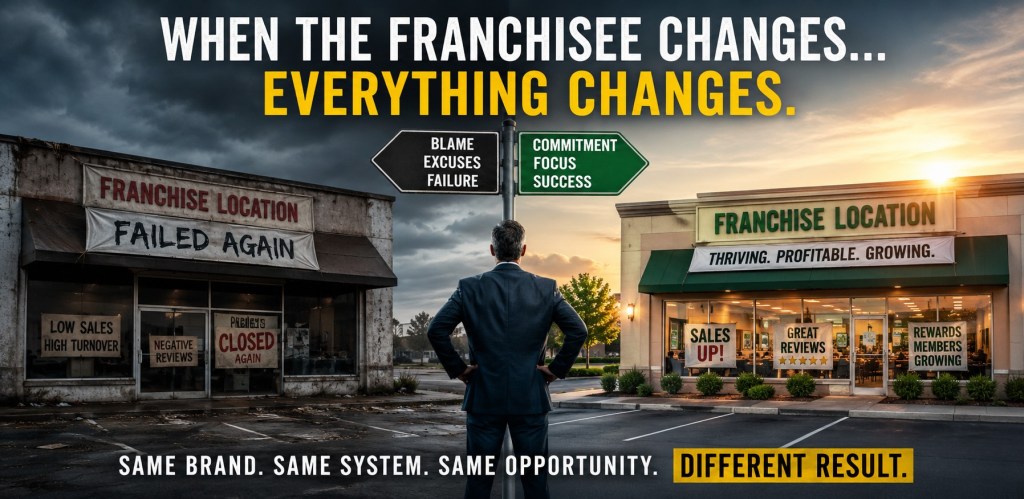
What continues to amaze me, even after all these years, is watching an underperforming location change hands multiple times… only to suddenly become successful under a new franchisee.

I’ve seen locations turned over two or three times. Everyone involved questioned the site. The area. The market. The brand. The franchisor. The viability of the model itself.

Then a new franchisee comes in.

Within six months, revenue doubles.

Customer reviews improve dramatically.

Rewards memberships begin growing consistently.

Margins improve.

Team morale changes.

The energy changes.

The same location.

The same market.

The same brand.

The same franchisor.

So what changed?

The operator.

That’s not meant as criticism toward the former franchisees. Most were not bad people. Many worked hard. Some likely sacrificed everything financially and emotionally trying to make the business work.

And contrary to what many people immediately assume, the answer is not always capitalization either.

In several cases I’ve witnessed, the new franchisee was actually less capitalized than the previous operator. They inherited operational issues, damaged reputations, employee turnover, unhappy customers, and financial strain. They entered an uphill battle surrounded by skepticism.

Yet somehow… they succeeded.

And then something even more interesting happens.

That same franchisee goes on to take over another struggling location that had also failed multiple times.

Same story.

Same skepticism.

Same questions.

And once again, the results change dramatically.

So what changed?

Again… the operator.

And candidly, I know this firsthand because I was once that franchisee.

Years ago, I took over a terrible location and immediately turned it around.

Then I did it again at another location.

Same story. Same results.

Then another.

And another.

And yet another.

People started believing I had some kind of magic formula.

But eventually, I crashed and burned.

I lost everything.

Why?

That’s the hard question very few franchisees are willing to honestly ask themselves.

The answer was me.

Somewhere along the way, I changed.

I was no longer operating with the same intensity, commitment, urgency, and discipline that drove those early turnarounds.

The things I did relentlessly at the first locations, I slowly stopped doing at the others.

I became less immersed.

Less focused.

Less hands-on.

My goals changed.

My mindset changed.

And like many franchisees who struggle, I found plenty of things to blame.

The economy.

The market.

The labor pool.

The franchisor.

Competition.

Costs.

Location challenges.

Operational pressures.

After all, what franchisee ever wants to blame themselves?

But eventually, experience and maturity force you to confront uncomfortable truths.

Sometimes the greatest difference in success or failure is not the market, the model, the brand, or even the location.

Sometimes it’s the operator looking back at themselves in the mirror.

Because franchise brands are only as good as the people operating them.

Yes, franchising requires strong systems, support, training, leadership, and operational infrastructure. Without those things, even good franchisees can fail.

But even the strongest franchise system cannot compensate for a lack of commitment, urgency, resilience, accountability, adaptability, and relentless determination from the franchisee.

Some operators simply approach business differently.

They engage differently.

They lead differently.

They respond to adversity differently.

Some possess an overwhelming desire to succeed.

Others operate with something even stronger:

A need to succeed.

And there is a difference.

The franchisees who often create the greatest turnarounds are not necessarily the smartest, wealthiest, or most experienced. Frequently, they are the ones who become completely immersed in the business. They understand every customer interaction matters. Every review matters. Every labor hour matters. Every catering order matters. Every missed opportunity matters.

They do not wait for rescue.

They do not spend their energy assigning blame.

They focus on solutions.

They lead from the front.

They outwork problems.

And perhaps most importantly, they understand something many people fail to fully appreciate:

Business is business… but business is also personal.

Very personal.

Especially in franchising.

Because behind every location is a person, a family, a dream, a financial risk, a reputation, and often years of sacrifice.

This is precisely why I’ve always believed the franchise relationship deserves more balanced conversations. Not every struggling location is proof of a bad brand. Not every failed franchisee was “sold a dream.” Not every successful operator simply “got lucky.”

Sometimes the greatest difference is the person operating the business.

That reality may not always be comfortable to discuss, but after more than four decades in franchising, I can say with complete confidence:

People remain the greatest variable in business success.

Always have been.

Always will be.

If you are a franchisor, franchisee, restaurant operator, or entrepreneur facing operational challenges, franchise relationship concerns, performance issues, or questions about growth, scalability, or franchise viability, I welcome the opportunity to discuss them with you.

Sometimes the answers are operational.
Sometimes they are structural.
And sometimes… they are personal.

National Small Business Week: Why Franchising Must Reclaim Its Place in the Small Business Conversation

As National Small Business Week approaches May 3–9, there will be countless stories shared about entrepreneurship, startups, family-owned businesses, local economic development, and the importance of supporting small business owners across America.

And rightfully so.

Small businesses remain the backbone of the American economy.

Yet, year after year, one of the largest segments of small business ownership continues to be overlooked in the broader conversation: franchisees.

Somehow, franchising has gradually become disconnected from the public perception of “small business,” despite the fact that the overwhelming majority of franchise locations across America are independently owned and operated by local entrepreneurs.

The person who owns the neighborhood sandwich shop.
The family operating a quick-service restaurant.
The husband-and-wife team running a home services business.
The local operator employing 15, 30, or 100 people in the community.

These are small business owners.

They sign leases. They hire employees. They manage payroll. They sponsor local Little League teams. They support schools, charities, churches, and community organizations. They carry the stress and responsibility that every entrepreneur carries.

Yet too often, franchise businesses are viewed simply as “corporate chains.”

That perception problem matters.

And franchisors themselves have an opportunity, and arguably a responsibility to help change it.

National Small Business Week presents one of the best opportunities each year for franchise organizations to elevate the role franchisees play in entrepreneurship and local economic development.

The reality is that franchising has long served as one of the most accessible pathways into entrepreneurship for aspiring business owners. For many individuals and families, franchising represents a bridge between employment and business ownership. It provides systems, support, brand recognition, training, operational guidance, and infrastructure that can significantly reduce some of the risks associated with starting a business entirely from scratch.

But ownership is still ownership.

Risk is still risk.

Leadership is still leadership.

And local impact is still local impact.

Franchisors should be aggressively leaning into that narrative during National Small Business Week, not from a public relations standpoint alone, but from a positioning standpoint for the future of franchising itself.

For years, I have personally been a very vocal advocate for recognizing franchisees for what they truly are: small business owners.

In fact, since 2010, I have actively promoted franchising’s inclusion and awareness within the American Express Small Business Saturday initiative and the broader small business conversation. I have long believed that franchise businesses deserve a far more visible seat at the table when America celebrates entrepreneurship and local business ownership.

Franchise Means Local: Why Franchise Businesses Deserve a Spotlight on Small Business Saturday

That belief also led me to become a creator of movements like #BuyFranchise and #DineFranchise, efforts designed to help consumers better understand that supporting a franchise location often means supporting a local entrepreneur, local jobs, and local families within their own communities.

The Franchise Dilemma in Small Business Saturday by American Express

Additionally, initiatives such as the Franchise Means Local campaign by the International Franchise Association continues to play an important role in helping reshape public perception around franchising. The initiative reinforces a simple but critically important truth: franchise businesses are deeply woven into the fabric of local communities. Behind national brands are local owners employing local residents, supporting local causes, investing locally, and serving the communities in which they live and work every day.

Happily, we are making progress.

Consumers are becoming more aware. Communities are beginning to better understand the role franchisees play in local economies. More franchisors are embracing the entrepreneurial stories behind their brands.

But despite that progress, there remains a significant perception gap.

Even many highly educated individuals still struggle to separate the franchise brand from the franchise owner. Too often, franchise businesses are viewed solely through the lens of national branding, while the local entrepreneur behind the business becomes invisible.

The reality is that franchisees face many of the very same challenges as any independent Mom & Pop business owner across America.

They invest their life savings. They take personal financial risks. They worry about payroll. They navigate inflation, labor challenges, rent increases, competition, regulations, and economic uncertainty. They work long hours. They sacrifice time with family. They carry the emotional weight that comes with business ownership.

In many ways, the entrepreneurial journey is exactly the same.

The only difference is that franchisees choose to build their businesses within an established system and brand framework.

This week presents another opportunity for franchisors to more aggressively showcase franchisees as entrepreneurs and local small business owners.

Franchisors should spotlight franchisees as entrepreneurs, not merely operators. The language matters. Many franchise organizations unintentionally over-corporatize their messaging. Marketing materials often emphasize systems, consistency, growth, and scale while failing to showcase the entrepreneurial stories behind the individual businesses themselves.

Yet consumers connect emotionally with people. They connect with stories. They connect with local ownership.

Franchise brands should spend National Small Business Week highlighting the journeys of franchisees:
Why they chose business ownership.
What challenges they overcame.
Why they invested in their communities.
How many jobs they created locally.
What entrepreneurship means to their families.

This humanizes franchising.

Franchisors should also localize their messaging. Consumers increasingly want to support local businesses. Many simply do not realize that their local franchise restaurant, fitness center, child care business, salon, or service provider is independently owned.

Simple messaging can help reinforce this:
“Locally Owned and Operated.”
“Proud Small Business Owner.”
“Part of Your Community.”

These messages should not be hidden in fine print. They should become part of the identity of the franchise location itself.

Franchise systems should further encourage franchisees to engage visibly in local community leadership. National Small Business Week should become a coordinated systemwide initiative involving community partnerships, chamber involvement, entrepreneurship seminars, local events, school programs, and small business roundtables.

When franchisees become more visible as local leaders, the perception of franchising changes naturally.

Franchisors should also invest more heavily in entrepreneurship education. Many aspiring entrepreneurs still fail to recognize franchising as a legitimate pathway into business ownership. Too often, people believe they either have to start a business entirely from scratch or remain employees indefinitely.

Franchising sits in the middle as a hybrid model of entrepreneurship—independent ownership supported by an established system.

That message deserves greater visibility.

Ironically, some franchise systems spend years trying to look less like small businesses and more like major corporations, when in reality, their greatest strength may be their local ownership structure.

Large national brands with local owners create a unique economic model:
National recognition.
Local entrepreneurship.
Community-level economic impact.

That is powerful.

And it deserves far more attention during National Small Business Week.

The future of franchising may very well depend on how effectively the industry reconnects itself to the broader entrepreneurial narrative in America, especially as younger generations increasingly seek independence, flexibility, purpose, and pathways to ownership.

Franchising should not sit outside the small business conversation.

It should be at the center of it.

Because behind nearly every successful franchise location is not simply a brand.

There is an entrepreneur.

There is a family.

There is a local employer.

There is a small business owner pursuing the American Dream.

As National Small Business Week reminds us of the vital role entrepreneurs play in shaping communities and strengthening the economy, it should also remind us that franchising remains one of the most powerful and proven pathways to small business ownership in America.

If you’re a franchisor looking to strengthen franchisee engagement, elevate your brand’s entrepreneurial positioning, or further align your organization with the small business movement, I’d welcome the opportunity to have a conversation. Likewise, if you’re an aspiring entrepreneur exploring franchising as a path to business ownership, let’s connect.

Please connect with me to continue the discussion around entrepreneurship, franchising, and the future of small business ownership in America.

Franchising Is Still Franchising — Whether You Have 5 Employees or 500

When people think about a large franchise organization, they picture a sophisticated corporate structure with layers of leadership, departments, specialists, systems, and support personnel spread across every discipline imaginable.

There’s a CEO, COO, CFO, legal counsel, franchise development department, operations team, field support managers, marketing department, training directors, HR personnel, technology support, supply chain management, real estate professionals, construction coordinators, and more. The organization chart can look overwhelming from the outside looking in.

And rightfully so.

Large franchise organizations are complex businesses with significant responsibilities tied to franchise development, operations, compliance, brand protection, and long-term scalability.

Now let’s compare that same structure to an emerging franchise brand.

An emerging franchisor may have a founder acting as CEO, head of operations, franchise salesperson, trainer, marketer, recruiter, and sometimes even technology support… all in the same day. The leadership team may consist of only a handful of people. In some cases, fewer than ten individuals are responsible for supporting an entire franchise system.

So the obvious question becomes:

Are the responsibilities of the franchisor actually different?

The answer is no.

The responsibilities are exactly the same.

The only real difference is scale, specialization, and volume.

A franchisee who invests in an emerging franchise brand is still entitled to proper onboarding, training, operational guidance, leadership, communication, systems, accountability, support, and brand stewardship. The obligation does not become smaller simply because the franchisor is smaller.

That reality is one of the most misunderstood aspects of franchising today.

Large organizations divide responsibilities among departments and specialists. Emerging brands consolidate those same responsibilities into fewer hands. That is where the challenge and the danger often begins.

In a mature franchise organization, individuals typically operate within clearly defined roles. One person focuses on field operations. Another handles franchise recruitment. Another oversees training. Another manages digital marketing. Another handles supply chain relationships.

At the emerging brand level, one individual may be responsible for all of it simultaneously.

And that creates enormous pressure on leadership.

The founder of an emerging franchise brand is not simply building locations. They are building infrastructure while simultaneously trying to grow revenue, support franchisees, protect the brand, recruit talent, establish systems, and preserve culture.

That balancing act is extraordinarily difficult.

Unfortunately, many emerging brands underestimate what franchising actually requires operationally.

They often view franchising primarily as expansion.

But franchising is not simply expansion.

Franchising is support.

Franchising is systems.

Franchising is consistency.

Franchising is accountability.

Franchising is leadership.

Franchising is infrastructure.

And perhaps most importantly, franchising is responsibility.

The franchisee does not invest in potential alone. They invest in the expectation that the franchisor is capable of helping them operate successfully within a structured system.

That expectation does not diminish because the franchisor is “still growing.”

In fact, one could argue that emerging brands must often work harder than large brands because they lack the margin for error that mature systems possess.

Large brands may have the advantage of established recognition, operational depth, vendor relationships, technology infrastructure, training departments, and extensive support teams.

Emerging brands compete differently.

They compete through accessibility.

They compete through founder involvement.

They compete through passion.

They compete through adaptability.

They compete through innovation.

They compete through speed of decision-making.

They compete through culture.

And when done correctly, they compete through relationships.

One of the greatest advantages an emerging franchisor can offer is direct access to leadership. Franchisees in emerging systems often work closely with founders and senior leadership in ways that would never occur within massive franchise organizations.

That can create a uniquely collaborative environment.

However, passion and accessibility alone are not enough.

An emerging franchisor must still operate with discipline.

Systems must still be documented.

Training must still be structured.

Operational standards must still be enforced.

Communication must still be consistent.

Support must still be reliable.

And perhaps most critically, growth must remain deliberate.

One of the biggest mistakes emerging franchisors make is pursuing unit growth faster than their infrastructure can support. The excitement of selling franchises can quickly outpace operational readiness.

That creates strain internally.

It creates inconsistency externally.

And eventually, it creates frustration among franchisees.

Emerging franchisors must understand something very important:

Every franchise sold increases responsibility exponentially.

Each additional franchisee requires onboarding, operational support, coaching, communication, problem solving, technology assistance, marketing guidance, and relationship management.

Growth without support infrastructure becomes dangerous very quickly.

This is why disciplined franchising matters.

Not every brand should franchise immediately.

Not every successful independent business is automatically franchise-ready.

And not every founder is naturally prepared to become a franchisor.

Operating one successful business and leading a franchise organization are two entirely different responsibilities.

The transition requires a shift in mindset from operator to organizational leader.

That shift often determines whether an emerging brand becomes sustainable or unstable.

So how does an emerging franchisor successfully lead and manage the brand?

By recognizing early that franchising is not merely about selling opportunities.

It is about building systems capable of supporting other people’s investments, livelihoods, and futures.

It requires humility to recognize operational gaps.

It requires discipline to grow deliberately.

It requires leadership to build culture.

It requires structure to maintain consistency.

And it requires a commitment to franchisees that cannot fluctuate based on company size.

Because at the end of the day, the franchisee’s investment is very real.

Their risk is very real.

Their expectations are very real.

And their need for leadership, training, support, and accountability is no less important simply because the franchisor is still emerging.

The strongest emerging franchise brands understand this early.

That understanding often becomes the foundation for sustainable growth, stronger franchise relationships, healthier unit economics, and ultimately, long-term brand value.

The reality is this…

Emerging franchise brands do not compete by pretending to be large organizations.

They compete by becoming disciplined organizations early.

The brands that ultimately separate themselves are not always the ones growing the fastest. More often, they are the brands building the strongest operational foundation, protecting franchisee relationships, developing infrastructure deliberately, and understanding that franchising is a long-term leadership responsibility… not simply a growth strategy.

That requires difficult conversations.

It requires honest evaluation.

It requires strategic planning.

And in many cases, it requires guidance from individuals who understand both the entrepreneurial side of building a business and the structural realities of franchising.

Whether you are an emerging franchisor evaluating your next stage of growth, a founder considering franchising for the first time, or a franchisee evaluating an emerging opportunity, the questions surrounding infrastructure, support, scalability, leadership, and operational readiness matter more than ever.

At Acceler8Success America and especially through through this platform, Acceler8Success Cafe, and across social media, those are exactly the conversations being had every day with founders, operators, franchisors, and entrepreneurs navigating growth and expansion.

If you would like to discuss your franchise brand, growth strategy, operational readiness, franchise infrastructure, or the realities of scaling an emerging system, connect directly with me by email at Paul@Acceler8Success.com.

Can Franchise Brands Still Achieve Explosive Growth in Today’s Market?

Explosive growth in franchising has always carried a certain mystique. It suggests momentum, demand, brand heat, and the kind of scalability that defines category leaders. But in today’s business climate where labor challenges persist, capital is more selective, and consumers are both value-driven and experience-focused—the question isn’t just whether explosive growth is possible. It’s whether it can be achieved responsibly, sustainably, and with intention.

The short answer is yes, a franchise brand can still achieve explosive growth. But not in the way many once imagined. The era of growth for growth’s sake is over. What replaces it is a more disciplined, structured, and deliberate approach… one that requires brands to earn their expansion rather than chase it.

The first reality is that explosive growth today must be built on strong unit economics. Without this, nothing else matters. A brand can generate interest, sign franchisees, and even open locations quickly, but if those units are not profitable, or at least predictably trending toward profitability, the system will fracture. Franchisees will struggle, validation will weaken, and growth will stall as quickly as it began. Today’s sophisticated franchise candidates are asking deeper questions. They want transparency. They want data. They want to understand not just the opportunity, but the risk. Brands that cannot confidently present this foundation will not sustain momentum.

That evolution in the franchise candidate is not new. It is something I first recognized back in 2008, when I stated that candidates were becoming more knowledgeable, more sophisticated, and more technologically advanced than ever before. At the time, that realization was eye-opening. It marked a shift in how brands needed to present themselves, how they needed to communicate, and how they needed to support their systems. Fast forward 18 years, and that shift has accelerated beyond what most could have imagined… assuming it is even fully recognized. Today’s candidates are not just informed; they are highly analytical. They research deeply, compare aggressively, and leverage technology in ways that fundamentally change the dynamic between franchisor and franchisee. Brands are no longer simply offering an opportunity; they are being evaluated with a level of scrutiny that demands precision, transparency, and credibility at every level.

Closely tied to this is operational infrastructure. Growth is not just about selling franchises; it is about supporting them. The brands that scale effectively are those that have invested early in systems, training, supply chain alignment, and field support. Without this, rapid expansion becomes a liability. Locations open, but consistency erodes. Customer experience varies. Brand integrity weakens. In today’s environment, where online reviews and social media amplify every misstep, inconsistency can do more damage than slow growth ever could.

Another critical factor is clarity of positioning. The market is crowded. Consumers have more choices than ever, and franchise candidates are evaluating multiple opportunities at once. A brand that hopes to grow quickly must stand for something distinct and relevant. It cannot be a slightly better version of something that already exists. It must be clearly understood, easily communicated, and consistently delivered. Whether that differentiation comes from product, experience, operational model, or target market, it must be undeniable.

Equally important is the quality of the franchisee. Explosive growth fueled by the wrong partners is one of the fastest ways to undermine a brand. The pressure to expand can lead to compromises in franchisee selection, but those decisions rarely age well. Strong brands are disciplined in awarding franchises. They look for alignment, capability, and commitment—not just capital. They understand that every franchisee is a steward of the brand, and that long-term growth depends on the collective strength of the system.

All that said, it raises a question that is becoming more relevant with each passing year: is there even a place in franchising today for the single-unit franchisee?

The answer is yes, but the role is evolving. The single-unit franchisee is no longer the default growth engine for most emerging or scaling brands. Instead, many franchisors are prioritizing multi-unit operators and area developers who bring capital, infrastructure, and experience. This shift is driven by efficiency, speed to market, and the ability to scale with fewer, more sophisticated partners.

However, to dismiss the single-unit franchisee would be a mistake. In many ways, they remain the backbone of franchising, particularly at the community level. Single-unit operators often bring a level of passion, local engagement, and hands-on ownership that is difficult to replicate at scale. They are deeply invested in their business, their team, and their customer base. They can be exceptional brand ambassadors.

Where the shift has occurred is in expectations. Today’s single-unit franchisee must operate with the mindset of a multi-unit operator, even if they only own one location. They must be disciplined, data-driven, and operationally sound. They must embrace technology, understand their numbers, and execute consistently. In other words, the bar has been raised.

For franchisors, the challenge is alignment. Not every concept is suited for single-unit ownership, and not every candidate is suited for multi-unit development. The most effective brands are those that clearly define their ideal franchisee profile and build their growth strategy accordingly. Some will lean heavily into multi-unit development to accelerate expansion. Others will intentionally cultivate strong single-unit operators in targeted markets to build density and brand integrity.

Capital strategy also plays a more nuanced role today. Access to funding still exists, but it is more scrutinized. Lenders and investors are looking closely at performance, leadership, and scalability. Brands seeking rapid expansion must be prepared to demonstrate not only their current success, but their ability to replicate it across markets. This often means having a thoughtful development strategy, targeting specific regions, building density, and avoiding overextension. The concept of “saturate, then scale” has never been more relevant.

Technology has also become a force multiplier. From POS systems and data analytics to digital marketing and customer engagement platforms, the right technology stack can accelerate growth by improving efficiency, enhancing the customer experience, and providing actionable insights. However, technology alone is not the answer. It must be integrated into the broader operational strategy and supported by proper training and execution at the unit level.

Brand storytelling and marketing cannot be overlooked. Explosive growth requires demand, not just from consumers, but from prospective franchisees. The brands that capture attention today are those that communicate a compelling narrative. They connect emotionally while delivering rational value. They show not only what they are, but why they matter. This is where public relations, content strategy, and social proof play a critical role in building credibility and momentum.

Perhaps the most overlooked element of explosive growth is leadership discipline. Growth introduces complexity. It tests systems, people, and decision-making. Leaders must be prepared to make difficult choices, to say no when necessary, and to protect the long-term integrity of the brand over short-term gains. This requires a mindset shift from chasing opportunity to curating it.

There is also an important distinction to be made between fast growth and explosive growth. Fast growth can be linear. Explosive growth suggests acceleration, often driven by a combination of strong fundamentals, market timing, and strategic execution. It is not accidental. It is engineered. And more often than not, it follows a period of deliberate preparation that may not appear “explosive” at all from the outside.

In today’s environment, the brands that will achieve this level of growth are those that embrace a paradox. They move quickly, but think long-term. They pursue scale, but prioritize stability. They generate excitement, but remain grounded in fundamentals. They are aggressive in vision, but disciplined in execution.

So yes, explosive growth is still possible in franchising. But it looks different. It is less about speed alone and more about alignment… alignment between economics, operations, brand, leadership, and franchisees. When those elements come together, growth can accelerate in a way that is not only impressive, but enduring.

And within that framework, both multi-unit developers and single-unit franchisees still have a role to play, provided they evolve with the expectations of the modern franchising landscape.

The brands that understand this will not just grow. They will define what growth looks like in the next era of franchising.

The question is, where does your brand stand today, and more importantly, where is it truly prepared to go?

If you’re evaluating growth, recalibrating your strategy, or questioning whether your brand is positioned for disciplined, scalable expansion, now is the time to take a step forward with clarity and intention. Let’s start the conversation. Connect directly with me to explore how your brand can build, scale, and accelerate the right way. My email is paul@acceler8success.com.

Chasing Perfect: What Great Franchisors Actually Get Right

Perfection is a dangerous word in franchising. It implies a finish line that doesn’t exist. Franchising is not static. It evolves with markets, with people, with consumer expectations, with economics. So no, there is no such thing as a perfect franchisor. But there is something far more meaningful and far more attainable… a franchisor in constant pursuit of getting it right.

And that pursuit is what defines excellence.

A perfect franchisor is not one that never makes mistakes. It is one that builds a system designed to recognize, respond, and improve continuously. It is structured, disciplined, and intentional. It understands that franchising is not about selling units, it is about building a brand through other people’s capital, effort, and belief.

At its core, a franchisor’s responsibility is stewardship.

Stewardship of the brand. Stewardship of the system. Stewardship of the people who have trusted that system with their livelihoods.

That’s where the conversation begins.

A “perfect” franchisor has absolute clarity on unit economics. Not assumptions. Not projections built on best-case scenarios. Real, validated, repeatable performance. They know what it costs to open, what it costs to operate, what it takes to break even, and what it takes to generate sustainable profitability. And more importantly, they are honest about it. Transparency here is not optional. It is foundational.

They don’t franchise to fix a broken model. They franchise to replicate a proven one.

A “perfect” franchisor is operationally obsessed. They understand that brand standards are not suggestions. They are the very thing that protects the integrity of the system. But this is where many get it wrong. Enforcement without support creates friction. Support without accountability creates inconsistency. The balance between the two is where great franchisors live.

They build systems that are teachable, transferable, and executable. Not dependent on extraordinary operators, but designed for capable, committed ones.

A “perfect” franchisor invests heavily in onboarding and ongoing training. Not just at the beginning, but throughout the lifecycle of the franchisee. Because the reality is this, people don’t fail because they don’t care. They fail because they don’t know, or they drift from what they once knew.

Training is not an event. It is a culture.

A “perfect” franchisor knows their franchisees beyond the surface. Not just as unit numbers or royalty checks, but as operators, leaders, and individuals. They understand performance metrics, yes, but they also understand behaviors. Engagement. Participation. Attendance at conferences. Willingness to collaborate with peers. Openness to coaching.

They recognize early signs of struggle long before they show up in declining sales.

A “perfect” franchisor communicates consistently and with purpose. Not just when there is a problem. Not just through one-way updates. Real communication is dialogue. It invites feedback, even when that feedback is uncomfortable.

Because the best systems are not built in boardrooms alone. They are refined in the field.

A “perfect” franchisor protects the brand at all costs, but not at the expense of the franchisee. That balance is delicate. Every decision, marketing, pricing, vendors, technology, must be evaluated through both lenses. What strengthens the brand long-term while still allowing franchisees to win?

If franchisees are not profitable, the system is broken. Period.

A “perfect” franchisor is disciplined in growth. They understand that expansion is not validation. Too many brands chase unit count as a measure of success, only to realize later that they’ve built a wide but fragile system.

The right franchisor grows deliberately. They protect territories. They select the right operators. They say no more often than they say yes.

Because every bad franchisee is not just a failed unit. It’s a crack in the system.

A “perfect” franchisor builds culture intentionally. Culture is not a tagline. It is what happens when leadership is not in the room. It is how franchisees treat their teams, how they treat customers, and how they treat each other.

And culture, more than anything else, determines whether a brand scales with strength or with tension.

So again, is there such a thing as a perfect franchisor?

No.

But there are franchisors who commit to the disciplines that move them closer to that ideal every day. They are self-aware. They are accountable. They are relentless in improvement. They are willing to challenge their own assumptions.

And perhaps most importantly, they never forget what franchising really is.

It is not a growth strategy.

It is a responsibility.

If you’re building a franchise brand, or already operating one, and you’re questioning whether your system is truly built for sustainable success, that’s the right question to be asking.

Reach out to me at paul@acceler8success.com and let’s have that conversation.